Maritime Procurement: Why Buying for Ships Breaks Every Rule of Traditional Purchasing
Ship procurement is nothing like land-based purchasing. Moving delivery destinations, classification society requirements, multi-currency invoices, and off-hire penalties of $60,000 per day make maritime procurement one of the most complex purchasing disciplines in any industry. Here is what makes it so hard — and what modern ship management software can do about it.

A factory stays in one place. A warehouse has a fixed address.
A retail store receives deliveries on a predictable schedule. Ships have none of these luxuries.
When a chief engineer on a bulk carrier in the South China Sea identifies a failing pump, the procurement process that follows is unlike anything in land-based industry. The spare part must be sourced from a supplier who may be on a different continent, shipped to a port the vessel has not yet reached, cleared through customs in a country with its own import regulations, verified against classification society type-approval requirements, and delivered to the vessel during a port call window that may last only hours — all while the vessel continues sailing.
Get it wrong, and the vessel sits idle. Off-hire penalties for a large container vessel can exceed $60,000 per day.
For a Capesize bulk carrier, the figure is $30,000 to $40,000 daily. An emergency air-freight shipment of spare parts to a remote port can cost more than the parts themselves.
Maritime procurement is not a variation of regular procurement. It is a fundamentally different discipline — one that demands specialized workflows, deep domain knowledge, and software built specifically for the realities of managing vessels at sea.
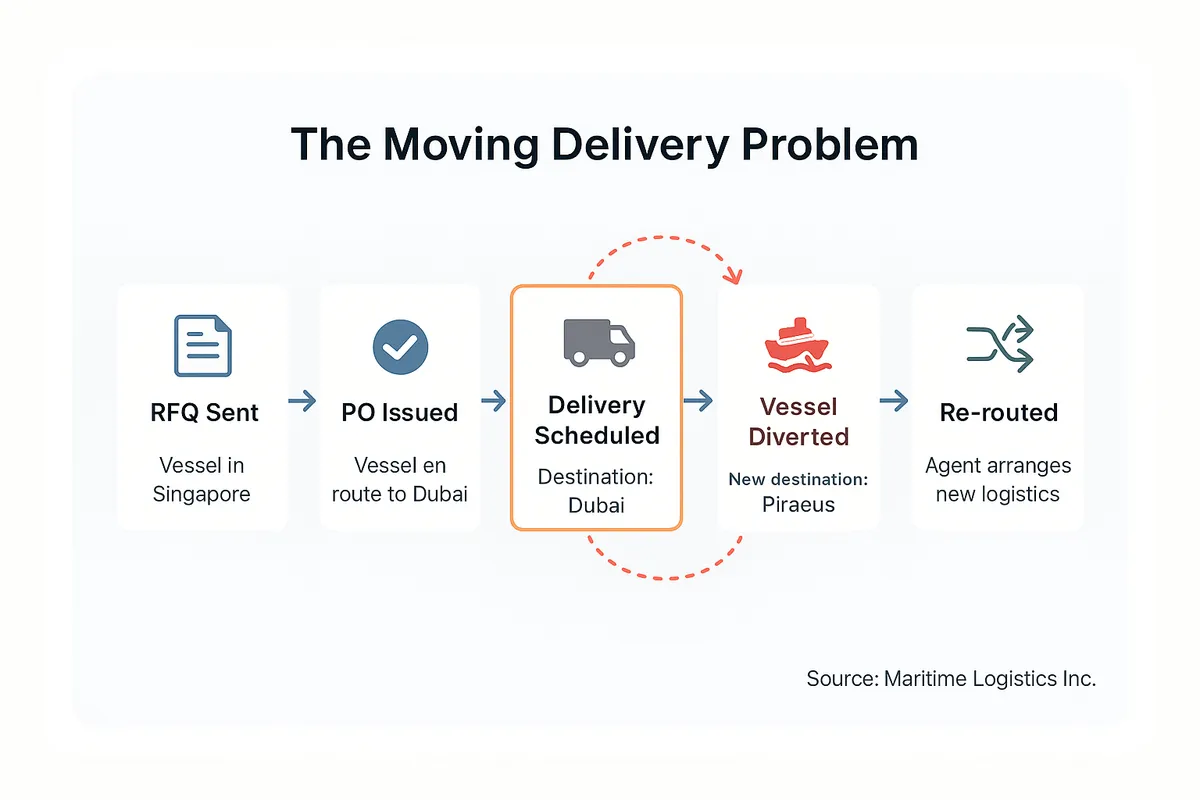
The moving delivery destination problem
The most obvious difference between maritime and land-based procurement is that the delivery address changes with every port call. A vessel trading between Singapore, Rotterdam, and Houston may have three different "delivery addresses" in a single month.
If a spare part misses the delivery window in one port, it must be forwarded to the next — incurring additional freight costs, customs clearance fees, and potential delays.
This creates a coordination challenge that simply does not exist on land. The procurement team must track the vessel's schedule, anticipate which port offers the best delivery window, coordinate with local port agents, and align everything with supplier lead times.
Any disruption — weather delays, charterer schedule changes, canal transit queues — can invalidate the entire delivery plan.
Research from a 2025 academic simulation of maritime procurement workflows found that the average cycle from requisition creation to purchase order issuance takes 9.6 days under optimal conditions. In practice, with manual processes and communication delays between ship and shore, this stretches to weeks.
Classification society requirements: the compliance layer that changes everything
In land-based procurement, a buyer can typically substitute one pump for a cheaper equivalent without regulatory consequence. In maritime, this substitution could void the vessel's insurance policy.
Almost all safety-critical components on a vessel must be type-approved by a classification society — Lloyd's Register, DNV, Bureau Veritas, ABS, or one of several others. Type approval certifies that a component meets specific safety, performance, and environmental standards for marine use.
Replacing a type-approved component with a non-approved alternative affects the vessel's overall classification, potentially making it uninsurable and unable to trade.
This means procurement teams cannot simply choose the lowest bidder. Every critical spare must be verified against the classification society's list of approved products.
The procurement workflow must enforce this verification at the requisition and purchase order stages — before the order is placed, not after the part arrives onboard.
Multi-currency, multi-timezone, multi-jurisdiction
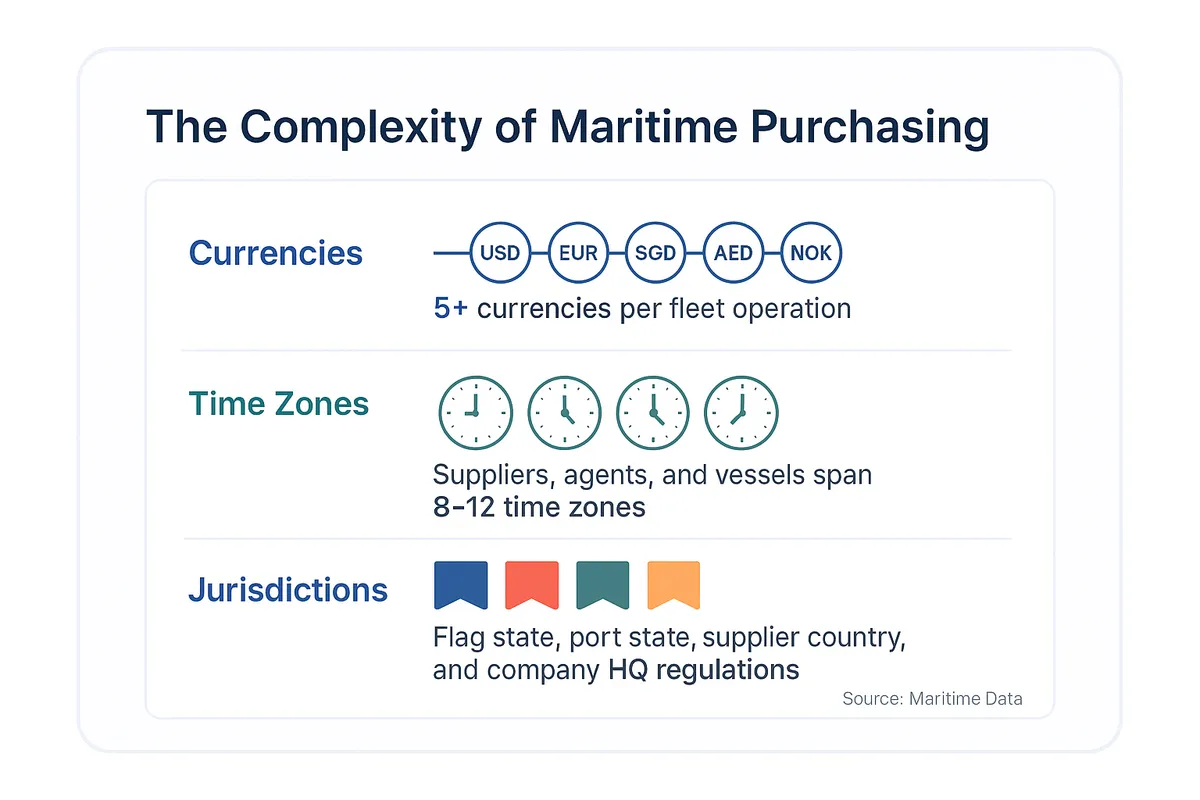
A single procurement transaction in maritime may involve a vessel crewed by Filipino seafarers, managed by a German company, purchasing from a Japanese manufacturer, paying in US dollars, with delivery arranged through a Singaporean freight forwarder to a Brazilian port. Five countries, four currencies, and at least three time zones — for one spare part.
Currency exchange rate fluctuations directly impact procurement costs. A purchase order issued in euros but paid weeks later in US dollars may cost significantly more — or less — than originally budgeted.
Fleet operators managing dozens of vessels across global trade routes face this currency exposure on hundreds of transactions simultaneously.
The multi-jurisdictional nature of maritime procurement also creates customs complexity. Bonded stores — duty-free provisions like alcohol, tobacco, and crew supplies — require specific customs documentation at every port.
Every country has different import regulations for ship spares. What clears customs easily in Singapore may be held for days in a West African port.
When equipment fails at sea: the emergency procurement scenario
Planned procurement is complex enough. Emergency procurement — triggered by unexpected equipment failure — adds urgency that compounds every existing challenge.
When a critical system fails at sea, the financial pressure is immediate. Unplanned equipment failures can cost vessel operators between $50,000 to $250,000 per day in lost revenue, depending on vessel size and cargo type.
The procurement team must identify the correct part, find a supplier who has it in stock, arrange expedited shipping to the next port of call, and coordinate customs clearance — all while the vessel may be days away from its next port.
If the vessel is trading in remote waters or calling at ports with limited supplier networks, the challenge intensifies. Parts may need to be air-freighted across multiple countries, consolidated at a regional warehouse, and hand-carried to the vessel by a port agent.
The approval bottleneck: where days become dollars
Maritime procurement involves multiple stakeholders with different priorities. The vessel's chief engineer identifies the technical need.
The shore-based technical superintendent validates it. The purchasing manager evaluates commercial options.
The finance department confirms budget availability. In some organizations, a senior manager or director must approve high-value purchases.
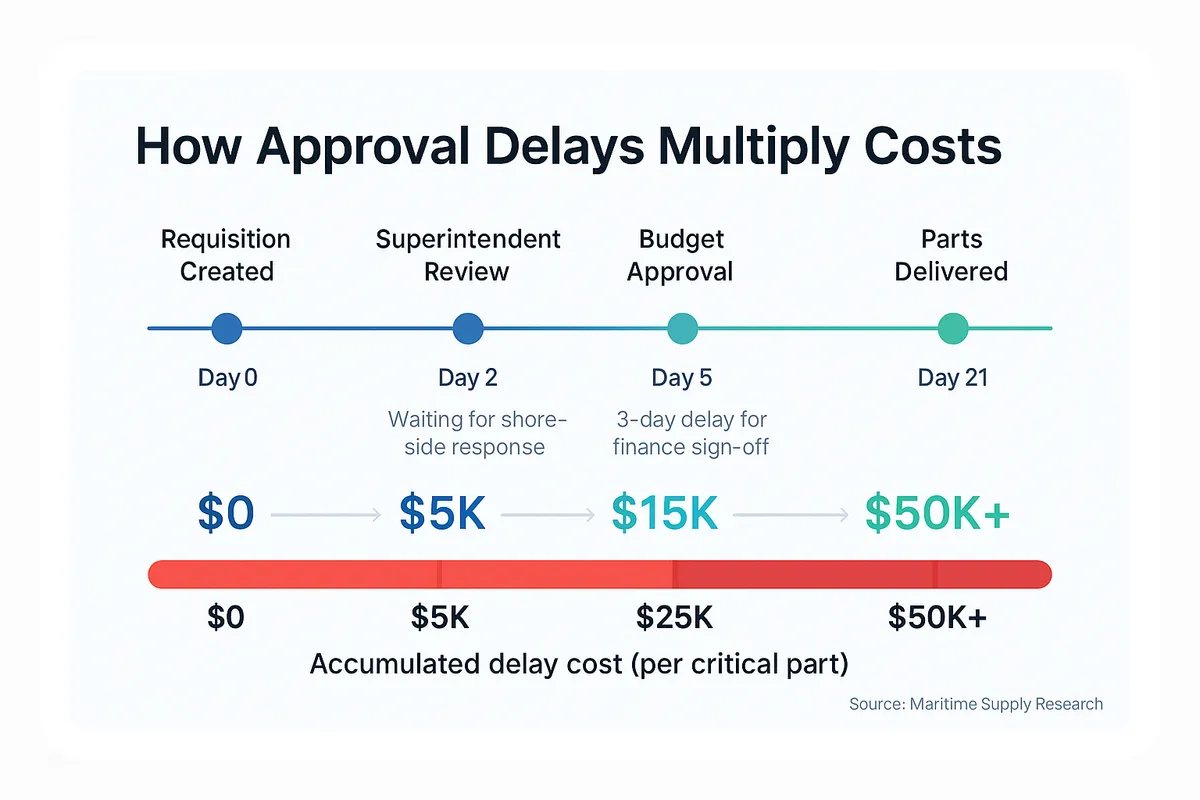
Each handoff in this approval chain introduces delay. When stakeholders are spread across different time zones — the vessel in the Pacific, the superintendent in Hamburg, the finance team in Athens — a requisition that could be approved in hours can take days.
Delayed approvals are one of the primary causes of missed port delivery windows. A part ordered one day too late misses the vessel's port call, must be forwarded to the next port, and arrives days or weeks late.
The cascading cost: additional freight charges, potential off-hire if the vessel cannot operate without the part, and increased risk of a more serious failure.
Supplier management across 1,500 ports
Maritime procurement requires maintaining relationships with suppliers scattered across the globe. A fleet operator with 30 vessels trading worldwide may work with hundreds of suppliers across dozens of countries.
Evaluating supplier performance — delivery reliability, price competitiveness, quality consistency — requires systematic tracking across thousands of transactions.
Approximately 70% of global shipping companies operate fleets of fewer than 10 vessels, limiting their purchasing scale and negotiating power. Smaller operators often lack the procurement infrastructure to systematically compare quotes, track vendor performance, or leverage spending data for better pricing.
Procurement platforms like ShipServ connect buyers to networks of over 50,000 maritime suppliers, but the challenge of evaluating and managing these relationships remains. Without structured vendor analytics — spend tracking, lead time comparison, quality scoring — fleet operators make purchasing decisions based on relationships and habit rather than data.
The hidden cost of manual processes
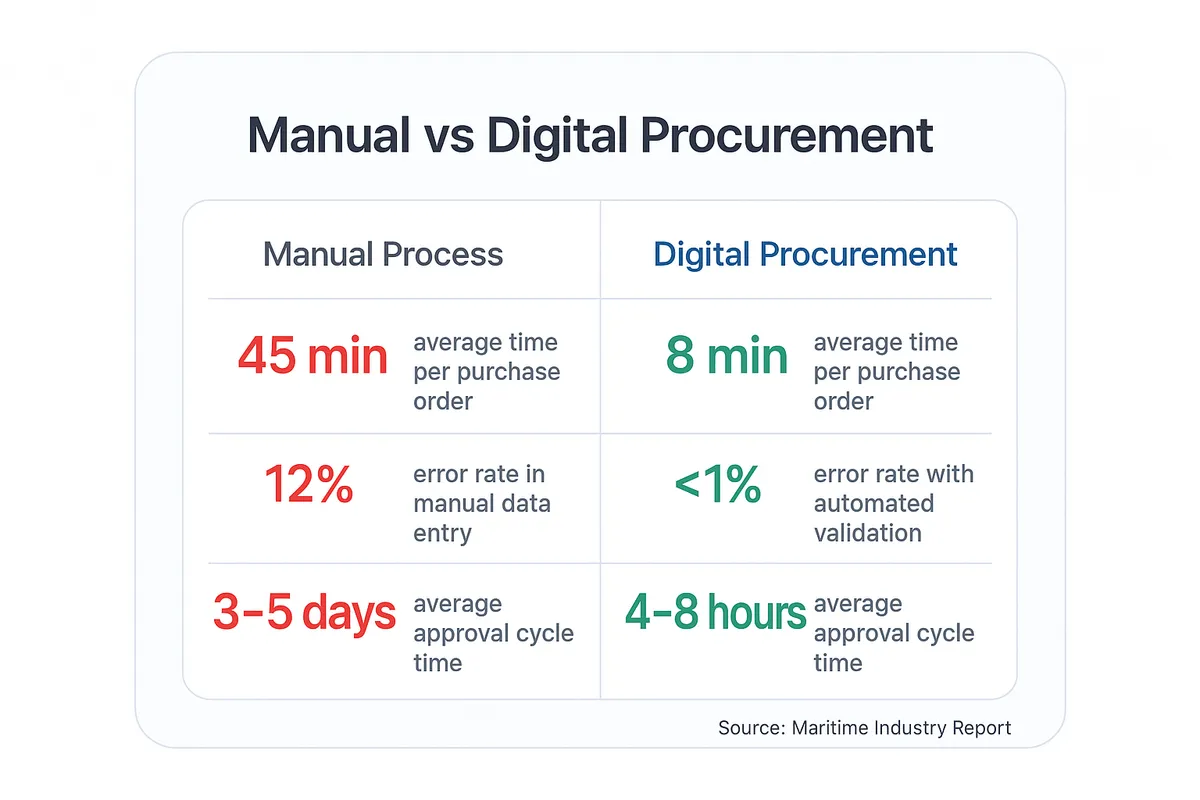
Despite the complexity and financial stakes involved, manual processes remain stubbornly common in maritime procurement. A 2024 report from ProcureShip documented finance teams manually checking hundreds of invoice items using printouts, papers, rulers, and pens to match invoices against purchase orders — a practice that would be unthinkable in most land-based industries.
Paper-based purchase orders, email-driven requisitions, and spreadsheet-based tracking introduce errors, create delays, and make audit compliance difficult. The ISM Code requires every shipping company to maintain documented procedures and records that are open to scrutiny during classification society audits and port state control inspections. Manual processes make maintaining this audit trail unreliable.
The financial impact is significant. Industry estimates suggest that digital procurement platforms can reduce procurement costs by 10–20%, and that e-invoicing alone can speed up invoice processing by more than 60%.
For a fleet operator spending millions annually on spares, stores, and services, these savings are substantial.
What modern maritime procurement software must do differently
General-purpose procurement software — built for factories, retail chains, or service companies — cannot handle the realities described above. Maritime procurement software must address a set of requirements that are unique to the industry:
- End-to-end document lifecycle: From requisition through RFQ, vendor quotation, purchase order, goods receipt, and invoice matching — with full traceability between each stage.
- Multi-tier approval workflows: Configurable approval chains that route documents based on value thresholds, material categories, vessel location, and organizational hierarchy — with escalation rules to prevent bottlenecks.
- Vendor comparison and award engines: Automated comparison of vendor quotations across price, lead time, delivery capability, and quality — with support for split awards across multiple vendors.
- Supplier portal for vendor collaboration: A portal where suppliers can view RFQs, submit quotations, and confirm orders without needing accounts or training — reducing response times and friction.
- Multi-currency with exchange rate management: Every document must support multiple currencies with configurable exchange rates, including comparison currencies for cross-currency quote evaluation.
- Inventory integration: Procurement must connect directly to the vessel's inventory and planned maintenance system. A requisition should reflect current on-hand stock, minimum quantities, and criticality flags at the moment of approval.
- Landed cost tracking: Beyond unit price — freight, insurance, packaging, customs duties, and per-unit landed cost must be tracked to understand the true cost of every purchase.
- Complete audit trail: Every field change, status transition, approval action, and comment must be recorded with timestamp and user identity — not just for compliance, but for operational intelligence.
The best maritime procurement systems do more than digitize existing paper processes. They enforce compliance at every step, surface insights from historical purchasing data, and eliminate the coordination gaps between ship and shore that cause delays, overspending, and risk.
How Navatom approaches maritime procurement
Navatom's procurement module was built from the ground up for the maritime industry — not adapted from a land-based ERP. It covers the complete procurement lifecycle: requisitions with inventory-aware stock snapshots, multi-vendor RFQs with seven automated award comparison scenarios, a vendor portal for frictionless quotation submission, purchase orders with full landed cost tracking, and goods receipts that automatically update vessel inventory.
The approval workflow engine supports five organizational tiers — from vessel-level to external auditor — with configurable execution methods including sequential, majority vote, and all-must-approve. Approval rules can be triggered by purchase amount, material category, vendor classification, or legal entity, ensuring that the right people review the right transactions without creating unnecessary bottlenecks.
Because Navatom is a genuine cloud platform, requisitions created onboard a vessel are visible to shore-based teams in real-time. There is no synchronization delay, no file to upload, no email to send.
The procurement team sees the request the moment it is submitted — and the vessel crew can track its progress through every approval stage, RFQ round, and delivery milestone.
Every procurement action in Navatom is recorded in an immutable audit trail — over 220 distinct event types across requisitions, RFQs, quotations, purchase orders, and goods receipts. When a port state control inspector or classification society auditor asks to see procurement records, the answer is immediate.
If your fleet still runs procurement on spreadsheets and email, the gap between where you are and where the industry is heading grows wider every quarter. Navatom offers a free trial at app.navatom.com/trial/signup — no installation, no hardware, no commitment.