Maritime Inventory Management: How to Control Spare Parts Across Your Fleet
Managing spare parts across a fleet of vessels is a $10 billion challenge shaped by ISM Code mandates, SOLAS requirements, and the operational reality of ships that never stop moving. This guide covers the regulations, common pitfalls, and best practices for maritime inventory control.

The global ship spares and equipment market exceeds USD 10 billion annually. Yet most ship management companies still track inventory with spreadsheets, emails, and guesswork.
The gap between what regulations demand and how fleets actually manage spare parts is staggering. Under the ISM Code, every vessel operator must maintain ships in conformity with relevant rules.
That includes having the right spare parts, in the right place, at the right time.
Maritime inventory management is not warehouse logistics with a nautical theme. Ships move.
Ports change. Connectivity drops.
Crew rotates. Every assumption that works in shore-side supply chain management breaks down the moment materials cross a gangway.
This guide examines the regulatory framework, the operational challenges, and the practical strategies that separate well-run fleets from those that lose money on emergency procurement and avoidable downtime.
The Hidden Cost of Poor Inventory Management at Sea
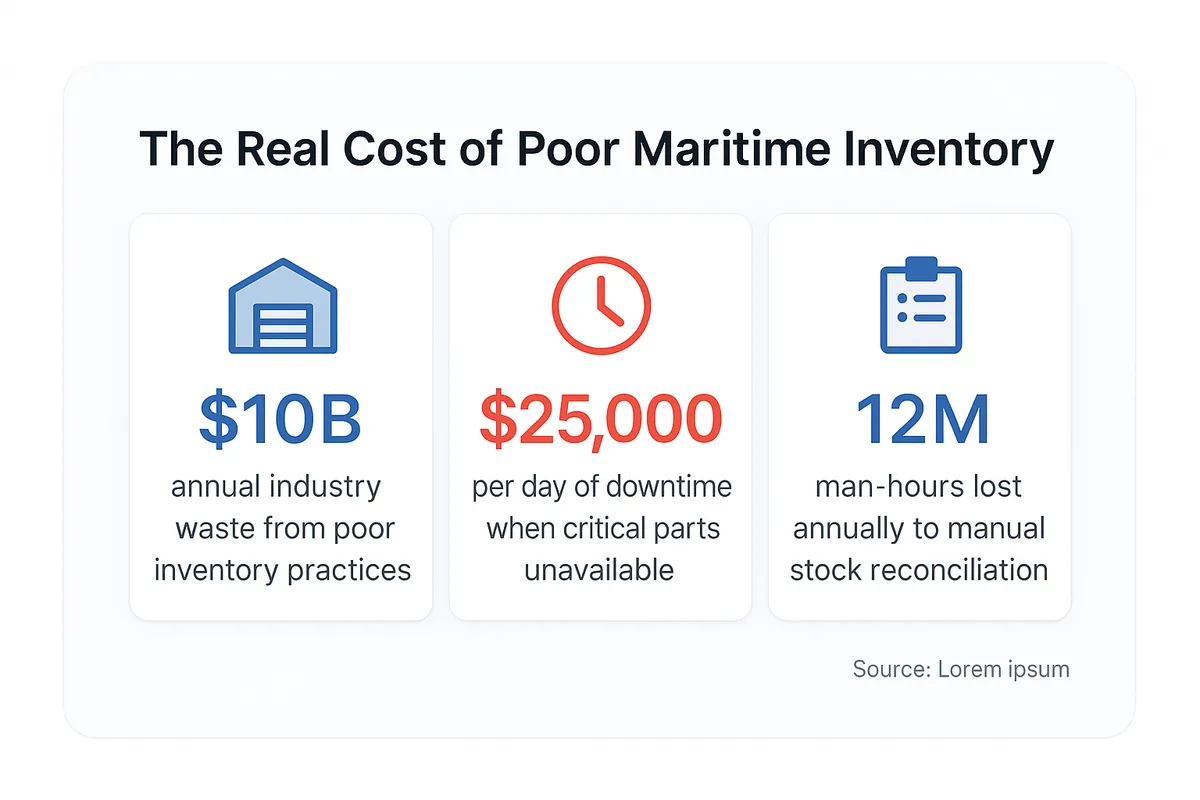
The $10 Billion Problem Nobody Talks About
Spare parts, stores, and consumables represent one of the largest recurring costs in vessel operations. According to Persistence Market Research, the ship spares and equipment market is projected to grow from USD 10.1 billion in 2025 to USD 14.3 billion by 2032.
Fleet expansion, regulatory tightening, and the growing complexity of modern vessel systems are driving this growth.
Maintenance and repair — including spares, stores, and lubricants — typically accounts for 15 to 25 percent of a vessel's total operating expenditure. For aging vessels, that figure climbs to 30 percent or more.
Data from SAFETY4SEA and Clarksons Research confirms that repair and maintenance costs have been trending upward year over year.
The problem is not that companies spend too much on spare parts. The problem is that they spend it badly:
- Overstocking slow-moving items that expire before use
- Understocking critical components that trigger emergency procurement at premium rates
- Losing visibility into what is already aboard
When the Right Part Isn't There: Downtime at $25,000 a Day
A standard Panamax containership generates operating costs of roughly USD 25,000 per day. Larger container vessels can reach USD 85,000 per day.
These costs run whether the vessel is earning revenue or sitting idle waiting for a replacement part.
A Lloyd's List study found that proactive spare part management can reduce vessel downtime by up to 40 percent annually.
The math is straightforward. If a vessel averages five unplanned off-hire days per year due to parts unavailability, and each day costs USD 25,000, that is USD 125,000 in avoidable losses — per ship.
Multiply that across a fleet of 20 vessels and the number is hard to ignore.
Emergency procurement makes it worse. When a critical part is needed urgently, shipping costs alone can range from GBP 50 to over GBP 2,000 per shipment.
Add customs fees, agent handling charges, and the premium pricing that suppliers charge for rush orders.
A part that costs USD 200 through normal channels can easily cost USD 1,500 as an emergency air shipment to a vessel in a remote port.
12 Million Man-Hours Lost to Manual Reconciliation
According to data published by The Maritime Executive, the global shipping industry wastes an estimated 12 million man-hours every year reconciling spare parts inventory — and achieves only 20 percent data accuracy. That means four out of every five inventory records on a typical vessel are wrong.
The root cause is systemic. Paper-based or spreadsheet-driven systems cannot keep pace with stock movements on an operating vessel. Parts are constantly:
- Consumed during maintenance
- Received from suppliers
- Transferred between vessels
- Damaged, expired, or borrowed
Every one of those events needs accurate recording. When the recording tool is a crew member typing into a spreadsheet during a busy watch, errors pile up faster than anyone can correct them.
What the Regulations Actually Require
Maritime inventory management is not optional — it is a regulatory obligation. Multiple international instruments govern how vessel operators procure, store, track, and maintain spare parts. Understanding these requirements is the foundation for any effective inventory strategy.
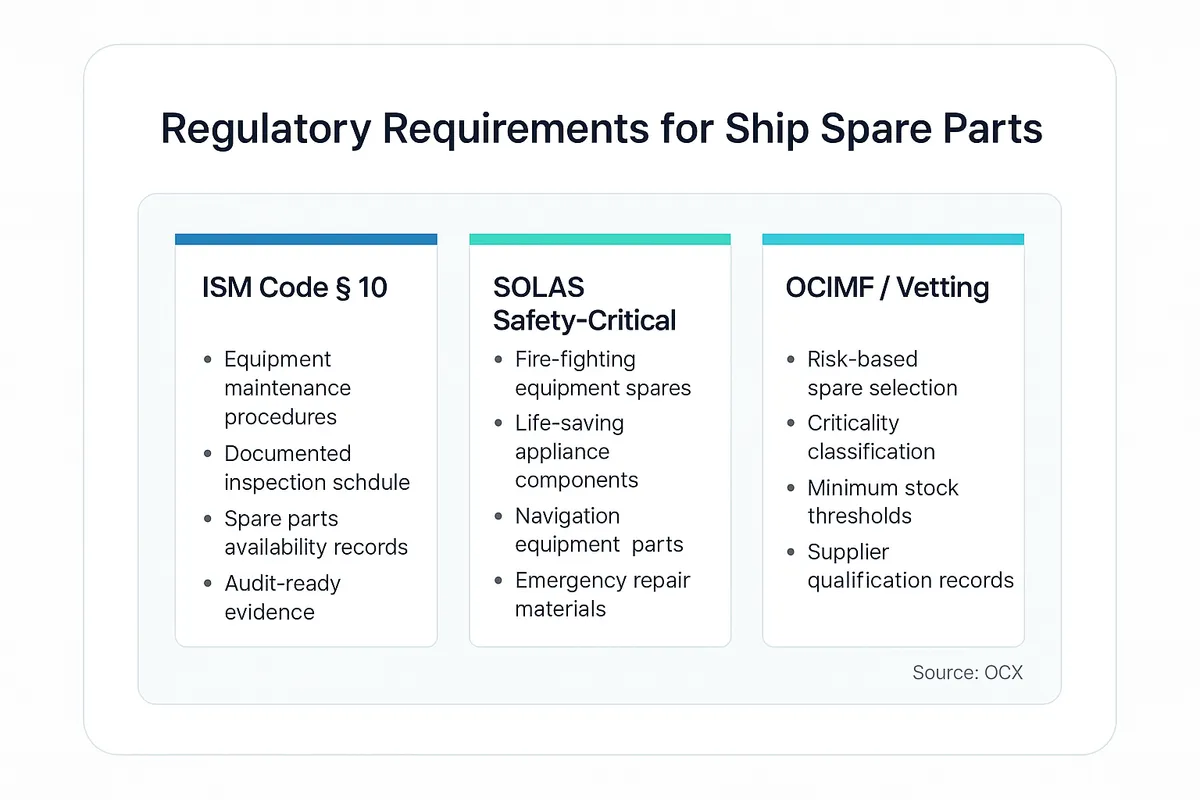
ISM Code Section 10 — Maintenance and Equipment Reliability
The International Safety Management (ISM) Code, Section 10, sets the primary regulatory framework for vessel maintenance. Section 10.1 requires the Company to "establish procedures to ensure that the ship is maintained in conformity with the provisions of the relevant rules and regulations."
This is not aspirational language. It is a mandatory element of the Safety Management System (SMS) that every ISM-certified vessel must demonstrate.
Section 10.2 and 10.3 go further, requiring:
- Inspections at appropriate intervals with non-conformity reporting and root cause analysis
- Corrective action and maintenance of records for all activities
- Identification of equipment whose sudden failure could create hazardous situations, with specific measures to promote reliability
The implication for inventory management is clear. If your SMS requires specific maintenance procedures, and those procedures require specific spare parts, then spare parts availability is a compliance issue — not just a logistics one.
An auditor who finds that a safety-critical maintenance task was delayed because the required spare was unavailable is not identifying a procurement problem. They are identifying an ISM non-conformity.
SOLAS Requirements for Safety-Critical Spares
While SOLAS does not mandate a general spare parts inventory, it does impose specific carriage requirements for safety equipment. SOLAS Chapter II-2, Regulation 10.3.3 mandates that ships carry spare charges for portable fire extinguishers: 100 percent spare charges for the first ten units, and 50 percent for the remainder, up to a maximum of 60 total spare charges.
These are not suggestions. A vessel found without the required spare charges during a Port State Control inspection faces deficiency findings and potential detention.
New SOLAS requirements for lifting appliances, which entered into force on 1 January 2026, add maintenance, inspection, and testing obligations for all shipboard lifting equipment regardless of installation date.
MARPOL Annex VI introduces additional tracking requirements. Emission-critical spare parts for diesel engines above 130 kW must carry a unique IMO identification number, stamped on the part itself and recorded in the engine's NOx technical file.
From 1 January 2026, ships may not use or store firefighting media containing PFOS or PFAS compounds. Every vessel's inventory of firefighting consumables must be audited and, where necessary, replaced — a clear example of how regulatory changes drive inventory decisions.
OCIMF's Risk-Based Approach to Spare Part Decisions
The Oil Companies International Marine Forum (OCIMF) published its "Safety Critical Equipment and Spare Parts Guidance" in 2018. It established a risk-based methodology that has reshaped how the industry thinks about spares.
OCIMF defines safety-critical equipment as "an individual piece of equipment, a control system, or an individual protection device which, in the event of a single point failure, may result in a hazardous situation which could lead to an accident."
This matters because previous IACS class society requirements for specific mandatory spare parts have been replaced by guidance. Companies can no longer rely on a prescribed list of spares to carry.
Instead, they must conduct their own single-point failure analysis and risk assessment. The burden of proof has shifted from the classification society to the operator.
For inventory management, the decision about what to carry is no longer a simple checklist exercise. It requires data:
- Failure history for each piece of equipment
- Lead times from suppliers and logistics providers
- Operational criticality and risk assessment outcomes
Operators must be able to track and justify these decisions for auditors and vetting inspectors.
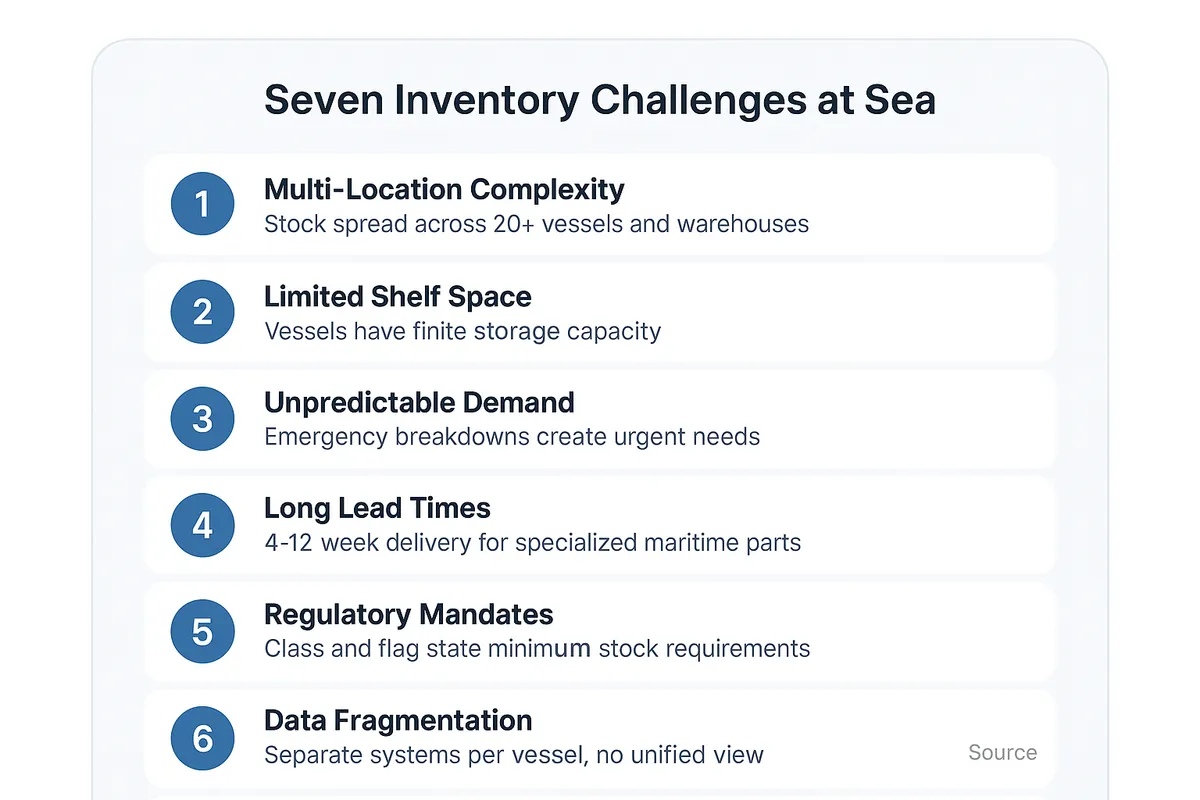
Seven Challenges Every Fleet Inventory Manager Faces
Understanding why maritime inventory management is uniquely difficult helps explain why generic ERP tools consistently fail on vessels. These challenges are structural, not incidental.
- Multi-vessel stock synchronization. A fleet of 20 vessels has 20 independent warehouses that move around the world. The same turbocharger nozzle ring might be urgently needed in Singapore while three identical units sit unused on a sister ship in Rotterdam. Without real-time visibility, surplus and shortage coexist permanently.
- Port time pressure and emergency procurement. Vessels spend less and less time in port. Container ships that once stayed 48 hours now turn around in 18. Every hour is scheduled for cargo operations, bunkering, crew changes, and inspections. The window for receiving spare parts is measured in hours, not days.
- Limited crew resources and competing priorities. As Skuld documents, shipboard maintenance is constrained by manpower shortages, commercial pressure, and limited tools. Inventory tasks — counting stock, recording receipts, updating records — compete with watchkeeping, cargo work, and the maintenance itself. Something always gives. Usually it is the paperwork.
- Batch tracking, expiry dates, and material traceability. Fire extinguisher charges expire. Medical supplies have shelf lives. Lubricating oils have storage limits. Emission-critical spare parts need IMO identification numbers. Tracking all of these dimensions manually — across dozens of categories and multiple storage locations — is a data problem spreadsheets cannot solve.
- Balancing overstocking against stockout risk. Carry too much and you tie up capital in items that deteriorate, consume limited storage space, and create disposal costs. Carry too little and a single failure can ground a vessel earning USD 25,000 per day. The right balance differs for every material, vessel, and trade route.
- Supply chain disruptions and extended lead times. Red Sea rerouting has added thousands of nautical miles to Asia-Europe trade, cutting global container capacity by up to 15 percent and adding up to 12 extra days to transit times. When your spare parts delivery reroutes around the Cape of Good Hope, planned maintenance schedules become unrealistic.
- Aging vessels with obsolete components. Older vessels face a compounding challenge. Machinery becomes harder to source parts for as manufacturers discontinue product lines. A 15-year-old engine may need components with a 16-week lead time from a single remaining supplier. Without accurate consumption data and forward-looking coverage planning, these situations always become emergencies.
Best Practices for Ship Inventory Management
Effective maritime inventory management requires both disciplined processes and the right tools. These five practices form the foundation of a reliable inventory strategy.
Standardize Your Item Catalogue Across All Vessels
The most common source of inventory chaos is the lack of a unified material master. When each vessel uses its own naming conventions — "Fuel Oil Filter" on one ship, "FO Filter Element" on another, "M/E Fuel Filter, 10 micron" on a third — the same physical item has three different identities.
Fleet-level reporting becomes impossible. You cannot aggregate stock across vessels, compare consumption patterns, or identify surplus for redistribution.
A centralized material catalogue with standardized naming, categorization, and unit-of-measure definitions is the single most impactful investment in inventory management. Each material should carry consistent tracking configuration — defined once at the master level and enforced across every vessel.
Implement Coverage-Based Reorder Points Per Location
A bulk carrier trading on the Baltic does not need the same spare parts coverage as an LNG carrier on a Middle East–Asia route. Coverage targets — minimum, optimal, and maximum stock levels — should be set independently for each material at each location.
The vessel's trade pattern, operational profile, and supply chain access should drive these targets.
The coverage analysis view should make gaps visible at a glance:
- Red for below minimum
- Amber for below optimal
- Green for within range
Fleet-wide coverage reports let your supply chain team prioritize replenishment across the entire fleet. This directs limited budget to the most critical shortages rather than processing requisitions in the order they arrive.
Use Purpose-Built Workflows for Every Transaction Type
Not all inventory transactions are alike. Receiving goods against a purchase order is different from correcting a stock discrepancy, which is different from transferring materials between vessels.
Each transaction type has its own validation requirements, approval chains, and documentation needs.
Best-in-class inventory systems use specialized journal types:
- Arrival journals that link to purchase orders with tolerance checking
- Adjustment journals that require reason codes for every correction
- Counting journals that support blind counting and variance analysis
- Transfer journals that track in-transit status with dual-approval for inter-vessel movements
When each transaction follows its own purpose-built workflow, process compliance becomes automatic rather than manual.
Track by Batch, Serial Number, and Owner Simultaneously
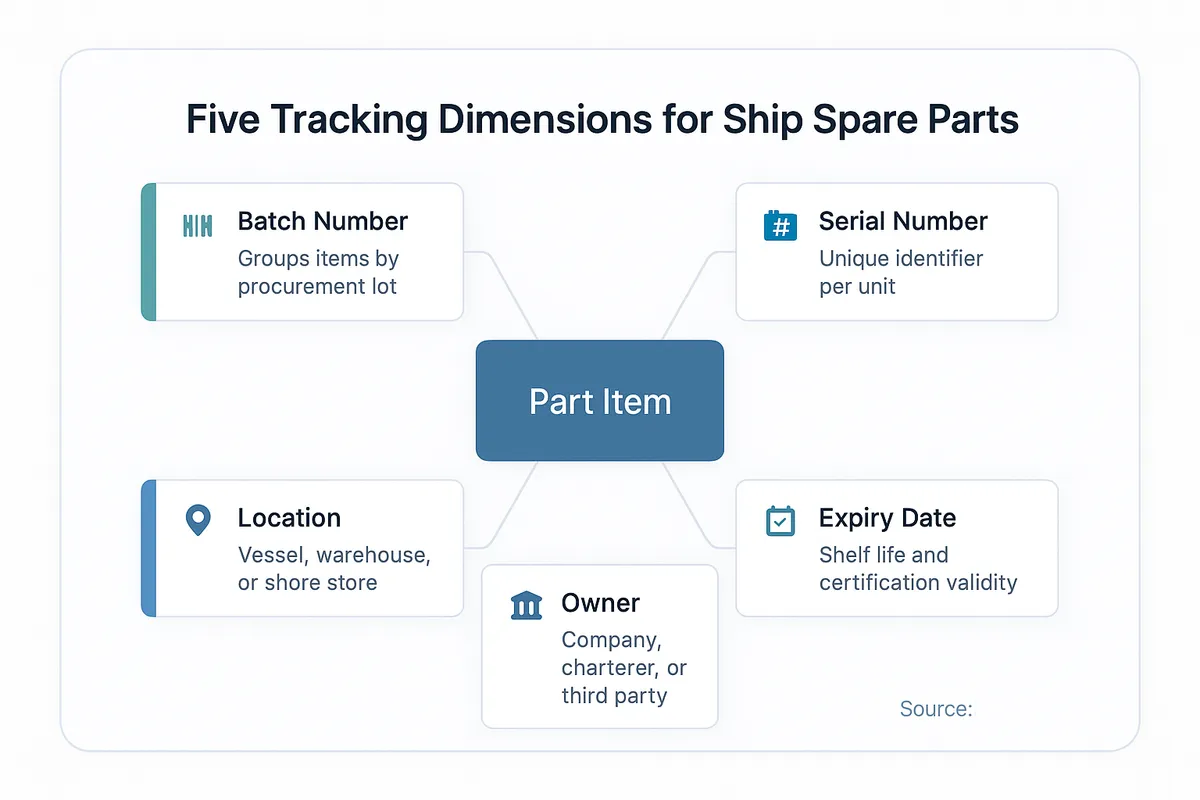
Maritime inventory demands multi-dimensional tracking that goes beyond simple quantity management. A single spare part may need to be tracked across several dimensions:
- Batch — for traceability to the manufacturer
- Serial number — for regulatory compliance on safety-critical items
- Owner — when management companies operate vessels for different shipowners
- Status — unrestricted, quality hold, blocked, or in inspection
The key is configurability at the material level. Not every item needs the same tracking depth:
- Safety-critical engine spares should carry full serial number traceability
- Bulk consumables like cleaning supplies need only space tracking
- Chemicals and medical supplies need batch and expiry date monitoring
A rigid system that forces the same tracking on every item creates either unnecessary burden or insufficient traceability. Neither is acceptable.
Integrate Procurement with Real-Time Stock Levels
Inventory and procurement are two sides of the same coin. Coverage analysis should drive purchase requisitions automatically.
When stock drops below the reorder point, the system should generate a requisition without waiting for someone to notice the gap.
As we explored in our guide to maritime procurement, this closed loop — from stock need to purchase order to goods receipt — is what separates reactive procurement ("we ran out, order more") from proactive supply chain management ("we will need replenishment in 45 days").
Arrival journals should link directly to purchase order line items for automatic goods receipt with tolerance checking. When the second engineer scans a delivery against a PO line and the quantity matches, the inventory is updated, the PO is partially receipted, and the audit trail is complete — without a single spreadsheet entry.
How Cloud-Based Ship Management Systems Transform Inventory Control
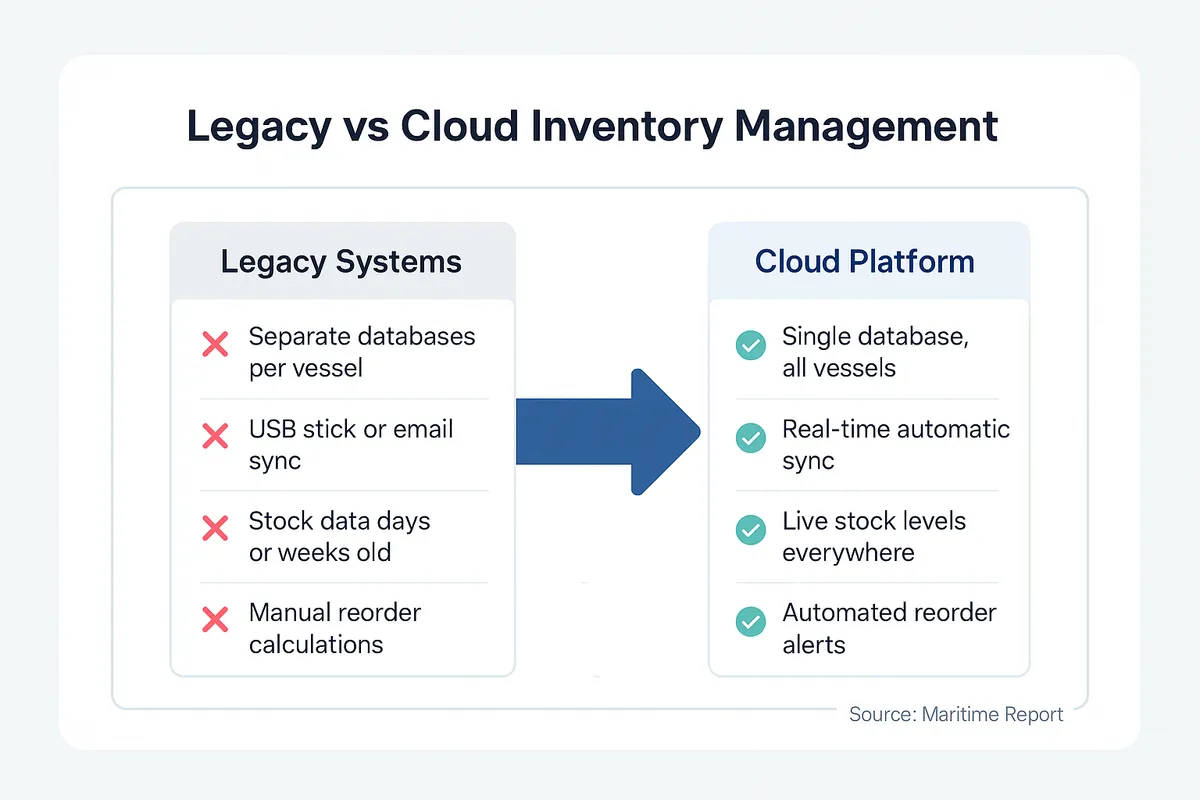
The best practices described above are straightforward in principle but difficult to implement with legacy tools. Spreadsheets cannot enforce approval workflows.
Email cannot provide real-time on-hand visibility across 20 vessels. Shore-based ERP systems that need constant connectivity do not work on vessels with intermittent satellite links.
This is where purpose-built maritime inventory platforms deliver value. Systems like Navatom's Inventory module are designed from the ground up for fleet operations, including:
- Office-ship synchronization over satellite links with automatic conflict resolution
- Seven specialized journal types with configurable multi-tier approval workflows
- Five independent tracking dimensions per material
- Real-time on-hand aggregation across the entire fleet
The architectural difference matters. A cloud-native platform processes transactions locally on the vessel and synchronizes when connectivity is available.
Your crew can receive goods, conduct physical counts, and process transfers without depending on a shore-side server. When the satellite link comes back, changes merge automatically. No lost data, no duplicate entries, no reconciliation exercises.
Integration between inventory and other modules — material management, procurement, and planned maintenance — creates the closed-loop data flow that makes proactive fleet management possible:
- Your PMS consumes a spare part during a maintenance task
- Inventory is updated automatically
- Stock drops below coverage targets and a procurement requisition is generated
- Goods arrive, the PO is receipted, and stock is available for the next job
This is the cycle that eliminates the 12 million man-hours of manual reconciliation.
Key Takeaways
- Maritime inventory management is a regulatory obligation under the ISM Code (Section 10), not just a logistics function. Spare parts availability is a compliance issue.
- The global ship spares market exceeds USD 10 billion annually. Poor management — overstocking, emergency procurement, expired materials — is one of the largest hidden costs in vessel operations.
- Proactive spare part management can reduce vessel downtime by up to 40 percent. At USD 25,000+ per day, the financial case is overwhelming.
- OCIMF's risk-based approach means companies must conduct their own failure analysis and justify spare parts decisions. A generic checklist no longer suffices.
- Purpose-built maritime inventory systems with multi-dimensional tracking, specialized journal types, and office-ship sync solve problems that generic ERP tools cannot.
- The closed loop between inventory, procurement, and maintenance transforms reactive "we ran out" operations into proactive fleet-wide supply chain management.
If you are evaluating inventory management solutions for your fleet, explore Navatom's Inventory module to see how purpose-built maritime software handles these challenges — from multi-vessel stock visibility and coverage planning to audit-ready compliance records.
Frequently Asked Questions
What is maritime inventory management?
Maritime inventory management is the practice of tracking, controlling, and optimizing spare parts, consumables, stores, and equipment across a fleet of vessels and shore-based warehouses.
It covers goods receipt, stock adjustments, physical counting, inter-vessel transfers, expiry monitoring, and coverage planning. All of these activities are governed by the ISM Code's requirement that ships be maintained in conformity with applicable regulations.
How does the ISM Code affect spare parts management?
The ISM Code, Section 10, requires vessel operators to establish maintenance procedures, conduct inspections at appropriate intervals, identify safety-critical equipment, and maintain records of all maintenance activities.
Since maintenance procedures depend on spare parts availability, the ISM Code effectively mandates that operators have a system for ensuring the right parts are available when needed. A maintenance non-conformity caused by parts unavailability is an ISM finding, not just a supply chain issue.
What tracking dimensions matter for ship spare parts?
The five most important tracking dimensions for maritime spare parts are:
- Batch — manufacturer traceability and recall management
- Serial number — individual identification for safety-critical items
- Owner — managing stock for multiple shipowners or legal entities
- Status — unrestricted, quality hold, blocked, or in inspection
- Space or location — tracking exactly where items are stored aboard the vessel
The optimal configuration depends on the material type. Safety-critical engine spares may need full serial traceability, while bulk consumables may need only location tracking.
How much do shipping companies spend on spare parts?
The global ship spares and equipment market was valued at roughly USD 10.1 billion in 2025. It is projected to reach USD 14.3 billion by 2032.
For individual vessels, maintenance and repair costs — including spares, stores, and lubricants — typically account for 15 to 25 percent of total operating expenditure. A Panamax containership running at roughly USD 25,000 per day may allocate USD 3,750 to USD 6,250 per day to maintenance-related spend, including spare parts procurement and inventory holding costs.
What is the difference between planned and emergency spare parts procurement?
Planned procurement is driven by coverage analysis and consumption forecasting. Orders are placed with enough lead time to negotiate competitive pricing and arrange standard shipping.
Emergency procurement occurs when an unexpected equipment failure requires a part that is not in stock. This triggers rush orders at premium pricing with expensive express delivery.
The price difference can be five to ten times the normal cost, plus air freight charges and port agent handling fees.
The primary goal of effective maritime inventory management is to minimize emergency procurement. This means maintaining appropriate stock levels for critical components based on risk assessment and consumption history.