Maritime CMMS vs PMS: What's the Difference?
CMMS and PMS appear interchangeably in maritime RFPs and classification surveys, yet they are not identical. This article dissects the real differences — from regulatory roots to ship-shore architecture — so you can evaluate maintenance systems with clarity.

If you have spent any time evaluating maintenance software for a shipping company, you have encountered two acronyms that seem to compete for the same conceptual space: CMMS (Computerized Maintenance Management System) and PMS (Planned Maintenance System). Vendor brochures use them interchangeably.
Classification society surveyors refer to both in the same breath. RFP templates list them side by side, as though they were synonyms — or as though one were a subset of the other.
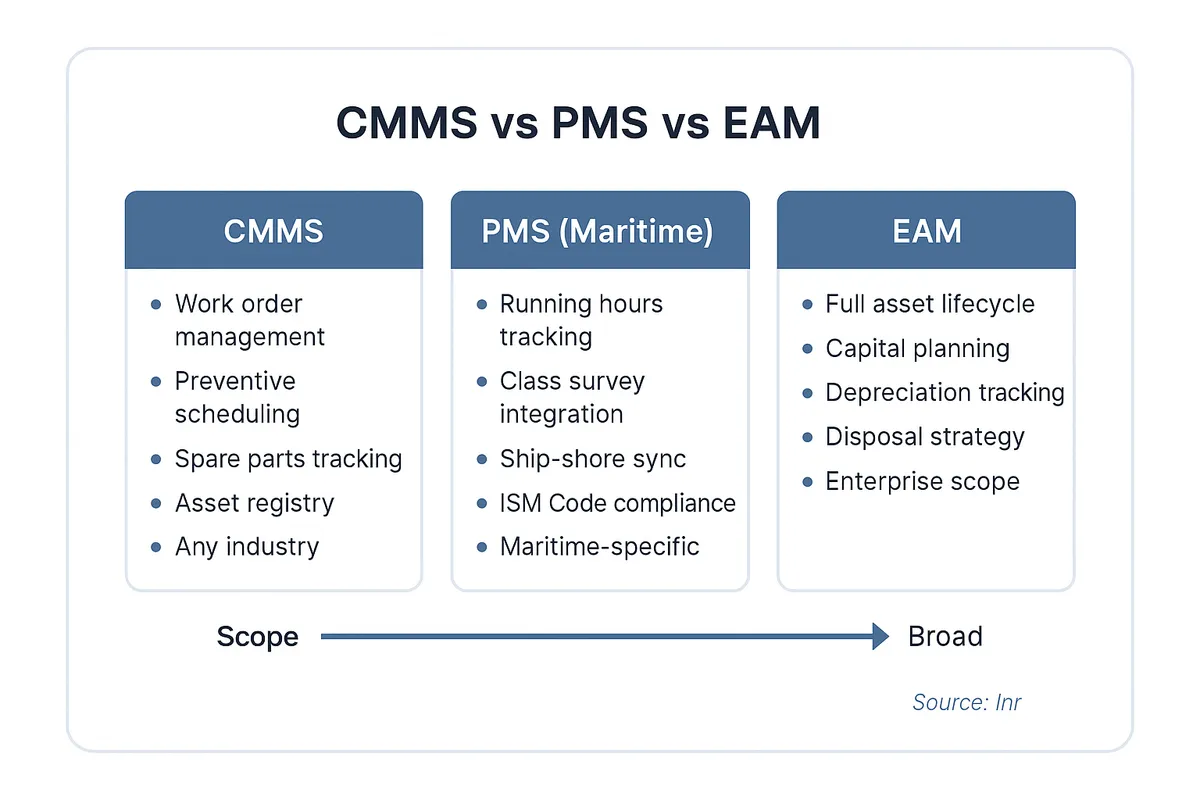
They are neither. CMMS is the broader category that spans every industry from aviation to pharmaceuticals.
PMS is the maritime-specific version, shaped by the ISM Code, SOLAS conventions, class society rules, and the realities of managing machinery on a vessel that is always moving. Understanding where they overlap and where they diverge is not academic.
It determines whether the system you choose will survive contact with a class surveyor, a chief engineer at sea, and a superintendent who needs real-time data ashore.
Defining the Terms — CMMS, PMS, and EAM
What Is a CMMS?
A Computerized Maintenance Management System is a software platform that centralizes maintenance information — asset registries, work orders, spare parts inventories, maintenance schedules, and labour records — into a single database. The concept emerged in the 1960s when large manufacturing plants began replacing paper-based maintenance logs with computerized tracking.
By the 1980s, CMMS had become standard in industries where equipment uptime directly correlated with revenue: oil refineries, power plants, airlines, and factory floors.
A modern CMMS typically provides five core capabilities:
- An asset register that catalogues every piece of equipment and its technical specifications
- A work order system that tracks maintenance tasks from creation through completion
- A preventive maintenance scheduler that triggers jobs based on time or meter readings
- A spare parts inventory module that manages stock levels and reorder points
- A reporting engine that analyses maintenance history to identify cost drivers and failure patterns
The global CMMS market serves every asset-intensive industry, but it was designed with shore-based assumptions: reliable internet connectivity, centralized IT departments, single-site or multi-site operations where all assets share the same physical infrastructure. These assumptions break down at sea.
What Is a Ship Maintenance System (PMS)?
A Planned Maintenance System is the maritime industry's answer to the same problem, but built from the waterline up. The term originates from the International Safety Management (ISM) Code, adopted by the International Maritime Organization (IMO) in 1993 and made mandatory under SOLAS Chapter IX.
Section 10 of the ISM Code requires every shipping company to "establish procedures to ensure that the ship is maintained in conformity with the provisions of the relevant rules and regulations." That single sentence created the regulatory basis for every PMS deployed on a commercial vessel today.
A ship maintenance system goes beyond what a generic CMMS provides. It must understand classification society survey cycles, running hours synchronization from onboard automation, the hierarchical structure of vessel equipment (hull → engine room → main engine → cylinder unit → piston rings), and the operational reality that a vessel may lose satellite connectivity for hours or days at a time.
A modern PMS platform integrates all of these elements natively, not as afterthoughts bolted onto a generic framework.
Where Does EAM Fit In?
Enterprise Asset Management (EAM) is the broader discipline that covers the entire lifecycle of a physical asset — from procurement and commissioning through operation, maintenance, and disposal. If CMMS is about keeping things running, EAM is about deciding whether to keep them running at all.
In maritime terms, EAM covers the full vessel lifecycle:
- Newbuild specification
- Dry docking strategy
- Equipment replacement planning
- Residual value analysis
- Scrapping
A CMMS or PMS handles the maintenance portion of that lifecycle. An EAM system wraps around it with financial planning, depreciation tracking, and capital expenditure management.
Some maritime software vendors position their products as EAM solutions, others as CMMS, and still others as PMS. The label matters less than the substance: what does the system actually do when a chief engineer needs to record a running hours reading at 02:00 in rough weather with intermittent satellite signal?
The Regulatory Mandate — Why Ship Maintenance Systems Are Not Optional
ISM Code Section 10 — Maintenance of the Ship and Equipment
The ISM Code is the regulatory backbone of every PMS in commercial shipping. Chapter 10 (Maintenance of the Ship and Equipment) does not prescribe how maintenance should be managed, but it mandates what must be achieved.
Section 10 establishes four requirements:
- Inspections must be held at appropriate intervals
- Any non-conformity must be reported with its possible cause
- Appropriate corrective action must be taken
- Records of all these activities must be maintained
Section 10.3 adds a critical dimension: companies must identify equipment and technical systems whose sudden operational failure could create hazardous situations, and the safety management system must include specific measures to promote the reliability of that equipment. This is not a suggestion — it is a mandatory requirement verified during every ISM audit.
A generic CMMS that lacks a criticality classification framework will leave your fleet exposed during an external audit.
SOLAS Chapter IX and Class Society Expectations
The ISM Code itself is given legal force through SOLAS Chapter IX, which makes it mandatory for all passenger ships and cargo vessels of 500 gross tonnage and above on international voyages. But the regulatory landscape does not stop at the ISM Code.
Classification societies — DNV, Lloyd's Register, Bureau Veritas, ClassNK, ABS, and others — layer their own survey requirements on top. These class rules define specific inspection intervals for hull structures, machinery components, safety equipment, and electrical systems.
A PMS must be capable of aligning its scheduled maintenance tasks with these class-mandated survey windows.
Classification societies are increasingly open to alternative maintenance strategies. DNV's condition-based maintenance programme, for example, allows ship owners to replace predetermined maintenance intervals with condition monitoring for specific machinery — provided the monitoring system is type-approved and the results are integrated into the vessel's PMS.
This is a capability that no generic CMMS supports out of the box.
Critical Equipment Identification — ISM 10.3 in Practice
The concept of critical equipment identification deserves its own discussion because it is one of the most frequently cited deficiencies in port state control inspections. ISM 10.3 requires that companies identify every piece of equipment whose sudden failure could result in a hazardous situation — and then demonstrate that specific measures exist to promote its reliability.
In practice, this means tagging equipment with criticality ratings in the maintenance system, assigning more frequent inspection intervals to high-criticality items, maintaining dedicated spare parts for them, and documenting the rationale for each classification.
A shore-based CMMS typically offers a flat priority field (high, medium, low) attached to each asset. A maritime PMS needs a richer model: criticality ratings tied to the vessel's Safety Management System, mappings between critical equipment and required spare parts, escalation rules that notify the superintendent when a critical item goes overdue, and audit trails that demonstrate compliance to flag state inspectors.
The difference is not cosmetic — it is the difference between passing and failing an ISM audit.
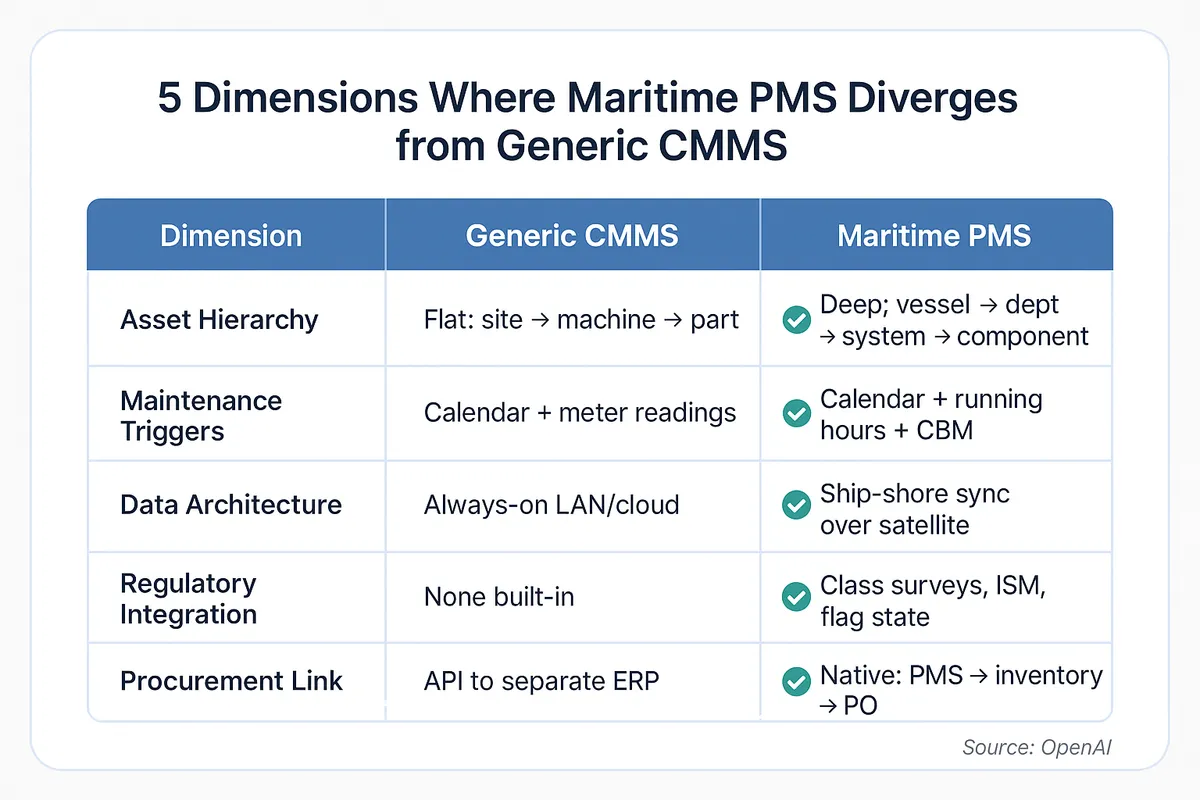
Five Dimensions Where Maritime PMS and Generic CMMS Diverge
1. Asset Hierarchy and Equipment Ontology
In a factory, the asset hierarchy is relatively flat: site → building → production line → machine → component. On a vessel, the hierarchy is deep, domain-specific, and governed by class society standards.
A typical main engine alone decomposes into cylinders, pistons, connecting rods, fuel injectors, turbochargers, exhaust valves, and dozens of ancillary systems — each with its own maintenance schedule driven by running hours, calendar intervals, or condition monitoring data.
Maritime PMS platforms use equipment hierarchies that mirror classification society conventions: vessel → department (deck, engine, safety) → system → subsystem → component. This structure is not arbitrary — it maps directly to how class surveyors inspect the vessel, how spare parts are catalogued in procurement systems, and how chief engineers think about their machinery.
A generic CMMS can be configured to replicate this hierarchy, but it requires significant customization and ongoing maintenance to keep aligned with class expectations.
2. Maintenance Trigger Models — Time, Running Hours, and Condition
Generic CMMS platforms schedule maintenance on calendar intervals (every 90 days) or meter readings (every 500 hours). Maritime PMS requires all three trigger models simultaneously: calendar-based intervals for items like safety equipment inspections, running hours for propulsion and power generation equipment, and condition-based triggers for machinery enrolled in class-approved CBM programmes.
Running hours synchronization is a uniquely maritime challenge. The main engine, auxiliary engines, purifiers, compressors, and dozens of other rotating machines each accumulate running hours at different rates.
A PMS must ingest these readings — either manually from the engine room log or automatically from onboard automation systems — and recalculate task due dates in real time. According to Bureau Veritas, ship owners are increasingly moving toward condition-based maintenance to replace traditional time-based intervals, but this requires a PMS that can integrate vibration analysis, oil analysis, and thermographic data into the scheduling engine — a capability rarely found in generic CMMS products.
3. Ship-Shore Data Architecture
This is perhaps the most fundamental architectural difference. A shore-based CMMS assumes persistent, high-bandwidth internet connectivity.
Every action — creating a work order, updating a spare part quantity, closing a maintenance task — happens in real time against a central database. On a vessel, connectivity ranges from adequate (VSAT in coastal waters) to non-existent (extended ocean passages with satellite outages).
Traditional approaches used store-and-forward synchronisation: the vessel runs a local database, queues changes, and uploads them when connectivity returns. The office runs a mirror database that reconciles incoming data.
This model works but introduces latency. The office may not see a critical maintenance failure for hours or even days.
Modern cloud-native platforms minimise this gap. They use persistent connections that transmit data in real time when bandwidth is available and queue intelligently when it is not. The choice between these models directly affects operational visibility.
4. Class Survey and Regulatory Integration
Every commercial vessel undergoes a continuous cycle of class surveys: annual surveys, intermediate surveys, special surveys (typically every five years), and various bottom and tailshaft surveys. Each survey has a defined scope — specific equipment and structural elements that must be inspected and found satisfactory.
A maritime PMS must align its maintenance schedules with these survey windows so that equipment is in optimal condition when the surveyor arrives, and so that maintenance records demonstrate a consistent history of compliance.
Generic CMMS platforms have no concept of class surveys. They do not understand that a main engine overhaul might need to coincide with a special survey to avoid double dry docking, or that certain machinery items can be granted extended survey intervals if condition monitoring data supports it.
This integration between maintenance planning and class compliance is native to maritime PMS and entirely absent from generic alternatives.
5. Procurement and Spare Parts Coupling
Maintenance and procurement are inseparable in maritime operations. When a planned maintenance task requires specific spare parts, the PMS should automatically check onboard stock levels, generate requisitions for items below minimum quantity, and route those requisitions through the company's procurement workflow — potentially triggering vendor enquiries, quotation comparisons, and purchase order generation.
Maintenance costs account for 10-30% of a vessel's total operating expenses, and a significant portion of that cost is driven by spare parts logistics.
In a generic CMMS, procurement integration typically means an API connection to a separate ERP system. In a maritime PMS that is part of an integrated ship management platform, the connection is native: the same system that schedules the maintenance task also manages the inventory, generates the purchase requisition, and tracks the delivery to the vessel.
This eliminates the data silos, reconciliation errors, and communication delays that plague disconnected systems.
The Maintenance Strategy Spectrum — From Reactive to Predictive
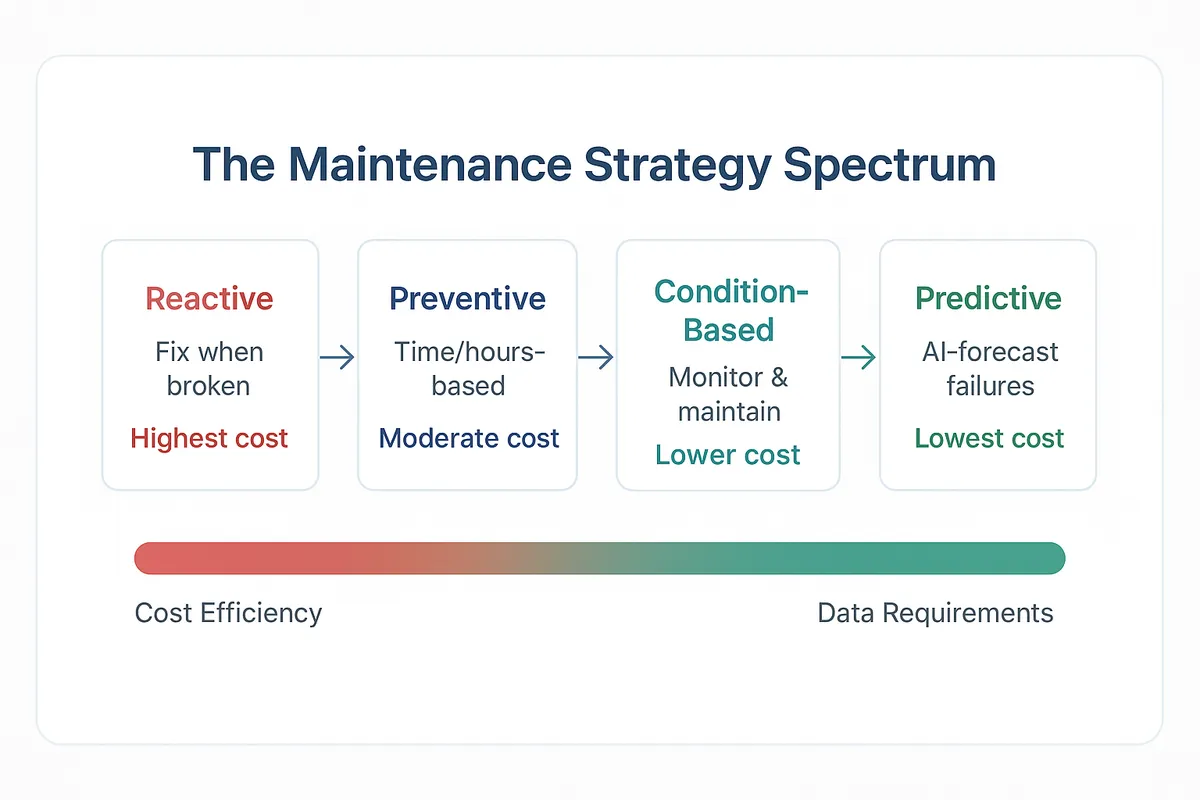
Both CMMS and PMS platforms support multiple maintenance strategies. Understanding the spectrum is essential for choosing the right approach for each piece of equipment on your vessel.
Corrective (Reactive) Maintenance
Fix it when it breaks. This is the oldest and most expensive maintenance strategy, yet it remains unavoidable for truly unpredictable failures.
The ISM Code does not prohibit corrective maintenance — but it requires that non-conformities be reported and corrective actions documented. A well-designed maintenance system captures these unplanned events as readily as it manages scheduled tasks, creating a historical record that can inform future preventive strategies.
Preventive (Time-Based and Running-Hours) Maintenance
Replace or service components at fixed intervals regardless of actual condition. This is the bread and butter of both CMMS and PMS — and it is where the maritime industry has lived for decades.
Manufacturer service letters, class society requirements, and operational experience define the intervals. The system's job is to track due dates, generate work orders, and ensure nothing falls through the cracks.
Research consistently shows that a well-planned preventive maintenance programme can reduce vessel maintenance expenses by 20-30% compared to a purely reactive approach.
Condition-Based Maintenance (CBM)
Service equipment based on its actual measured condition rather than a predetermined schedule. Vibration analysis, oil analysis, thermography, and ultrasonic testing provide the data.
Classification societies including DNV and Bureau Veritas (NI684 guidelines) now offer formal approval pathways for CBM programmes, allowing operators to extend or eliminate scheduled overhauls for machinery where condition data demonstrates continued fitness. The catch: the PMS must integrate with the monitoring equipment and present the data in a format that satisfies the class surveyor.
A significant portion of traditional time-based maintenance on vessels is, in fact, unnecessary — a product of historical conservatism and legacy class requirements. CBM addresses this by maintaining equipment only when the data says it needs maintaining.
However, few vessels have fully transitioned. While critical machinery such as turbochargers, thrusters, generators, and gearboxes are increasingly enrolled in class-approved CBM programmes, the broader fleet still relies primarily on scheduled intervals.
Predictive Maintenance — The Frontier
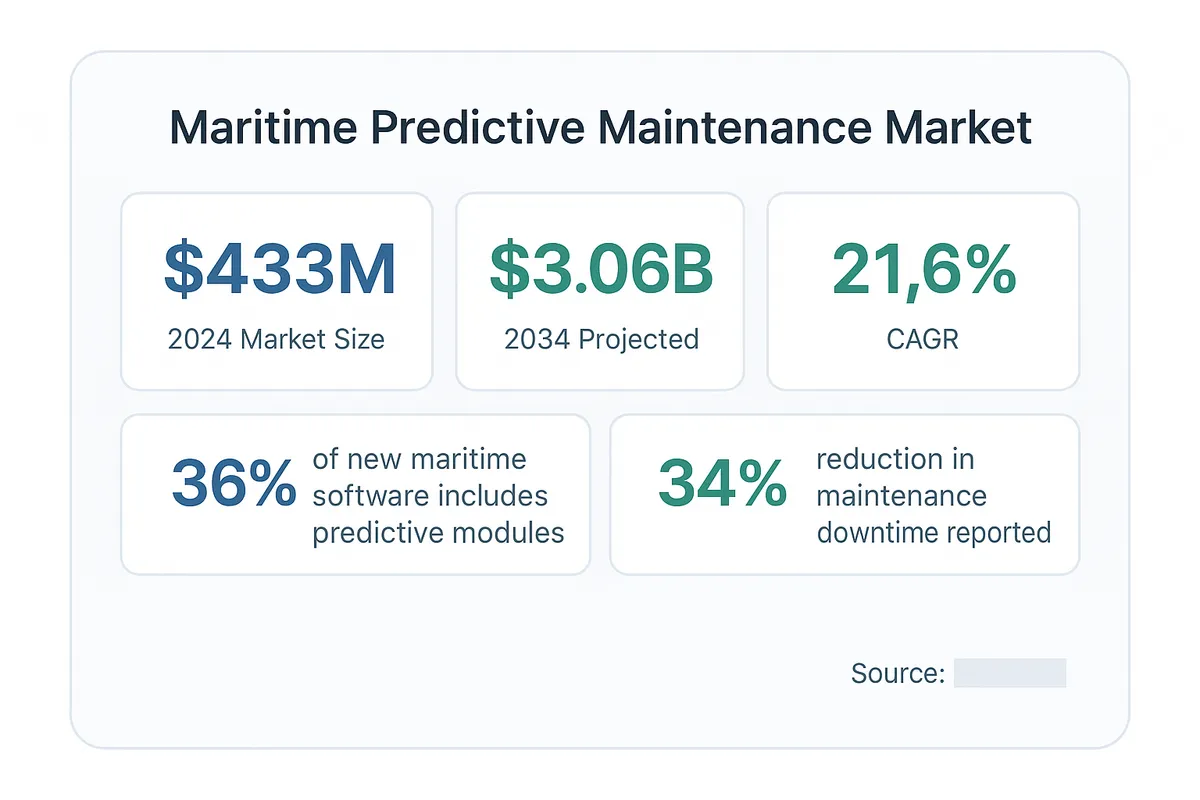
Predictive maintenance takes condition-based monitoring and adds machine learning: algorithms trained on historical failure data that forecast when a component is likely to fail, not just whether it is currently degraded. The maritime predictive maintenance market is projected to grow from approximately USD 433 million in 2024 to over USD 3 billion by 2034, reflecting a compound annual growth rate above 21%, according to recent industry analysis.
About 36% of newly developed maritime software solutions now include predictive maintenance modules.
The promise is compelling: reduced unplanned downtime, optimized spare parts procurement, and maintenance schedules that adapt to actual operating conditions rather than worst-case manufacturer assumptions. The reality, in 2026, is that predictive maintenance in maritime is still largely confined to high-value, data-rich machinery — main engines, propulsion systems, and large rotating equipment — where sensor data is plentiful and the cost of failure justifies the investment in monitoring infrastructure.
When a Generic CMMS Falls Short at Sea
Let us be specific about where generic CMMS products fail in a maritime context. These are not theoretical concerns — they are operational realities that surface within months of deployment on a commercial vessel.
- No running hours engine. Generic CMMS tracks meter readings but does not natively synchronize running hours from multiple engines, generators, and rotating machinery simultaneously. A vessel may have 30-50 independently metered machines, each requiring real-time running hours updates to calculate task due dates.
- No class survey calendar. Without awareness of annual, intermediate, and special survey windows, the system cannot coordinate maintenance activities with class-mandated inspections. Superintendents end up maintaining a parallel spreadsheet — defeating the purpose of the software.
- No multi-vessel fleet view. Most CMMS products are designed for single-site operations. Managing 10, 50, or 200 vessels — each with its own equipment register, maintenance history, and spare parts inventory — requires a fleet-level architecture that generic CMMS simply does not provide.
- No ship-shore synchronization. The chief engineer completes a maintenance task offshore. The superintendent needs to see it. A generic CMMS assumes both are on the same network. A maritime PMS handles the gap — whether through queue-based sync or real-time cloud architecture.
- No regulatory reporting. ISM audits, port state control inspections, and vetting inspections all require specific maintenance documentation in specific formats. A maritime PMS generates these reports natively. A generic CMMS requires custom development for every regulatory report.
The Convergence — Modern Maritime Maintenance Platforms
The distinction between CMMS, PMS, and EAM is becoming less about separate product categories and more about feature layers within integrated platforms. The most effective maritime CMMS solutions in 2026 are those that combine all three: the work order discipline of a CMMS, the regulatory awareness of a PMS, and the lifecycle perspective of an EAM — all within a single, cloud-native architecture that handles ship-shore data flow natively.
Systems like Navatom approach this by embedding the PMS within a broader ship management platform — where maintenance data flows directly into procurement, spare parts inventory, running cost tracking, and regulatory compliance modules. When a chief engineer closes a work order, the system simultaneously updates the equipment history, adjusts spare parts stock levels, recalculates the next due date based on running hours, and makes the record available to the superintendent in real time.
This integration eliminates the data fragmentation that occurs when organizations run separate CMMS, ERP, and procurement systems. For a deeper technical exploration, see our guide on what a PMS for ships actually entails.
Key Takeaways
- CMMS is the genus; PMS is the maritime species. Every maritime PMS is a CMMS, but not every CMMS is a maritime PMS. The difference is regulatory integration, ship-shore architecture, and domain-specific equipment modelling.
- The ISM Code (Section 10) makes maintenance systems mandatory for commercial vessels. The system must support inspection scheduling, non-conformity reporting, corrective action tracking, and record-keeping as a regulatory minimum.
- Running hours, class survey integration, and ship-shore data synchronization are the three capabilities that separate a maritime PMS from a generic CMMS.
- Condition-based maintenance is gaining class society acceptance, but it requires a PMS that can integrate monitoring data into the scheduling engine.
- Predictive maintenance is the fastest-growing segment (21%+ CAGR), but adoption in maritime is still concentrated on high-value propulsion and power generation equipment.
- Maintenance costs represent 10-30% of vessel OPEX. The right system pays for itself through reduced unplanned downtime, optimized spare parts logistics, and fewer audit non-conformities.
- The future favours integrated platforms that combine PMS, procurement, inventory, and analytics into a single system — eliminating the data silos that generic CMMS-plus-ERP architectures inevitably create.
Whether you are evaluating your first digital maintenance system or migrating away from a legacy CMMS that was never built for maritime, the question is not "CMMS or PMS?" — it is whether the system you choose understands the ISM Code, respects class society requirements, and works as reliably at sea as it does in port. Explore the Navatom glossary entry on PMS for technical specifications, or start a free trial to see the system in action.
Frequently Asked Questions
Is a PMS the same as a CMMS?
They share the same DNA — both manage assets, work orders, and preventive maintenance schedules — but a maritime PMS includes shipping-specific capabilities that a generic CMMS lacks: running hours tracking, class survey integration, ship-shore data synchronization, and ISM Code compliance features. Think of PMS as a CMMS that has been purpose-built for the maritime domain.
Do I need both a PMS and an ERP system?
That depends on your platform architecture. If your PMS is part of an integrated ship management platform that also handles procurement, inventory, crew, and finance, you may not need a separate ERP at all.
If your PMS is a standalone product, then yes — you will need an ERP or equivalent system for procurement, accounting, and other business functions, plus integration middleware to connect the two.
What does the ISM Code require for maintenance?
Section 10 of the ISM Code requires four things: inspections at appropriate intervals, reporting of non-conformities with probable causes, appropriate corrective action, and documented records of all maintenance activities. Section 10.3 additionally requires identification of equipment whose sudden failure could create hazardous situations, with specific measures to promote reliability of that critical equipment.
Can I use condition-based maintenance instead of scheduled intervals?
Yes, but it requires class society approval. DNV, Bureau Veritas, and other classification societies offer formal CBM approval programmes.
The condition monitoring system must be type-approved, the data must be integrated into the vessel's PMS, and the results must be made available to the class surveyor. In practice, CBM is most commonly applied to critical rotating machinery — turbochargers, thrusters, generators, and main engine components — rather than to all shipboard equipment.
How does a maritime CMMS differ from a shore-based CMMS?
Five key differences: maritime equipment hierarchies that mirror class society conventions, running hours synchronization across dozens of independently metered machines, ship-shore data architecture that handles satellite connectivity gaps, class survey calendar integration for coordinating maintenance with regulatory inspections, and regulatory reporting formats required by flag state inspectors and port state control officers.