Crew Work and Rest Hours: A Practical Guide to Maritime Compliance
Tracking crew work and rest hours is one of the most critical — and most frequently violated — compliance obligations in shipping. This guide breaks down STCW, MLC, and OCIMF requirements, common violations, and practical strategies for staying compliant.

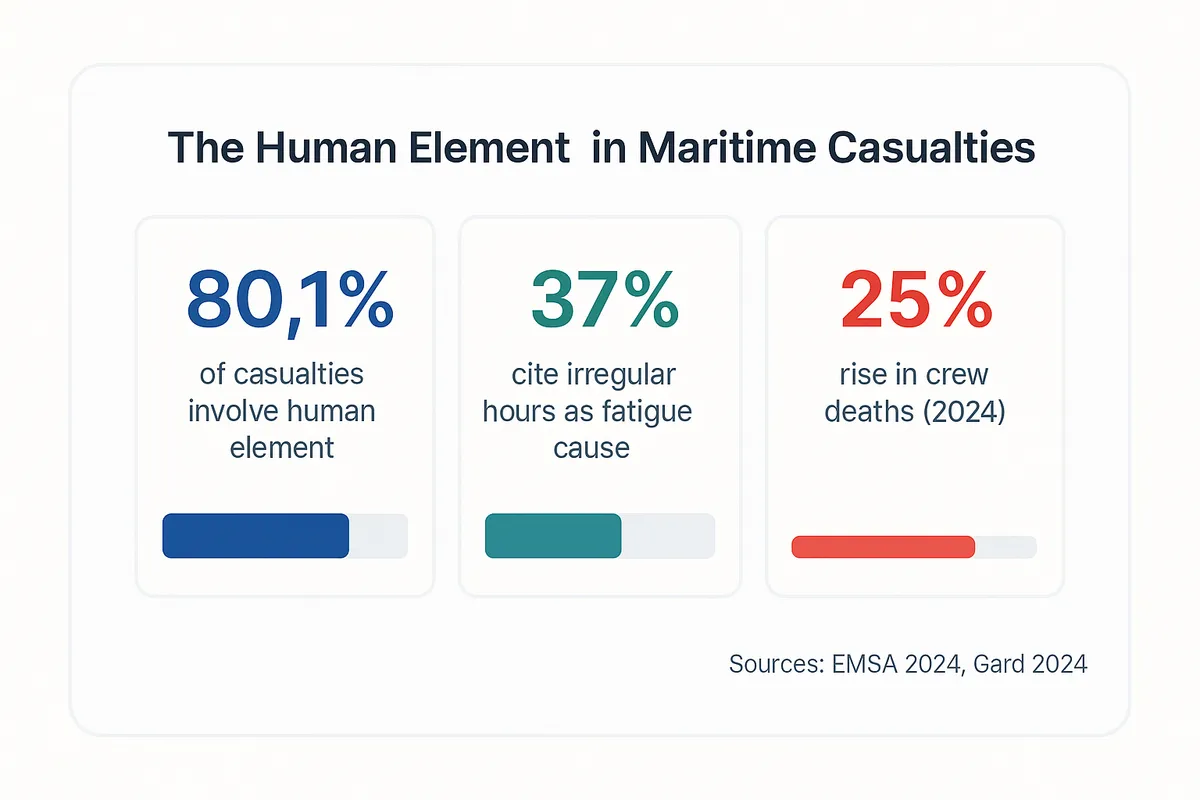
Four out of five maritime accidents involve human error. According to the EMSA Annual Overview of Marine Casualties and Incidents 2024, the human element was a contributing factor in 80.1 percent of all investigated casualties between 2014 and 2023.
Fatigue sits at the centre of this problem. When seafarers do not get enough rest, reaction times slow, judgment deteriorates, and the risk of a serious incident rises sharply.
That is why international regulations set strict limits on how many hours a crew member can work and how much rest they must receive. But understanding these rules — and actually complying with them day to day — are two very different things.
This guide walks through everything a crew manager needs to know: the regulatory framework, the most common violations, and practical strategies for keeping your vessel compliant.
Why Crew Rest Hours Matter More Than You Think
The Human Cost: Fatigue-Related Incidents at Sea
Fatigue at sea is not an abstract risk. It is a daily reality for thousands of seafarers serving on the world's 74,000-plus merchant vessels.
A Gard report published in 2024 revealed a 25 percent rise in crew deaths compared to the previous year, with illness, stress, and suicide among the leading causes. The same report found that 37 percent of seafarers cited irregular working hours as the primary driver of fatigue on board.
A fatigued officer on a bridge watch is not just a risk to themselves. They are a risk to the entire crew, the vessel, the cargo, and the marine environment.
Collisions, groundings, and allisions are overwhelmingly human-factor events, and insufficient rest is one of the most common root causes identified in accident investigations.
The IMO has specifically targeted seafarer fatigue as a priority area, recognizing that minimal crewing arrangements, long contracts, and rapid port turnarounds are pushing crews beyond safe operational limits.
The Financial Cost: PSC Detentions and Insurance Implications
Beyond the human toll, non-compliance with work and rest hours carries significant financial consequences. A vessel detained by Port State Control for MLC or STCW violations can face days of lost revenue while the deficiency is rectified.
For a mid-size bulk carrier, a single day of detention can cost upwards of $15,000 to $25,000 in lost charter hire alone — not counting port fees, agent costs, and reputational damage.
PSC inspectors review work and rest hour records as part of MLC compliance checks. If records are incomplete, inconsistent, or show clear violations, the inspector can issue deficiencies or detain the vessel until the company demonstrates corrective action.
Repeated detentions affect a vessel's risk profile, which in turn influences insurance premiums and chartering prospects.
For tanker operators, the stakes are even higher. OCIMF vetting through the SIRE 2.0 programme scrutinizes work and rest hour compliance as part of its crew management assessment.
A poor vetting result can effectively lock a tanker out of major oil company charters.
The Regulatory Framework: STCW, MLC, and OCIMF Explained
Three main regulatory frameworks govern crew work and rest hours. They overlap significantly but have important differences that every crew manager should understand.
STCW 2010: The Baseline Standard
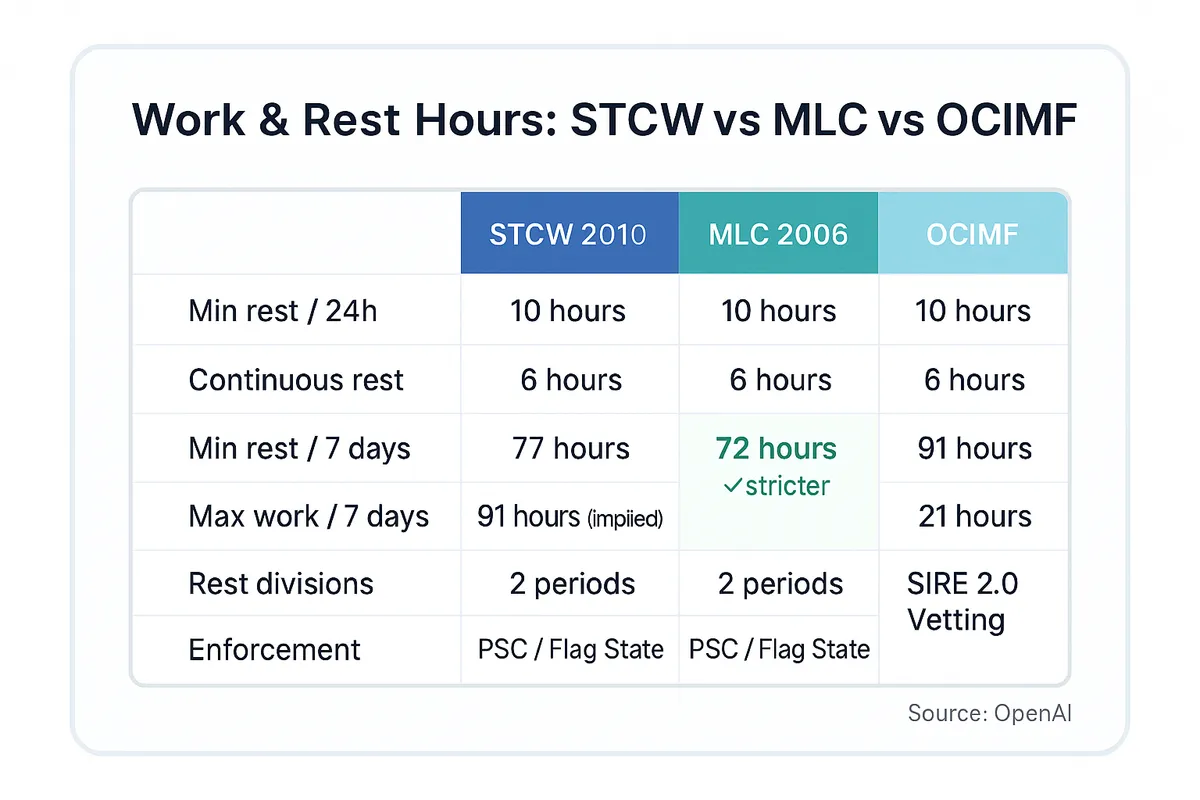
The STCW Convention (Standards of Training, Certification and Watchkeeping for Seafarers) sets the global baseline for crew competency and fitness for duty. Section A-VIII/1 specifically addresses rest hours for watchkeepers and personnel with designated safety duties. The core requirements are:
- Minimum 10 hours of rest in any 24-hour period
- Minimum 6 hours of continuous rest in any 24-hour period (rest cannot be broken into many small fragments)
- Minimum 77 hours of rest in any 7-day period
- Rest may be divided into no more than two periods, one of which must be at least 6 hours long
- The interval between consecutive rest periods must not exceed 14 hours
These rules apply to all officers in charge of a navigational or engineering watch and to all ratings forming part of a watch. They also cover personnel with designated safety, security, and pollution prevention duties.
MLC 2006: The Seafarer's Bill of Rights
The Maritime Labour Convention 2006 (MLC), often called the seafarer's bill of rights, takes a broader approach. Regulation 2.3 governs hours of work and rest, and it gives flag states two options for implementation:
- Maximum work hours: no more than 14 hours in any 24-hour period, and no more than 72 hours in any 7-day period
- Minimum rest hours: no less than 10 hours in any 24-hour period, and no less than 77 hours in any 7-day period
A critical difference between MLC and STCW lies in the weekly work cap. MLC limits work to 72 hours per 7-day period, which is stricter than STCW's 91-hour implied maximum (168 minus 77 hours of rest).
In practice, a vessel must comply with both conventions simultaneously, so the stricter limit always applies.
MLC also mandates that work and rest records be maintained in both the ship's working language and English, signed by both the seafarer and the master, with the seafarer retaining a copy. This dual-signature requirement adds accountability to the recording process.
OCIMF: Stricter Standards for Tankers
The Oil Companies International Marine Forum (OCIMF) publishes its own recommendations on work and rest hours that go beyond the statutory minimum. These recommendations feed into the SIRE 2.0 vetting programme and the Tanker Management and Self Assessment (TMSA 3) framework.
OCIMF's approach is risk-based. While the numerical thresholds align with STCW and MLC, OCIMF inspectors look more deeply at how hours are managed in practice.
They examine whether a vessel's safety management system genuinely addresses fatigue, whether crew schedules account for high-workload periods like port calls and cargo operations, and whether non-conformities are tracked and analysed over time.
For tanker operators, OCIMF compliance is not optional — it is a commercial prerequisite. A vessel that cannot demonstrate robust work and rest hour management will struggle to pass vetting and secure charters with major oil companies.
The Manila Amendments: When Three Rest Periods Are Allowed
The Manila Amendments to the STCW Convention, which entered into force on 1 January 2012, introduced an important exception to the standard two-period rest rule. Under specific circumstances, rest in a 24-hour period may be divided into three periods instead of two, provided that:
- One rest period is at least 6 hours long
- Neither of the other two periods is shorter than 1 hour
- The exception does not extend beyond two 24-hour periods in any 7-day window
This exception exists to accommodate operational realities — port arrivals, cargo transfers, and emergency situations sometimes make a strict two-period schedule impossible. However, it should be treated as a genuine exception, not a routine scheduling tool.
Crew managers who rely on three-period rest as a standard pattern are likely masking a systemic workload problem.
The Five Most Common Non-Compliance Scenarios
Understanding the rules is the first step. Knowing where violations actually happen is equally important.
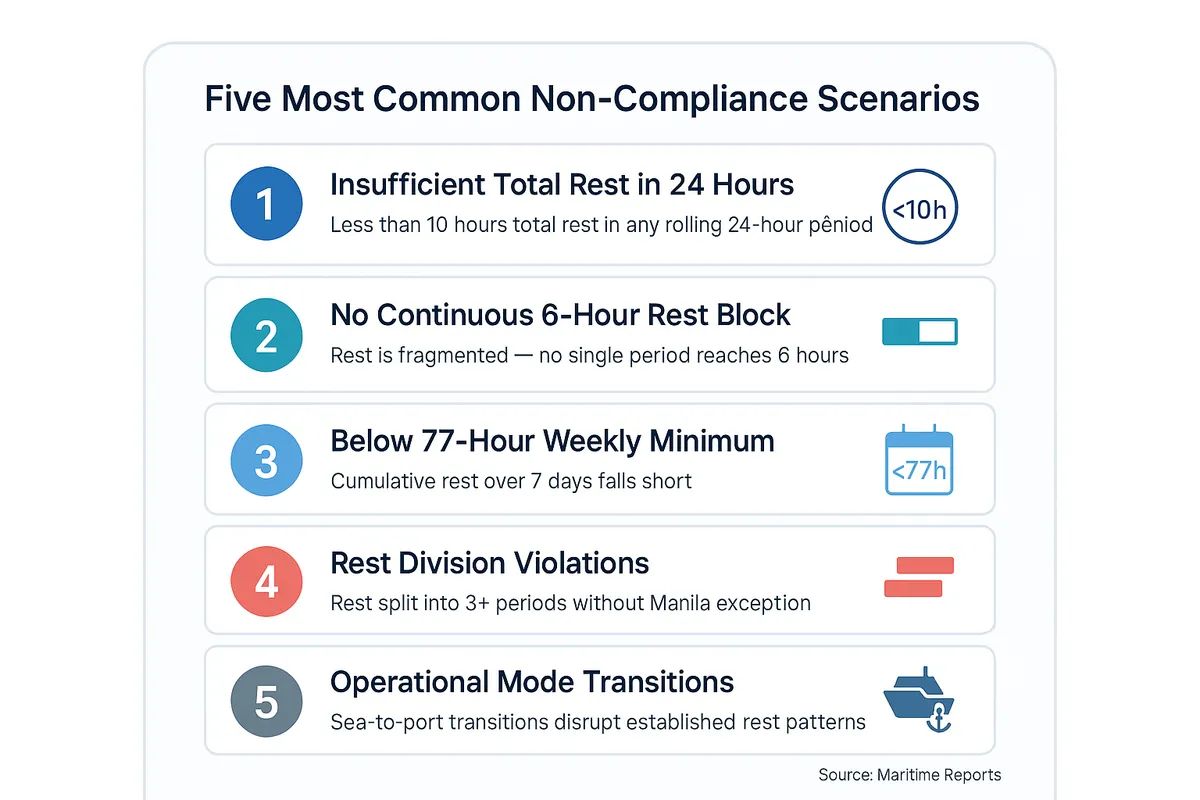
Based on regulatory guidance and industry experience, these are the five non-compliance scenarios that crew managers encounter most frequently.
1. Insufficient Total Rest in a 24-Hour Period
The most straightforward violation: a crew member receives less than 10 hours of total rest within a rolling 24-hour window. This typically happens during intense operational periods — port arrivals and departures, cargo loading and discharge, or emergency drills that run long.
A chief officer who stands a bridge watch from 0400 to 0800, supervises cargo operations from 0900 to 1700, and then returns for evening safety rounds may easily fall below the threshold.
The key word here is rolling. The 24-hour period is not fixed to midnight-to-midnight.
It is any consecutive 24-hour window, which means a violation at 0300 might only become apparent when you look back at the previous day's evening hours.
2. No Continuous 6-Hour Rest Block
Even if a seafarer's total rest exceeds 10 hours, the rest is non-compliant if none of the rest periods is at least 6 hours long. This violation is particularly insidious because it can happen when a crew member is technically "resting" for enough total hours but their rest is fragmented into short blocks by interruptions: unplanned drills, cargo monitoring checks, or being called to assist with mooring.
Sleep science confirms why this matters. A 6-hour continuous rest period allows a person to complete multiple sleep cycles, which is essential for cognitive recovery.
Fragmented rest — even if the minutes add up — does not provide the same restorative benefit.
3. Falling Below the 77-Hour Weekly Minimum
The weekly threshold is often the hardest to monitor because it requires looking at a rolling 7-day window. A crew member might be compliant on each individual day but still fall below 77 hours of total rest over the past seven days.
This happens gradually — a few extra hours of work each day compounds over the week.
Port-intensive schedules are the main culprit. A vessel calling at three ports in seven days, with each call requiring extended cargo operations and crew involvement in port security duties, can easily push weekly rest below the minimum without anyone realizing it until the records are reviewed.
4. Rest Division Violations
Under the standard STCW rule, rest in any 24-hour period may be divided into no more than two periods. If a crew member's rest is split into three or more segments — even if each segment is reasonably long — it constitutes a non-compliance unless the Manila Amendment exception applies and the conditions are met.
This is one of the violations that often goes unrecorded. A crew member who takes a short nap between tasks, then works, then rests again, then is called for an unplanned task, has effectively divided their rest into three or four periods. Without careful hour-by-hour recording, this pattern becomes invisible in the logs.
5. How Ship Operations Change the Equation
A vessel's operational mode — whether it is at sea, in port, or at anchorage — fundamentally changes work and rest patterns. At sea, watchkeeping schedules are relatively predictable: a 4-on-8-off or 6-on-6-off rotation provides a stable framework.
But the moment a vessel enters port, everything changes. Cargo operations, bunkering, provisions loading, port authority inspections, and crew changes all compete for the same crew members' time.
Anchorage presents its own challenges. While workload may be lower, crew must still maintain anchor watches and security patrols.
The unpredictability of port call timing — waiting days for a berth, then being told to shift at short notice — makes rest planning difficult.
The compliance rules do not change based on ship mode. Whether at sea, in port, or at anchorage, the same 10-hour, 6-hour, and 77-hour thresholds apply.
This means crew managers must plan schedules that account for the higher workload periods rather than hoping the numbers will work out.
The Compliance Gap Nobody Talks About
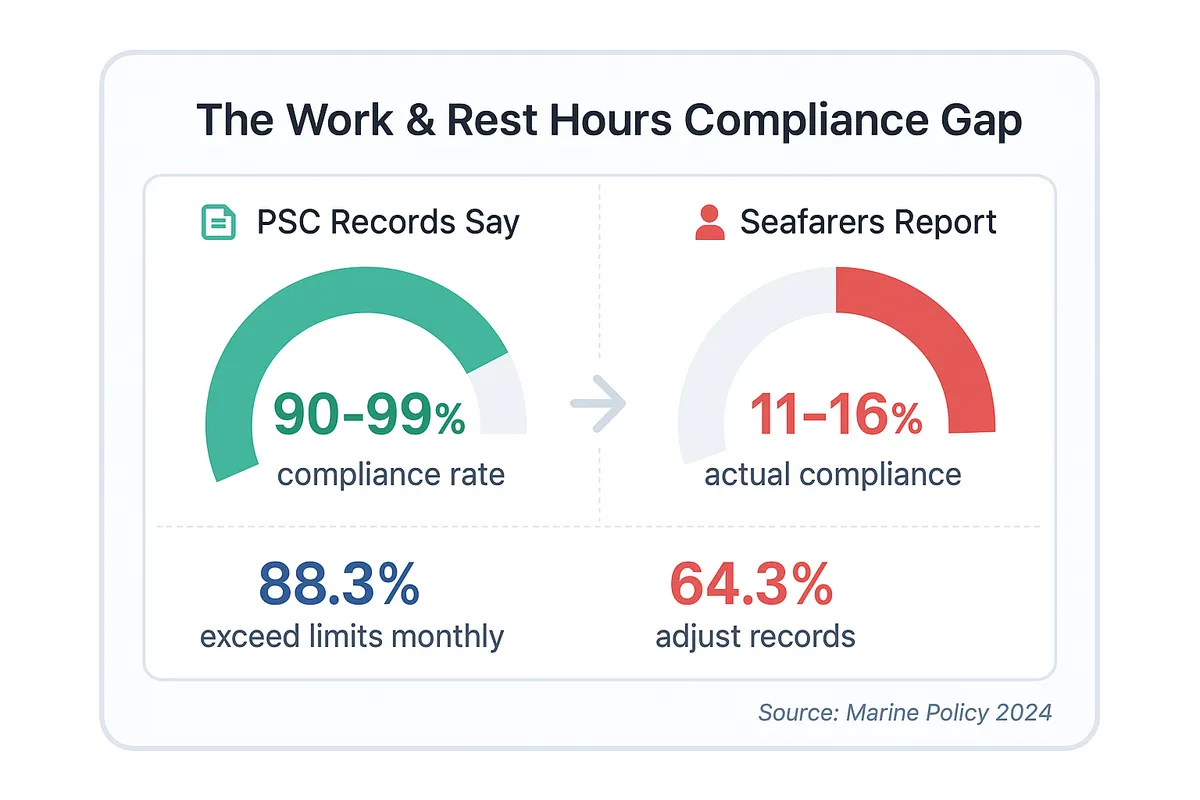
There is an uncomfortable truth that the maritime industry has started to confront more openly. A 2024 study published in Marine Policy found a stark gap between official compliance rates and reality.
While PSC inspection records show work and rest hours compliance rates between 90 and 99 percent, surveys of seafarers themselves reveal that only 11 to 16 percent report actually complying with the regulations consistently.
A three-year study covered by Splash 247 found that 88.3 percent of seafarers exceeded working time limits at least once a month, with 16.5 percent exceeding limits more than ten times monthly. Perhaps most concerning, 64.3 percent of seafarers reported adjusting their work and rest records to show compliance where none existed.
Why does this happen? Research into PSC enforcement weaknesses points to several factors.
Initial PSC inspections typically consist of simple document consultation — inspectors check that records exist and appear reasonable, but rarely cross-check entries against other ship records like deck logs, cargo logs, or engine room logs. PSC officers report that seafarers have become skilled at aligning records to appear compliant, making inconsistencies very difficult to detect.
This is not an indictment of seafarers. In many cases, the crew is caught between operational demands that make true compliance impossible and regulatory expectations that cannot be relaxed.
The real solution lies in addressing root causes — adequate manning levels, realistic port schedules, and tools that make honest recording easier than fabrication.
Best Practices for Managing Work and Rest Hours
Compliance starts with practical, day-to-day management decisions. These best practices are drawn from regulatory guidance and the experience of fleet operators who have reduced non-conformities across their vessels.
Designate Watchkeepers Clearly Every Month
STCW's rest hour requirements apply specifically to personnel assigned to watches and designated safety duties. Who qualifies as a watchkeeper can change month to month based on crew rotations, rank adjustments, and operational needs.
Establishing a clear, documented watchkeeper designation at the start of each month eliminates ambiguity about whose hours need to be monitored most closely.
This designation should not be a paperwork exercise. The chief officer and chief engineer should actively review whether the designated watchkeepers have realistic schedules that allow compliance, especially during planned port calls.
Use Schedule Templates for Standard Operations
Most vessels operate on predictable patterns. At sea, a standard 4-on-8-off watchkeeping rotation produces the same rest pattern every day.
In port, cargo operations follow a roughly similar rhythm. Creating pre-defined schedule templates for each operational mode — sea passage, port cargo operations, anchorage — gives crew a starting framework that is already compliant.
Templates do not eliminate the need for day-to-day adjustments, but they establish a compliant baseline. When deviations occur — an unplanned drill, an equipment breakdown, an extended cargo operation — they are recorded as exceptions against an otherwise compliant pattern, making non-conformities visible rather than hidden.
Record Remarks for Every Exception
Non-conformities will happen. Emergencies arise, port schedules shift, and unexpected work is a reality of life at sea.
The difference between a defensible record and a problematic one is context. When a crew member's rest falls below the minimum, the record should include a remark explaining why: what operation caused the deviation, why it could not be avoided, and what compensatory rest was provided.
PSC inspectors and vetting inspectors understand that occasional deviations are unavoidable. What raises flags is a pattern of violations with no explanatory context — it suggests either that nobody is monitoring the hours or that the records are being filled in retroactively.
Review Non-Conformity Reports Before Inspections
A proactive review cycle is one of the strongest signals of a well-managed vessel. Running a non-conformity report at the end of each month — listing every crew member who breached a rest hour threshold, the type of violation, and the number of occurrences — gives the master and the shore-based crew department a clear picture of compliance trends.
A work summary report that breaks down total hours worked versus hours worked in non-compliance — separately for watchkeepers and other crew — provides the breach percentage that OCIMF vetting inspectors specifically look for. If this percentage is trending upward, it is time to investigate root causes before the next inspection arrives.
How Digital Systems Are Changing Work and Rest Hour Compliance
The traditional approach to work and rest hours — paper logs filled in by hand at the end of each day or week — is fundamentally reactive. By the time someone reviews the records, the violations have already occurred and the records may not reflect what actually happened.
Modern ship management platforms like Navatom take a different approach by making compliance monitoring continuous and violations visible in real time.
In a digital system, each crew member's day is tracked in half-hour increments across all 24 hours. Work and rest periods are logged as they happen — either by the crew member or by the officer in charge — and the system validates each entry against the applicable compliance regime in real time.
If a cell turns red, the officer knows immediately that a threshold has been breached, not days later when someone reviews a paper form.
The ability to define operation templates — named, colour-coded activity types like "cargo watch", "engine room watch", or "safety drill" — means that scheduling becomes faster and more standardized. Combined with configurable compliance regimes (STCW, MLC, OCIMF, or custom company rules), the system adapts to different fleet requirements without requiring crew to understand the regulatory math themselves.
This crew management approach integrates rest hour tracking with the broader crew lifecycle — from assignment and embarkation to daily operations and monthly reporting.
Perhaps most importantly, digital systems make honest recording easier than falsification. When the system flags a violation automatically, there is no benefit to adjusting the record — the non-conformity is already documented with context.
This shifts the conversation from "did we comply?" to "why didn't we comply, and what do we do about it?" — which is exactly the question a good safety management system should be asking.
Key Takeaways
- Fatigue contributes to roughly 80 percent of maritime casualties. Work and rest hour compliance is a safety issue first, a regulatory issue second.
- STCW, MLC, and OCIMF all require a minimum of 10 hours rest in 24 hours, 6 hours continuous rest, and 77 hours in 7 days. When rules overlap, the stricter standard applies.
- The five most common violations — insufficient daily rest, no continuous 6-hour block, weekly shortfall, rest division breaches, and operational mode transitions — are all preventable with proper planning.
- Research shows a massive gap between official compliance rates (90-99 percent) and actual seafarer experience (11-16 percent). The industry is beginning to address this honestly.
- Monthly watchkeeper designation, schedule templates, contextual remarks, and regular non-conformity reviews are the four pillars of practical compliance.
- Digital work and rest hour systems make real-time validation possible, turning compliance from a retrospective paperwork exercise into a proactive safety tool.
If you are looking for a system that handles STCW, MLC, and OCIMF compliance out of the box, explore Navatom's Work and Rest Hours module or request a demo to see real-time validation in action.
Frequently Asked Questions
What happens if work and rest hour records show violations?
If a Port State Control inspector identifies work and rest hour violations, the outcome depends on severity. Isolated incidents with documented reasons (remarks) and evidence of compensatory rest typically result in an observation or minor deficiency.
Systemic violations — multiple crew members, multiple days, no corrective action — can lead to a detainable deficiency under the MLC. The vessel may be held in port until the company demonstrates corrective measures, which can take days.
Who is responsible for recording work and rest hours — the crew or the company?
Both. Under MLC Regulation 2.3, records must be maintained on board and signed by both the seafarer and the master (or an authorized officer).
The seafarer is responsible for accurately reporting their hours, and the master is responsible for reviewing, approving, and acting on the records. The company's shore-based management is responsible for providing the tools, manning levels, and schedules that make compliance achievable.
How do rest hour requirements differ between STCW and OCIMF?
The numerical thresholds are largely the same — 10 hours in 24, 6 continuous, 77 in 7 days. The difference is in scrutiny and expectations.
STCW sets the legal minimum and PSC checks for basic record compliance. OCIMF, through SIRE 2.0 and TMSA 3, expects a higher standard of fatigue management: demonstrated analysis of non-conformity trends, proactive schedule planning, and evidence that the safety management system genuinely addresses fatigue rather than just tracking hours.
Can rest be split into more than two periods in a day?
Yes, under the Manila Amendments exception. Rest may be divided into three periods provided one period is at least 6 hours, neither of the other two is shorter than 1 hour, and the exception is not used for more than two 24-hour periods in any 7-day window.
This is intended for exceptional circumstances like port operations or emergencies, not as a standard scheduling approach.
Are work and rest hour rules different for officers and ratings?
The rest hour minimums under STCW apply specifically to watchkeepers and personnel with designated safety duties — this includes officers in charge of watches and ratings forming part of a watch. However, MLC 2006 applies to all seafarers on board, regardless of rank or watchkeeping status.
In practice, this means every crew member's hours should be tracked, but watchkeepers face the most stringent monitoring requirements.