What Cloud Actually Means in Ship Management Software
Every maritime software vendor claims to be cloud-based. But the experience behind that label varies enormously -- from a browser you open anywhere to a server bolted to your vessel's deck. This guide helps fleet managers understand the difference and ask the right questions.
If you ask ten maritime software vendors whether their product is cloud-based, all ten will say yes. It has become table stakes -- the expected answer.
And yet, the daily experience of using these products can be remarkably different. In one case, you open a browser on any device and see live data from every vessel in your fleet.
In another, you are waiting hours for a data package to arrive from the ship, managing update schedules across dozens of separate installations, or troubleshooting a server that failed in the engine room.
This is not a criticism of any particular vendor. The maritime industry has unique constraints -- limited connectivity at sea, regulatory complexity, the sheer number of stakeholders involved in operating a vessel -- and different companies have approached these constraints in different ways over the past three decades.
But if you are evaluating ship management software today, or reconsidering the platform you already use, it is worth understanding what sits behind the label. Not all cloud is the same, and the differences affect your operations every single day.
Cloud Is a Spectrum, Not a Checkbox
The word 'cloud' has been stretched to cover a wide range of architectures. At one end, you have software that was designed for the cloud from its very first line of code -- where the entire system runs in a shared, centrally managed environment and every user accesses it through a web browser.
At the other end, you have software that was originally built as a desktop application twenty or thirty years ago, and has since been moved onto rented servers in a data centre. Technically, both are 'in the cloud.' Practically, they behave very differently.
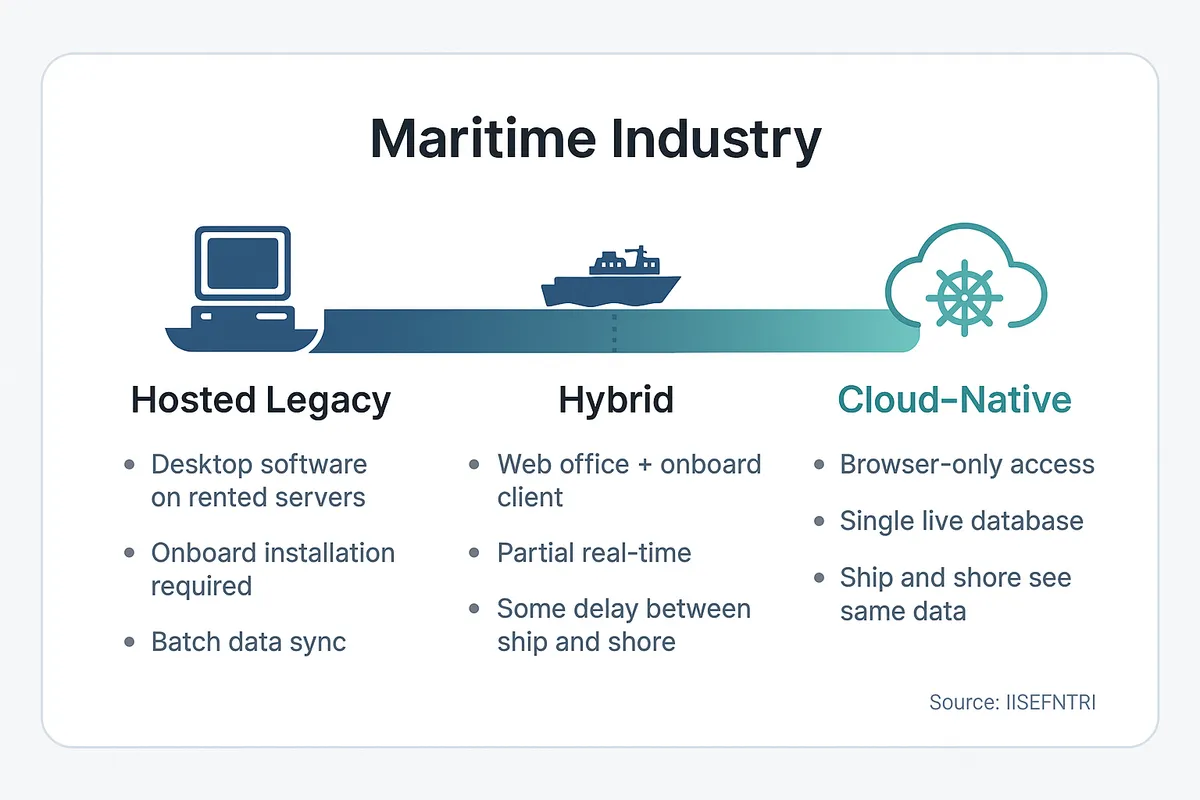
It may help to think of this as a spectrum with three broad categories:
Hosted legacy. The software was originally built for desktop computers and local networks.
It has been placed onto a virtual server in the cloud so that you no longer need to maintain the hardware yourself -- but its fundamental design has not changed. It still typically requires a local installation on each vessel, synchronises data in periodic batches, and may run a separate copy for each customer.
Hybrid. Some parts of the system run in the cloud, while others run locally on the vessel.
This is a common approach -- a web-based office application paired with a lightweight client or server on board. Data flows between the two, but there is always some delay.
The office and the vessel are not looking at the same information at the same moment.
Cloud-native. The system was designed from the ground up to run entirely in the cloud.
Ship and shore connect to the same central platform. There is one version of the software, one set of data, and every user sees the same thing. The vessel needs only a web browser.
None of these approaches is inherently wrong. Each reflects the technological reality of the era in which the product was first built.
But they produce very different day-to-day experiences, and it is important to understand which one you are buying.
What Matters for Your Daily Operations
Architecture is an engineering concern. But its consequences show up in very practical ways -- in how quickly you can act on information, how much time your team spends on administration, and how much you pay to keep the system running. Here are the areas where the differences are most visible.
Where Your Data Lives -- and How Fast It Moves
In a traditional setup, the vessel maintains its own database, and the shore office maintains a separate one. Periodically -- sometimes every few minutes, sometimes once or twice a day -- the two sides exchange data packages.
This is called batch synchronisation, and for decades it was the only realistic option because satellite bandwidth was expensive and unreliable.
That constraint is disappearing. Low-earth orbit satellite networks like Starlink have brought broadband-level connectivity to vessels at a fraction of historical costs.
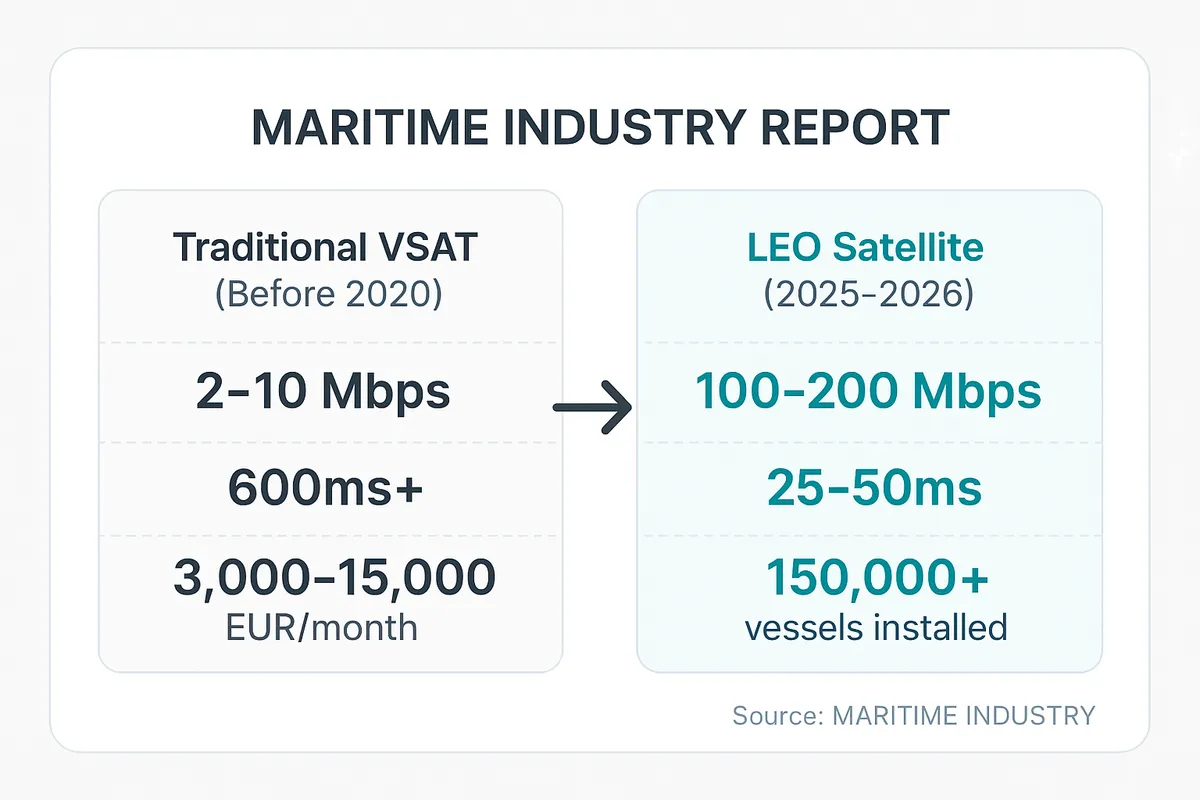
As of early 2026, over 150,000 maritime vessels have Starlink installed, with speeds of 100-200 Mbps and latency under 50 milliseconds -- a dramatic improvement over the 2-10 Mbps and 600-millisecond latency that traditional systems offered. The cost has dropped from thousands of euros per month to hundreds.
This changes the equation entirely. When the vessel has a reliable internet connection, there is no longer a technical reason to maintain two separate databases and synchronise them.
Ship and shore can work from the same data, in real time. A purchase requisition created on the bridge is visible in the procurement office immediately.
A completed maintenance job is recorded once and seen everywhere. There is no waiting, no syncing, no conflicting versions of the same record.
The practical consequence is significant. Research from OneOcean estimates that 25 percent of daily working time in fleet operations is spent requesting, searching for, and validating data -- time that largely evaporates when everyone works from the same live source.
What Happens on the Vessel
Many ship management systems require dedicated hardware on board -- a server, a workstation, or at least a locally installed application. This equipment needs to be maintained.
It needs power, cooling, and occasional physical attention. When it fails -- and hardware at sea does fail -- someone needs to troubleshoot it, often without IT support.
When the software vendor releases an update, that update needs to reach each vessel individually, which creates a period where different ships in the same fleet may be running different versions of the software.
A cloud-native platform removes this entirely. The vessel accesses the system through a web browser -- the same way you access your email or online banking.
There is nothing to install, nothing to maintain on board, and nothing that can fail independently of the rest of the system. The crew opens a browser, logs in, and they are working with the same application and the same data as the office.
A fair question at this point: what happens when the internet connection drops It is a valid concern, and it would be dishonest to pretend that satellite connectivity is perfect everywhere in the world. Modern web applications handle this through a technology called a progressive web app -- essentially, the application stores what it needs locally in the browser so that it continues to work during a connectivity gap.
When the connection returns, everything synchronises automatically. No separate server required. No manual intervention.
How Updates Reach Your Fleet
This is a subtle point that has large operational consequences. Some platforms run a separate copy of the software for each customer.
When the vendor builds a new feature or fixes a problem, they need to deploy that change to each copy individually. This can take weeks or months.
In the meantime, different customers -- and sometimes different vessels within the same fleet -- are running different versions.
In a true multi-tenant platform, there is one version of the software running for everyone. When an update is deployed, every customer has it immediately.
There are no version discrepancies, no waiting for your turn in the update queue, and no risk that a critical security patch reaches some users months after others.
For fleet managers, this also means that when you report an issue and the vendor fixes it, the fix is live for your entire fleet the same day. You do not need to coordinate a rollout across individual vessels or wait for a scheduled maintenance window.
Who Else Can Access the System
Ship management does not happen in isolation. Suppliers need to receive enquiries and submit quotations.
Crew members need to access their own records, contracts, and certifications. Inspectors and auditors may need to review documentation.
In a traditional model, these interactions happen outside the system -- through email, phone calls, and file attachments -- which creates friction, delays, and opportunities for error.
A cloud-native architecture makes it straightforward to offer dedicated access points for each type of user. A supplier can log in to their own portal to view purchase orders and submit quotes -- no email chain required.
A crew member can check their contract status or update their certification documents from their phone. These are not separate products; they are different views of the same underlying data, kept in sync automatically.
This kind of multi-portal approach is difficult to achieve when the system is built around separate installations for ship and shore. It becomes natural when everything runs from a single platform.
The ISM Code and Why Your Architecture Matters for Compliance
This is not purely a question of convenience. The ISM Code -- the International Safety Management Code, mandatory for all SOLAS vessels -- requires in Section 10 that companies establish procedures to ensure ships are maintained in conformity with regulations, that inspections are held at appropriate intervals, that non-conformities are reported, and that records of all these activities are maintained.
Section 11 further requires that all Safety Management System documentation is controlled: current, accessible, and free from obsolete versions.
When ship and shore are working from separate databases that sync periodically, there is always a window during which the records do not match. An inspection report completed on the vessel may not appear in the office system for hours.
A revised procedure issued from shore may not reach every ship immediately. These gaps create ISM compliance risk -- not because anyone acted wrongly, but because the architecture itself introduces delay between action and record.
A single-source-of-truth architecture -- where every user accesses the same live data -- eliminates this class of problem entirely. The record is the record, everywhere, at all times.
A Short Checklist for Your Next Vendor Conversation
You do not need to understand the engineering behind a platform to evaluate it effectively. You just need to ask the right questions.
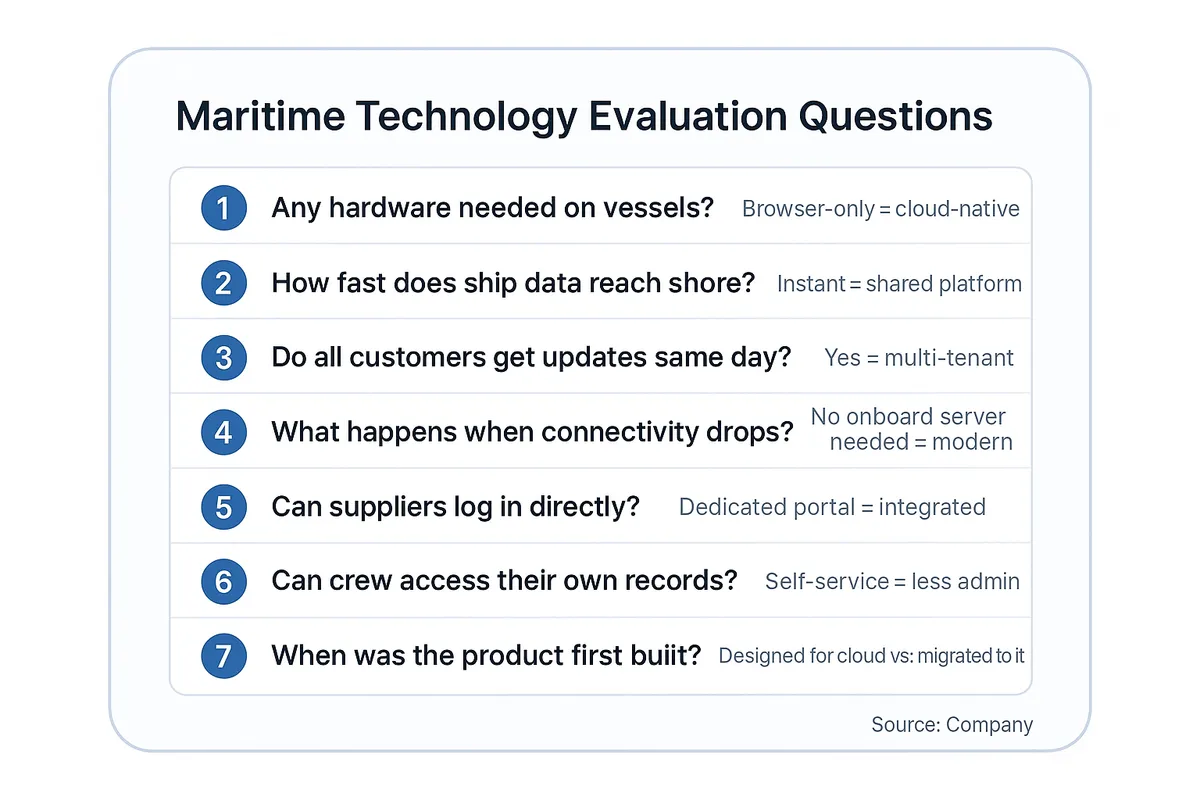
Here are seven that will tell you a great deal about what you are actually buying:
- Do we need to install any software or hardware on our vessels If the answer involves a server, a client application, or anything beyond a web browser, you are looking at a hybrid or legacy architecture.
- When someone on the ship creates a record, how long until the office can see it 'Instantly' and 'within five minutes' are very different answers. The first suggests a shared platform; the second suggests batch synchronisation.
- If you release an update, do all of your customers receive it on the same day If the answer is no, the vendor is likely running separate instances per customer, which means you may wait weeks or months for improvements.
- What happens when the vessel loses internet connectivity A well-designed cloud platform should continue working offline and synchronise gracefully when connectivity returns -- without requiring a dedicated onboard server.
- Can our suppliers log in and respond to RFQs directly If procurement still happens over email, the system is not truly integrated. A proper cloud platform should offer dedicated supplier access.
- Can our crew members access their own records and documents Self-service portals for crew reduce administrative overhead significantly and improve data accuracy -- a seafarer updating their own certification is more reliable than an office clerk re-entering it from a scan.
- When was the core product originally built, and has it been redesigned for the cloud or migrated to it There is no shame in a long heritage, but it is worth understanding whether the platform was designed for the way connectivity works today or adapted from an era when it worked very differently.
The answers to these questions will not appear in a brochure. But they will tell you far more about your future experience with a platform than any feature list.
Why We Built Navatom the Way We Did
I should be transparent about our perspective here. I am one of the co-founders of Navatom, and we made a deliberate decision more than ten years ago to build a cloud-native platform from the ground up -- not to migrate an existing product.
We did this because we saw the trajectory of maritime connectivity early. We believed -- and events have confirmed -- that vessels would gain reliable, affordable internet access, and that the traditional model of onboard servers and batch synchronisation would become unnecessary overhead rather than a necessary compromise.
We wanted to build for where the industry was heading, not where it had been.
The result is a platform where ship and shore genuinely work from the same live data. Where thirty-plus modules -- maintenance, procurement, inventory, safety, crew, certificates, inspections -- all share one source of truth.
Where suppliers and crew have their own dedicated portals. Where every customer is always on the latest version, because there is only one version to be on.
To give a concrete example: when a chief engineer completes a planned maintenance job on board, that record exists in the system immediately. The superintendent sees it.
The next audit can reference it. There is no 'sync pending' status, no possibility that the ship's records and the office's records will contradict each other during an inspection.
That is not a feature we added -- it is a consequence of the architecture we chose at the beginning.
We also designed the platform so that vessels need nothing more than a web browser. If the internet connection drops -- and it does, especially in certain ocean regions -- the application continues to function locally and reconciles when connectivity returns.
No server on board. No IT maintenance at sea. No hardware to fail.
I mention this not to suggest that our approach is the only valid one, but because I think it is helpful to understand the reasoning behind the architectural choices -- and because I believe the industry is moving in this direction regardless. The question is not whether maritime software will be fully cloud-native. It is when.
The Bigger Picture: Connectivity Is Changing Everything
The shift toward cloud-native maritime software is not a trend driven by software vendors. It is driven by a fundamental change in the operating environment.
According to Mordor Intelligence, cloud-based solutions already account for over 55 percent of total marine management software deployments as of 2024, and the segment is growing at a compound annual rate of more than 15 percent. The maritime software market overall is projected to grow from approximately 2 billion dollars in 2024 to nearly 5 billion by 2033.
The regulatory environment is moving in the same direction. BIMCO has formally advocated to the IMO for a comprehensive strategy on maritime digitalisation, citing the potential for electronic reporting, data harmonisation, and improved information exchange between ships and ports.
The IMO's Maritime Single Window requirement, mandatory since January 2024, is an early signal of where regulatory expectations are heading -- toward real-time, standardised, electronic data exchange rather than manual, paper-based processes.
For fleet operators, this means that the architecture of your ship management platform is not just an IT decision. It is a strategic one.
A platform that is designed for real-time data exchange will be better positioned to meet future regulatory requirements than one that was designed around batch synchronisation and local installations. The gap between these two approaches will only widen as regulations demand more granular, more timely, and more verifiable data from every vessel.
Key Takeaways
- "Cloud" in maritime software covers a wide range of architectures -- from rehosted legacy applications to genuinely cloud-native platforms. The label alone tells you very little.
- The most important practical differences are: whether you need hardware on your vessels, whether ship and shore share the same live data, whether all customers receive updates simultaneously, and whether external stakeholders like suppliers and crew can access the system.
- Maritime connectivity has improved dramatically. Low-earth orbit satellite networks now deliver broadband speeds to vessels at affordable prices, making cloud-native architectures practical where they once were not.
- ISM Code Sections 10 and 11 require that maintenance records and safety documentation are current and accessible. A single-source-of-truth architecture inherently supports this requirement in a way that batch synchronisation does not.
- Regulatory expectations are moving toward real-time, electronic data exchange. The architecture you choose today will determine how easily you can meet tomorrow's requirements.
- Ask your vendor the seven questions in the checklist above. The answers will reveal far more than any marketing material.
Frequently Asked Questions
Is cloud ship management software secure enough for sensitive fleet data
Yes -- and in most cases, more secure than an onboard server. Enterprise cloud platforms are maintained by dedicated security teams, receive continuous updates, and undergo regular third-party audits.
An onboard server, by contrast, is physically accessible, often updated infrequently, and managed by crew whose primary job is not IT. The assumption that keeping data on a local server is inherently safer is understandable, but it does not reflect the reality of modern security practices.
We operate in areas with very poor satellite coverage. Can a cloud platform work for us
It depends on the platform. A well-designed cloud platform will include offline capability -- allowing crew to continue working normally during connectivity gaps, with automatic synchronisation when the connection returns.
You should ask specifically how the platform behaves when the internet is unavailable and for how long it can operate independently. If the answer requires a dedicated onboard server, you are looking at a hybrid rather than a cloud-native solution.
What does "multi-tenant" mean, and why should I care
In a multi-tenant platform, all customers share the same running system -- though their data is kept strictly separate and private. This means the vendor maintains one version of the software, deploys updates once, and every customer benefits simultaneously.
In a single-tenant setup, each customer has their own isolated copy, which means updates are slower and the vendor's attention is divided across many separate installations. For you as a fleet operator, multi-tenancy means faster access to new features, faster bug fixes, and a more consistent experience. You can learn more about this in our maritime SaaS glossary entry.