Maritime Compliance Automation: What Comes After Digitization
Digitization moved maritime compliance from paper to screens. Automation moves it from human effort to system intelligence. Here is what that shift looks like across EU ETS, FuelEU, SIRE 2.0, MLC, and a dozen other obligations arriving in the same two-year window.
A superintendent at a mid-size tanker company recently told me that his compliance officers spend more time preparing for audits than his engineers spend on actual maintenance. He was not exaggerating.
Between EU ETS reporting, FuelEU Maritime verification, CII calculations, SIRE 2.0 questionnaires, MLC work-and-rest-hour records, MARPOL electronic logbooks, and the IMO Maritime Single Window — all arriving or tightening within the same two-year window — the compliance workload per vessel has grown faster than any fleet's back office can absorb.
Most shipping companies responded to the previous wave of regulation by digitizing their paperwork. They moved from binders to PDFs, from logbooks to spreadsheets, from fax machines to email.
That was necessary, and it helped. But digitization is not automation.
A spreadsheet that calculates your CII score is digital. A system that ingests voyage data, calculates the score continuously, flags when you are trending toward a D rating, and suggests operational adjustments — that is automated.
The difference matters, because the regulatory pile-up of 2025 and 2026 has made the manual approach — even the digitized manual approach — unsustainable.
This article maps the shift from compliance digitization to compliance automation: what it means in practice, where it matters most, and how to evaluate whether your fleet is ready for it.
Three Waves of Maritime Compliance
The way shipping companies handle compliance has evolved in three distinct phases, and understanding where you stand today determines what you need to do next.
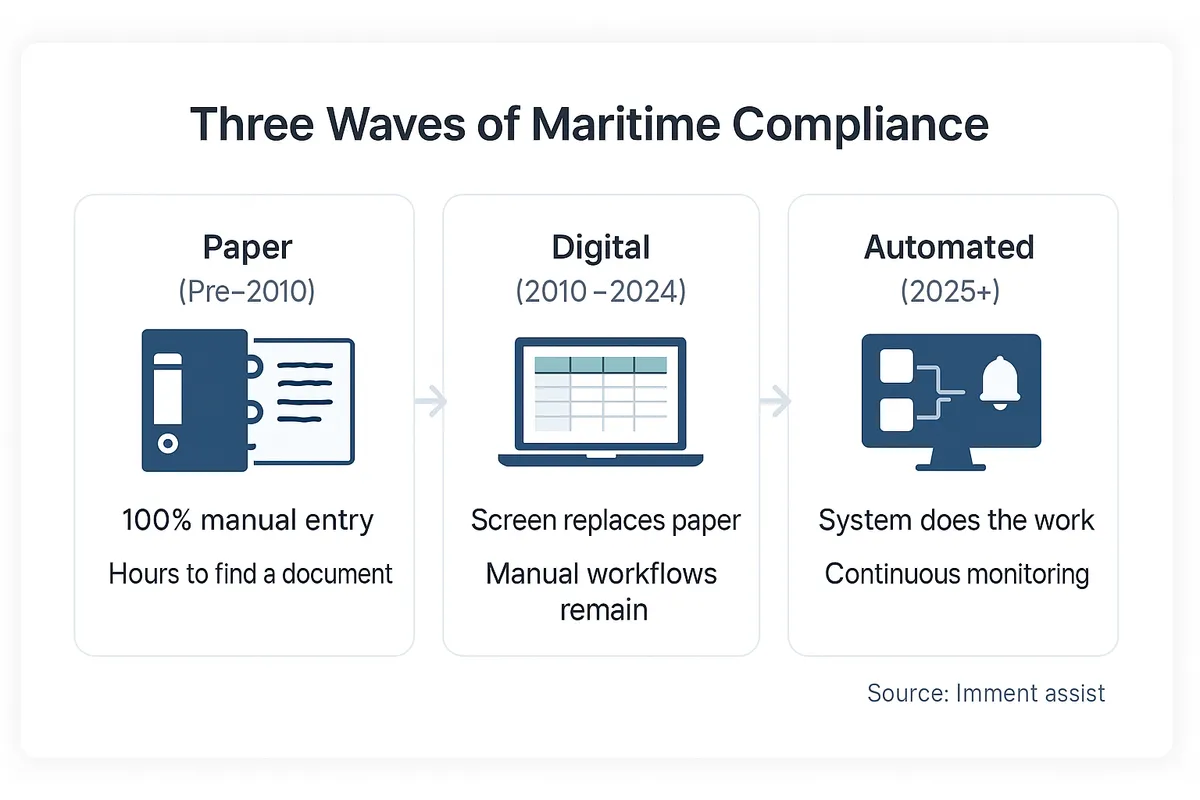
Paper (Pre-2010)
Compliance meant physical binders. The Oil Record Book was handwritten.
Certificates were filed in the master's cabin. Audit preparation involved the chief officer spending days pulling documents from ring binders and photocopying them for the inspector.
The system worked — barely — because the regulatory load was smaller and inspectors expected paper.
Digital (2010–2024)
The ISM Code had been in force since 2002, and by 2010 most serious operators had some form of electronic document management. Safety management systems moved to shared drives or early web applications.
Planned maintenance schedules became digital. Crew certificates were tracked in databases rather than Excel files.
This was a genuine improvement. Finding a document took minutes instead of hours.
Certificates could be filtered by expiry date. Maintenance records were searchable.
But the underlying workflows remained manual. Someone still had to enter the data.
Someone still had to check whether the work-and-rest-hour records added up. Someone still had to compile the quarterly emissions report from noon reports and bunker delivery notes. Digital meant the medium changed; the process did not.
Automated (2025 Onward)
Automation means the system does the work, not just stores the result. An automated compliance workflow has three characteristics:
- Data is captured at the source — from sensors, from operational inputs, from voyage events — without requiring a separate compliance entry.
- Rules are applied continuously — the system knows what each regulation requires and checks against those requirements in real time.
- Exceptions trigger action — when something is out of compliance or trending toward non-compliance, the system notifies the right person before it becomes a finding.
The distinction matters because the regulatory environment of 2026 has made the second wave — digital but manual — insufficient.
The Regulatory Pile-Up
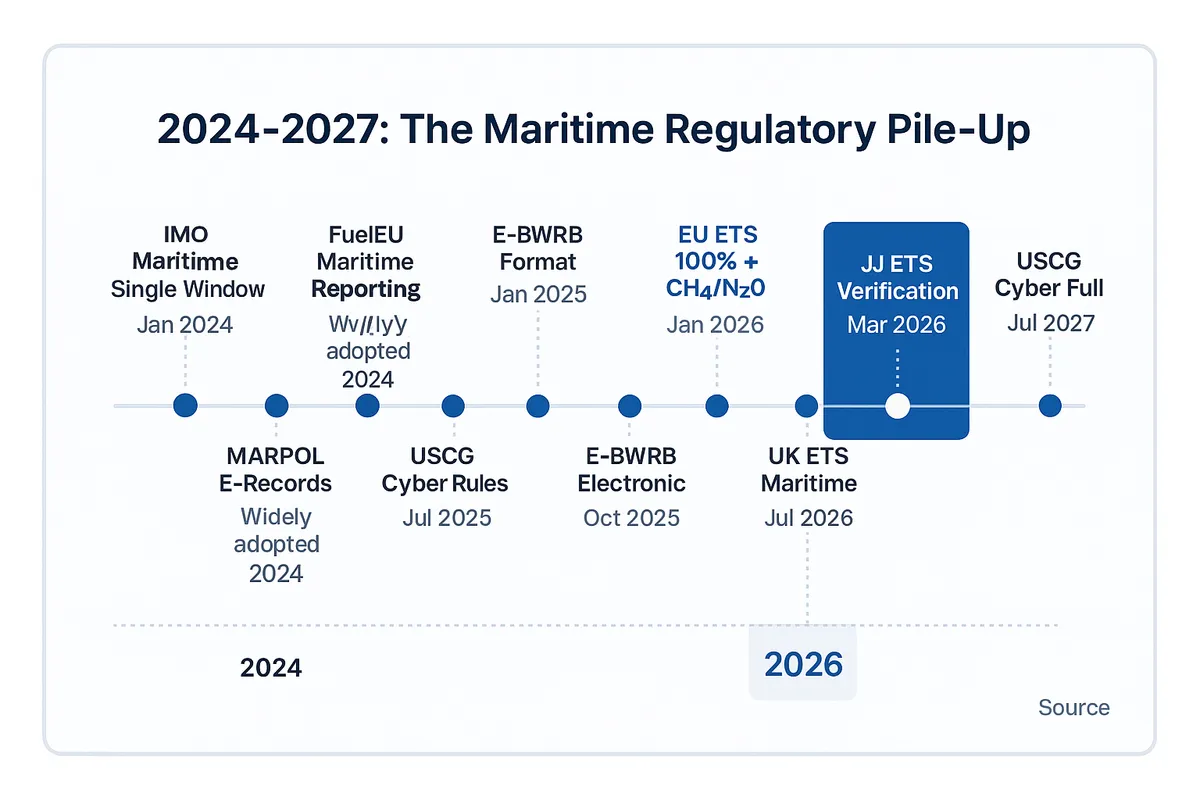
If you operate internationally flagged vessels in 2026, your compliance obligations have expanded dramatically in the past 18 months. Here is what landed, roughly in order.
IMO Maritime Single Window (mandatory since January 1, 2024): All member states must accept ship arrival and departure data through a centralized digital platform. One submission, distributed to the correct authorities.
This replaced the old system of submitting the same information separately to customs, immigration, port health, and the harbourmaster. The IMO FAL Convention amendments underpin this requirement.
MARPOL Electronic Record Books (available since October 2020, now widely adopted): Oil Record Books, Cargo Record Books, Garbage Record Books, and Annex VI air pollution records can be maintained electronically. Flag states must approve the system under IMO Resolution MEPC.312(74).
Electronic record books introduce automatic revision tracking and tamper detection — but the system must comply with stricter data integrity standards than paper ever did.
Electronic Ballast Water Record Book (mandatory format from February 2025, electronic option effective October 2025): Under IMO Resolution MEPC.372(80), the BWRB format was updated and the electronic alternative formalized. In US waters, the Ballast Water Management Report must be submitted to the National Ballast Information Clearinghouse within six hours of arrival.
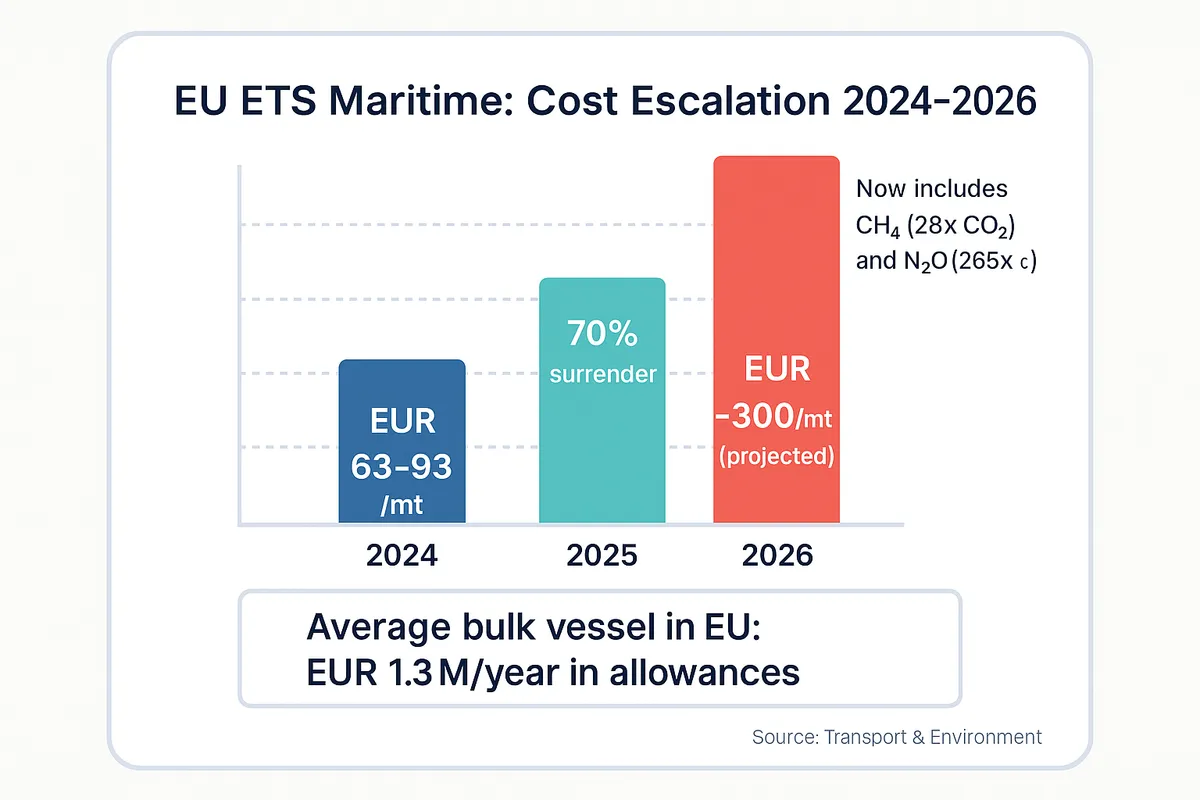
EU ETS — 100% Compliance (from January 2026): After a phase-in at 40% in 2024 and 70% in 2025, maritime transport now faces full allowance surrender. And for the first time, methane and nitrous oxide are in scope.
Methane's global warming potential is 28 times that of CO₂; nitrous oxide is 265 times. LNG-powered vessels, once seen as the cleaner option, now face significant compliance costs from methane slip. Reporting happens through EMSA's THETIS-MRV platform.
FuelEU Maritime (reporting since January 2025, first verifier assessment by March 31, 2026): Requires progressive reduction in the greenhouse gas intensity of marine fuels. Compliance involves well-to-wake calculations — tracking emissions not just from combustion but from the production and transport of the fuel. A compliance balance must be maintained and verified annually.
UK ETS Maritime Expansion (effective July 1, 2026): The UK's own emissions trading scheme extends to maritime transport for vessels above 5,000 gross tonnage. This is separate from the EU ETS and creates a parallel reporting obligation for vessels trading in UK waters.
USCG Maritime Cybersecurity (effective July 2025, training deadline January 2026, full compliance by July 2027): The US Coast Guard's MTSA Cyber Regulations require documented cybersecurity risk assessments and training for personnel at maritime facilities and on vessels operating in US waters.
Each of these regulations has its own reporting format, its own deadline cycle, and its own enforcement mechanism. Some overlap — EU ETS and FuelEU Maritime both require fuel consumption data, but they measure different things.
Some are region-specific — UK ETS applies only to UK voyages, EU ETS to EU port calls. And they arrive on top of the baseline ISM, SOLAS, STCW, and MLC obligations that were already there.
The cumulative effect is this: a vessel trading between Europe and the UK now has more than a dozen distinct compliance reporting obligations, each with its own data requirements and submission deadlines. No superintendent can track all of this in spreadsheets.
Five Compliance Domains Where Automation Changes Everything
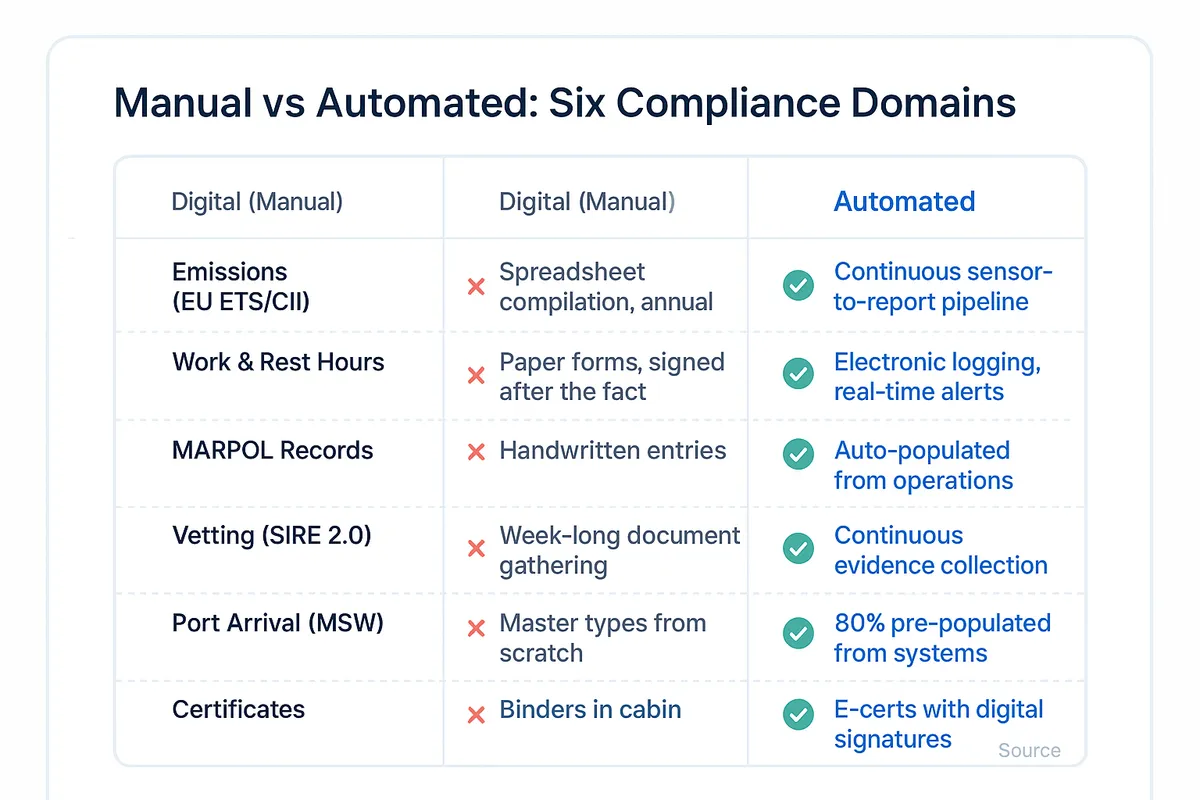
Not every compliance task benefits equally from automation. Here are the five areas where the difference between a digital process and an automated one is most consequential.
Emissions Reporting — EU ETS, MRV, FuelEU, CII
This is where automation has the most obvious payoff. The manual process involves collecting noon reports, bunker delivery notes, and voyage logs, then compiling them into the correct format for each regulation.
For EU ETS alone, operating an average bulk vessel within EU jurisdiction under full 2026 rules costs approximately EUR 1.3 million annually in allowances. Getting the calculation wrong is expensive.
An automated system ingests fuel consumption data — ideally from flow meters or engine monitoring, not manual logs — applies the correct emission factors, and produces the required reports for MRV, EU ETS, and CII simultaneously from the same data set. It tracks your CII rating continuously, not once a year, so you know by March whether you are trending toward a D rating by December.
The key advantage is not speed — it is consistency. Manual compilation introduces transcription errors, unit conversion mistakes, and timing discrepancies.
Automated pipelines eliminate these. NAPA ran a pilot with ClassNK covering 1,500 vessels before launching its FuelEU compliance tool — and the primary benefit cited was not faster reporting but more reliable data.
Work and Rest Hours — The 64 Percent Problem
This is the most uncomfortable example of why digitization alone is not enough. MLC 2006 requires a minimum of 10 hours of rest in any 24-hour period and 77 hours in any 7-day period.
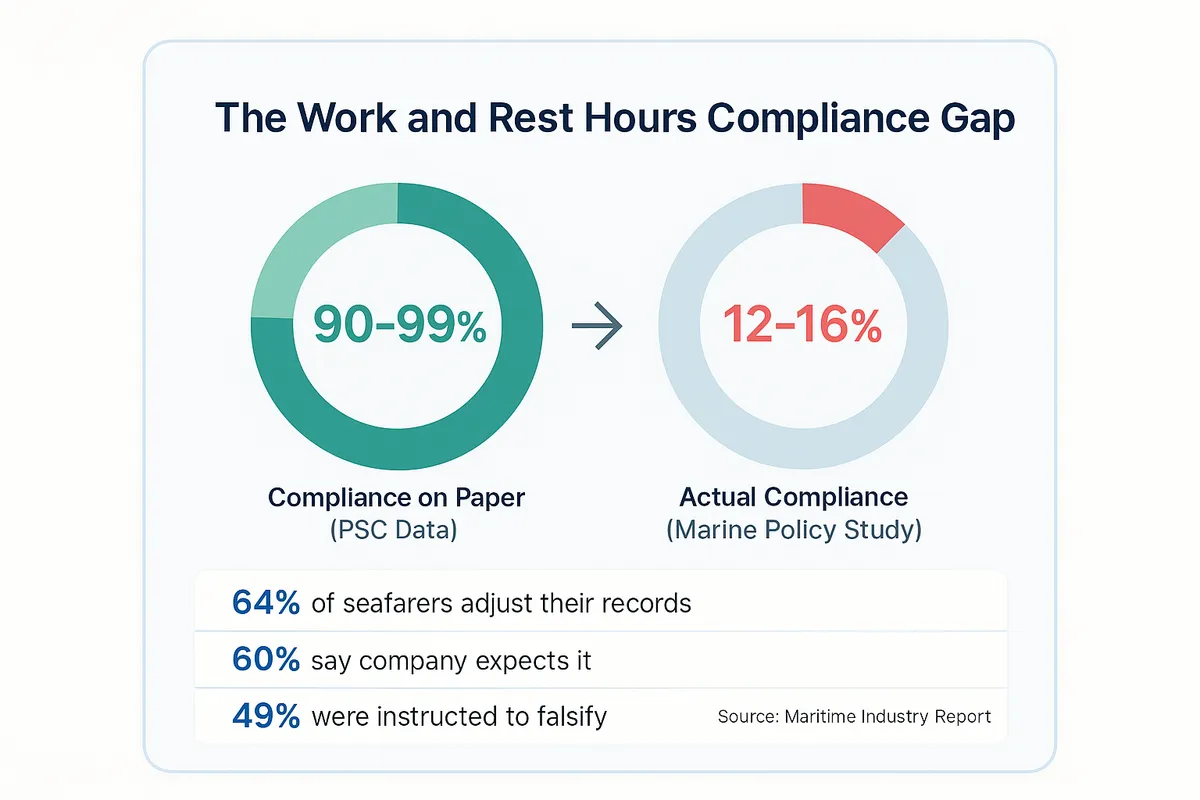
Records must be maintained on board for at least 12 months. On paper, compliance rates are excellent — port state control data shows 90 to 99 percent compliance.
But a three-year study published in Marine Policy found that actual compliance is between 11.7 and 16.1 percent. Sixty-four percent of seafarers reported adjusting their work-and-rest-hour records.
Sixty percent said their company expected them to do so. Forty-nine percent said they were explicitly instructed to falsify records.
This is not a technology problem in the conventional sense — it is a systemic one. But automated monitoring makes falsification harder.
When rest hours are logged through electronic systems that record start and stop times from logins, badge swipes, or bridge activity, rather than handwritten after the fact, the gap between paper compliance and actual compliance narrows. The researchers recommended that all vessels adopt electronic monitoring systems, precisely because digital systems are more difficult to manipulate than paper forms.
Electronic Record Books — MARPOL
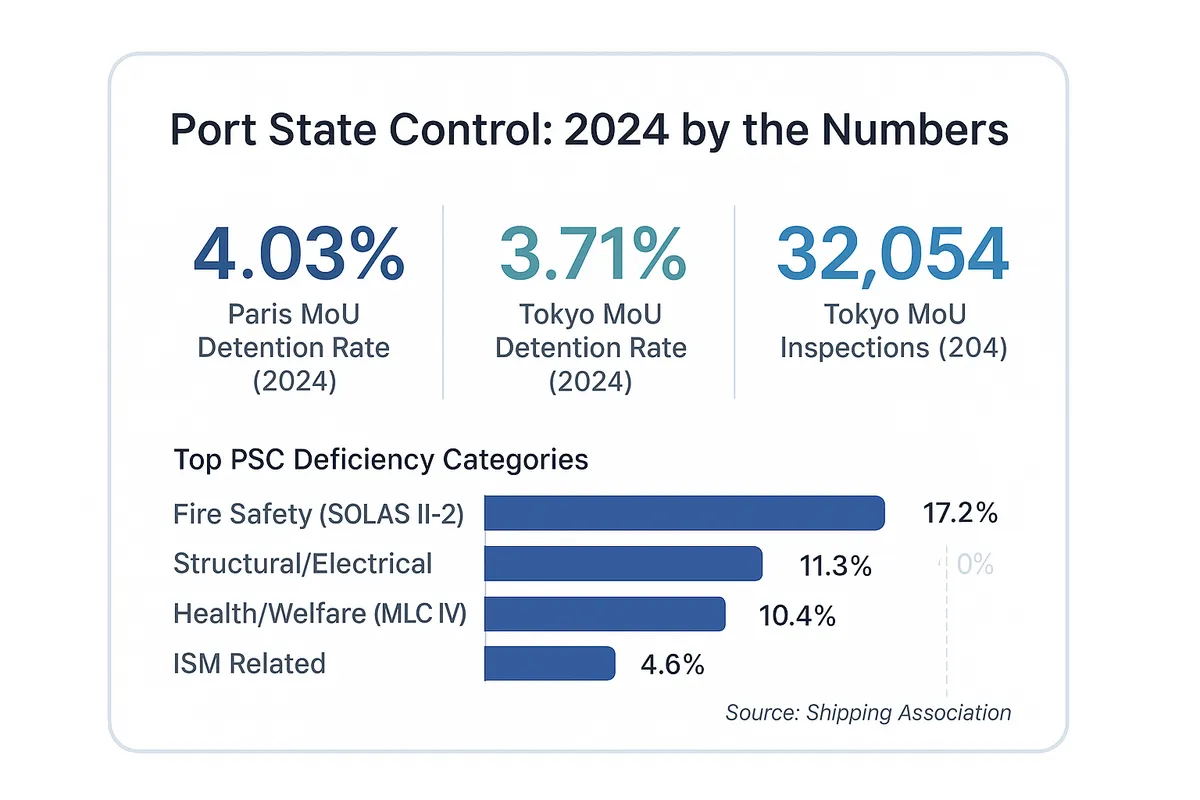
The Oil Record Book, the Garbage Record Book, and the Cargo Record Book are among the most-inspected documents in port state control. The 2024 Paris MoU annual report showed a detention rate of 4.03 percent, with fire safety (17.2%), structural and electrical deficiencies (11.3%), and crew health and welfare (10.4%) topping the list.
ISM-related deficiencies accounted for 4.6 percent. Record books are central to many of these findings.
The move to electronic record books under MEPC.312(74) does not just replace paper with screens — it introduces automatic revision tracking, role-based access control, and tamper detection. But the automation opportunity goes further.
An integrated system can pre-populate entries based on operational events. When the engine room reports a bilge water discharge, the system can auto-draft the ORB entry with the correct time, position, quantity, and method — leaving the officer to review and confirm rather than write from scratch. This reduces both the time burden and the error rate.
Vetting and Inspection — SIRE 2.0 and TMSA
SIRE 2.0 replaced the old static inspection questionnaire with an algorithm-generated Compiled Vessel Inspection Questionnaire (CVIQ) tailored to each vessel's type, cargo, and voyage profile. Questions are divided into core, rotational, campaign, and conditional categories.
Inspections are conducted digitally on intrinsically safe tablets with real-time photo capture. Over the past 12 months, OCIMF has processed more than 22,500 reports across 8,000 vessels — roughly 2.8 inspections per vessel per year.
The shift to risk-based, data-driven inspection means that operators who maintain their compliance evidence continuously perform significantly better than those who scramble before each inspection.
TMSA — used by over 90 percent of tanker operators — follows a similar pattern. The 13 management elements across 4 performance levels require sustained evidence of practice, not a one-time document dump.
Automated evidence collection from operational systems — maintenance completions feeding into Element 7, rest-hour records into Element 3, audit findings into Element 12 — turns TMSA from a quarterly exercise into a running score.
Port Arrival — Maritime Single Window
The IMO Maritime Single Window, mandatory since January 2024, requires one digital submission per port call that is distributed to all relevant authorities. This sounds simple, but the data requirements span cargo manifests, crew lists, health declarations, waste notifications, security information, and certificate status.
The automation advantage here is in pre-population. A well-integrated system already has the vessel's particulars, crew list, certificate status, and waste quantities.
It should be able to generate 80 percent of the MSW submission from existing data, leaving the master to confirm the port-specific details rather than type everything from scratch.
The Classification Societies Are Moving Too
It is not only flag state and port state compliance that is being automated. Classification societies — the organizations that survey and certify vessel structure and machinery — are also shifting toward digital and remote processes.
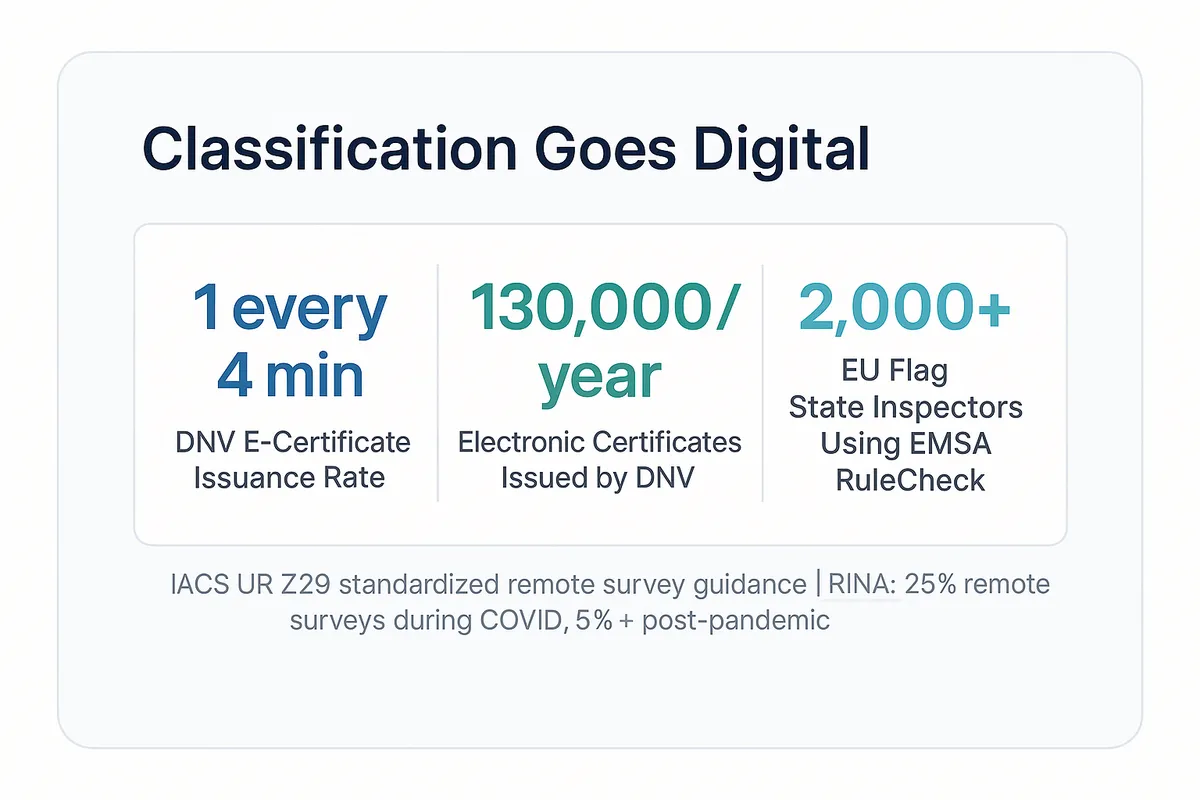
DNV now issues an electronic certificate every four minutes — more than 350 per day and 130,000 per year. These carry digital signatures and unique tracking numbers.
DNV was the first classification society to achieve full-scale e-certificate production, and the direction of travel is clear: paper certificates will eventually be the exception.
IACS issued Unified Requirement UR Z29, providing standardized guidance on remote surveys. During COVID, RINA conducted approximately 25 percent of surveys remotely.
Post-pandemic, the share has settled above 5 percent — a permanent shift. Remote and hybrid survey options are now available from most major class societies, with the surveyor reviewing real-time video, photos, and measurement data transmitted from on board.
EMSA has given more than 2,000 flag state inspectors across EU member states access to its RuleCheck system, which automatically filters applicable requirements by ship type, construction date, and size, generating customizable inspection checklists. And the Continuous Survey of Machinery approach distributes special survey requirements over five years instead of concentrating them in a single drydocking period — approximately 20 percent of machinery items are surveyed each year.
The common thread is the same: the classification world is moving from periodic, event-driven compliance checks to continuous, data-driven assurance.
A Checklist for Your Next Fleet Meeting
If you are evaluating how ready your fleet is for automated compliance, these are the questions worth asking. I use a similar list when reviewing our own product roadmap at Navatom, and I have found that the honest answers are more revealing than any vendor demo.
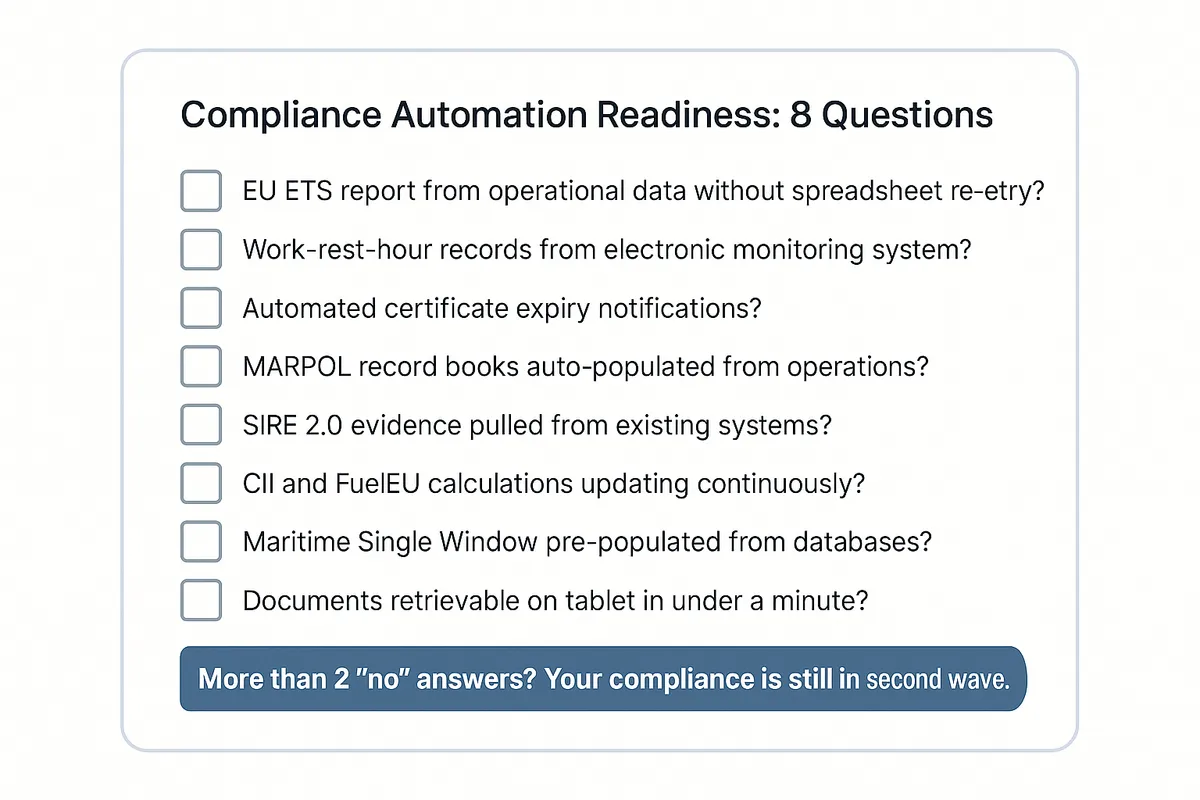
- Can your system produce an EU ETS emissions report from operational data without anyone re-entering figures from a spreadsheet?
- Are your work-and-rest-hour records generated from an electronic monitoring system, or are they still filled in after the fact?
- When a certificate expires in 60 days, does the responsible person receive an automated notification — or does someone check a spreadsheet monthly?
- Can your MARPOL record books auto-populate entries from operational events — discharges, garbage disposals, fuel changeovers?
- When preparing for a SIRE 2.0 inspection, can you pull the evidence for each CVIQ question from your existing systems — or does someone spend a week gathering documents?
- Do your CII and FuelEU calculations update continuously, or are they compiled annually?
- Is your Maritime Single Window submission pre-populated from your voyage, crew, and certificate databases — or does the master type it fresh each time?
- When a port state control inspector asks for a document, can your crew retrieve it on a tablet in under a minute?
If you answered no to more than two of these, your compliance process is still in the second wave — digital but manual. That was adequate five years ago. It is becoming a liability.
How We Approach Compliance at Navatom
I should be transparent: I am the project lead at Navatom, and we build ship management software. So I have a perspective on this that is shaped by the product decisions we make every day.
When we designed Navatom's compliance capabilities, we made a specific architectural choice: compliance data should not live in a separate module. It should be a layer across every operational process.
When a maintenance job is completed, that completion simultaneously feeds the PMS record, the ISM evidence trail, and the TMSA Element 7 documentation. When a crew member logs their watch hours, that entry feeds both the MLC work-and-rest-hour record and the STCW compliance check.
When fuel is bunkered, the data feeds the EU ETS report, the MRV submission, the CII calculator, and the FuelEU intensity tracking — all from one entry.
This is what I mean by automation versus digitization. We did not build a system where you enter data into the operational module and then re-enter it into the compliance module. We built a system where the operational data is the compliance data.
The practical result: when a superintendent opens the compliance dashboard, they are not looking at a status report compiled last week. They are looking at the current state — which certificates expire soon, which vessels are trending toward CII problems, which crew members are approaching rest-hour thresholds, which record books have gaps. And the system has already sent alerts to the relevant people.
I mention this not because our approach is the only valid one — there are good compliance-focused platforms that take a different architectural path. But I believe the integrated approach is where the industry is heading, because the regulatory environment no longer tolerates the delays and inconsistencies that come from moving data between separate systems.
The Bigger Picture
A recent industry report estimated that 80 to 95 percent of previously manual compliance work can now be automated at minimal cost. The Maritime Executive described 2026 as the year the industry shifts from digitizing paperwork to automating work.
The Thetius research group found that despite significant investment in digital tools, many shipping companies still rely on email and spreadsheets for critical compliance workflows.
There is no single vendor that solves every compliance requirement for every vessel type in every trading pattern. The regulatory landscape is too complex and too fast-moving for that.
But the direction is clear: the companies that treat compliance as an integrated, automated function of their operational systems — rather than a separate administrative burden — will spend less time on paperwork, face fewer deficiencies at inspection, and adapt faster when the next regulation arrives.
And it will arrive. The IMO Net-Zero Framework, adopted in preliminary form at MEPC 83, will introduce a goal-based marine fuel standard and a greenhouse gas pricing mechanism.
MEPC 84 in May 2026 will advance the implementation guidelines. UK ETS Maritime launches in July 2026. The regulatory pile-up is not slowing down.
The question for fleet managers is not whether to automate compliance. It is how quickly they can move from the second wave to the third.
Key Takeaways
- Digitization (paper to screen) was necessary but is no longer sufficient. Automation (system does the work) is the next step.
- The 2025–2026 regulatory pile-up — EU ETS at 100%, FuelEU Maritime, UK ETS, MARPOL e-records, BWM electronic logbooks, IMO Maritime Single Window — has made manual compliance unsustainable for international fleets.
- Work-and-rest-hour compliance is the starkest example: 90–99% on paper, 11–16% in reality. Electronic monitoring is the only credible path to actual compliance.
- Classification societies are shifting to electronic certificates, remote surveys, and continuous assurance — the audit world is going digital faster than many operators.
- The most effective approach integrates compliance into operational workflows rather than treating it as a separate reporting exercise.
- Evaluate your fleet against the eight-question checklist: if you answer no more than twice, your compliance architecture needs attention.
- The regulatory pace is accelerating, not slowing. Building automated compliance infrastructure now is preparation, not premature investment.
Frequently Asked Questions
Is compliance automation only relevant for large fleets?
No. In fact, smaller fleets often benefit more because they have fewer shore-based staff to absorb the administrative burden.
A five-vessel company without automated compliance typically relies on one or two superintendents to handle everything — maintenance, crew, procurement, and compliance. Automating the compliance layer frees those people to focus on operational decisions rather than data entry. Cloud-based platforms have made this accessible without large upfront infrastructure investments.
Do port state control inspectors accept electronic record books?
Yes. Since October 2020, MARPOL has allowed electronic record books as a replacement for paper, provided the system is approved by the flag state under IMO Resolution MEPC.312(74).
Electronic records must meet specific data integrity standards including automatic revision tracking, role-based access control, and data recovery capabilities. Most major flag states now accept electronic ORBs, GRBs, and CRBs.
The practical benefit during inspection is immediate retrieval — the inspector can see any entry within seconds, rather than waiting for the officer to find the right page in a binder.
How long does it take to move from digital to automated compliance?
The transition happens in stages. The initial implementation — connecting operational data sources to compliance reporting — typically shows results within 90 days, with a 40 percent reduction in preparation time for inspections.
Full predictive compliance, where the system actively monitors and alerts rather than just reports, usually takes 12 to 24 months to mature, as the system accumulates enough operational data to identify patterns and thresholds specific to your fleet.