What Is a Planned Maintenance System (PMS) for Ships?
A planned maintenance system schedules, tracks, and documents every maintenance task aboard a vessel. Here is what fleet operators need to know about PMS software, IMO requirements, and the shift from paper to cloud.

What Is a Planned Maintenance System?
A planned maintenance system is a structured framework for scheduling, executing, and documenting all maintenance activities aboard a vessel. It covers everything from main engines and auxiliary machinery to safety equipment, deck gear, and hull structures.
The fundamental purpose is to prevent failures through regular, scheduled inspections and servicing rather than waiting for equipment to break down.
In modern shipping, the term PMS refers to both the maintenance programme itself and the software that manages it. Class societies accept a properly implemented planned maintenance system as the basis for Continuous Machinery Survey (CMS) and Harmonised Survey programmes.
This means that instead of conducting all machinery surveys during a single drydocking period, maintenance work can be spread across the five-year class cycle and verified through PMS records.
At its core, a planned maintenance system maintains a complete registry of every piece of equipment on board, links each item to scheduled maintenance jobs, tracks when those jobs are due based on running hours or calendar intervals, and records what was done, by whom, and what parts were used. The result is a continuous, auditable history of the vessel's mechanical condition.
Why Ships Need a Planned Maintenance System
Safety at sea depends on equipment reliability. A main engine failure in heavy weather, a steering gear malfunction in a congested waterway, or a fire pump that fails to start during an emergency can have catastrophic consequences.
Unlike land-based operations where a breakdown means calling a technician, a ship at sea must rely entirely on the equipment and spare parts already on board. This fundamental reality makes preventive maintenance not just best practice but a matter of survival.
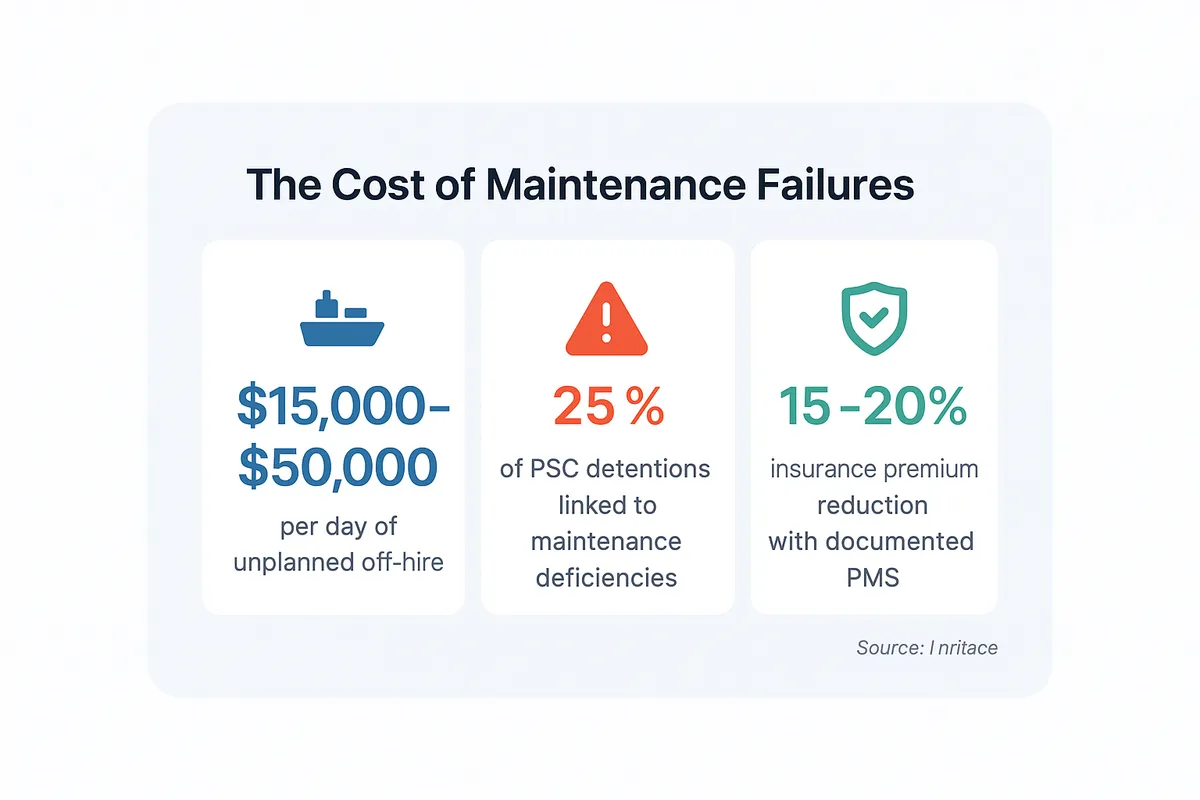
Beyond safety, there are compelling commercial reasons to maintain a robust PMS. Unplanned breakdowns lead to off-hire days, which cost vessel operators thousands of dollars per day in lost revenue.
Poor maintenance records raise red flags during vetting inspections, potentially disqualifying a vessel from lucrative charter contracts. Insurance underwriters scrutinise maintenance history when assessing claims, and a poorly documented maintenance programme can lead to coverage disputes.
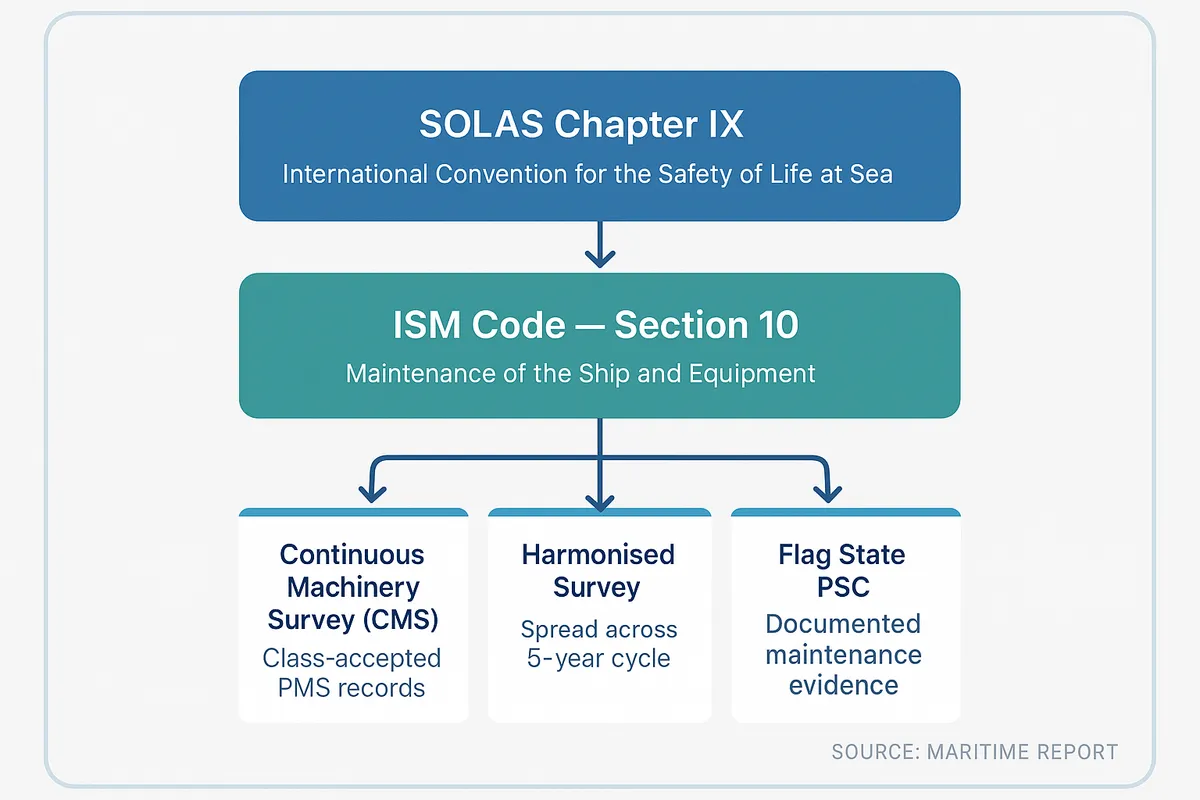
Regulatory requirements leave little room for ambiguity. The ISM Code, made mandatory under SOLAS Chapter IX, requires every shipping company to establish procedures for the maintenance of the ship and its equipment in accordance with relevant rules and regulations.
Flag state administrations, port state control officers, and class surveyors all expect to see evidence of systematic, documented maintenance. A planned maintenance system provides exactly that evidence.
IMO and Class Society Requirements
SOLAS Chapter II-1 sets out general requirements for the maintenance of ship structure, machinery, and electrical installations. The ISM Code, particularly Section 10 on Maintenance of the Ship and Equipment, requires that the company establish procedures to ensure the ship is maintained in conformity with the provisions of relevant rules and regulations and with any additional requirements established by the company.
This means maintenance cannot be ad hoc; it must follow a documented system.
Class societies play an equally critical role. Organisations such as DNV, Lloyd's Register, Bureau Veritas, ABS, and ClassNK all offer class-approved PMS programmes that allow operators to conduct machinery surveys on a continuous basis rather than during a single drydocking period.
Under a Continuous Machinery Survey (CMS) arrangement, the ship's chief engineer carries out maintenance and inspections according to the PMS schedule, and the class surveyor reviews the records and verifies a sample of completed jobs during periodic visits.
Port State Control inspections add another layer of scrutiny. PSC officers routinely review maintenance records during inspections, and deficiencies related to maintenance are among the most common findings.
A well-maintained PMS with complete, up-to-date records demonstrates compliance and reduces the risk of detention. Conversely, gaps in maintenance documentation can trigger expanded inspections and potential delays.
Core Functions of a Planned Maintenance System
Job Scheduling and Calendar Management
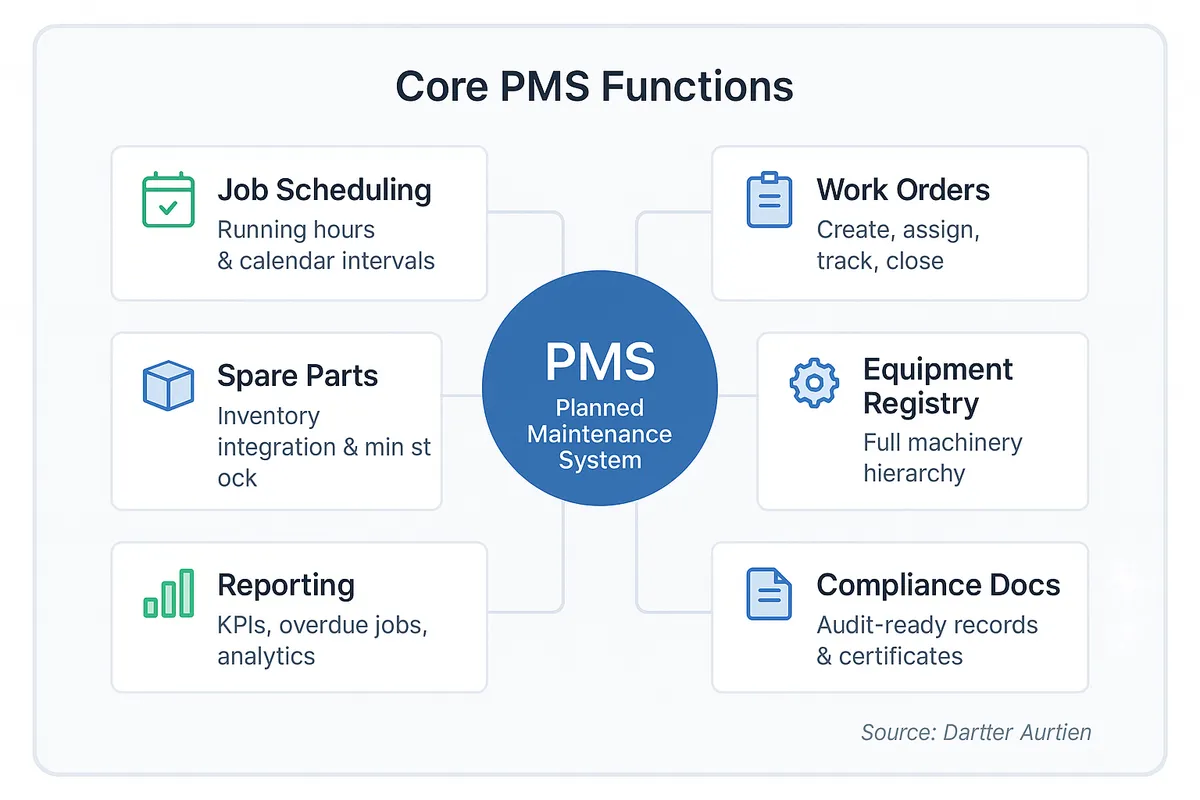
The scheduling engine is the heart of any planned maintenance system. Jobs are triggered based on three types of intervals: calendar time (every 3 months, every 12 months), running hours (every 4,000 hours, every 8,000 hours), or condition thresholds (when vibration exceeds a set level, when oil analysis shows contamination).
The system tracks these intervals automatically and generates work orders when a job becomes due. For example, a main engine turbocharger overhaul might be scheduled every 12,000 running hours, while lifeboat davit inspections are typically calendar-based at 12-month intervals.
Overdue job tracking is equally important. When a job passes its due date without completion, the system escalates it through visual alerts and notifications to both shipboard and shore-based management.
Chronic overdue jobs are a major red flag during audits and inspections, so the ability to monitor and address them promptly is essential for compliance.
Work Order Management
Work orders are the transactional records of maintenance activity. Each work order captures what needs to be done, who is responsible, what spare parts and tools are required, and any safety precautions that apply.
Upon completion, the engineer records what was actually done, any measurements taken, parts consumed, and observations about the equipment's condition. Photographs can be attached as supporting evidence.
This level of detail creates the audit trail that class surveyors and PSC officers expect to see.
Spare Parts and Inventory Integration
A maintenance job that cannot be completed due to missing spare parts defeats the purpose of planning. Effective PMS software links each job to the specific spare parts it requires and checks stock levels before the job becomes due.
When stock falls below the minimum threshold, the system can automatically generate a purchase requisition that feeds into the procurement workflow. This integration between maintenance, inventory, and procurement ensures that parts are ordered, delivered, and available when the chief engineer needs them.
Machinery and Equipment Registry
Every planned maintenance system maintains a hierarchical equipment tree that mirrors the physical structure of the vessel. The hierarchy typically follows: vessel, then system (e.g., main propulsion, auxiliary power, deck machinery), then component (e.g., main engine, generator, crane), then sub-component (e.g., turbocharger, fuel injector, hydraulic motor).
Each item in the tree carries its technical specifications, manufacturer data, serial numbers, commissioning date, and links to related drawings and manuals. This registry serves as the single source of truth for everything on board.
Reporting and Analytics
Data without analysis is just noise. A modern PMS provides reporting on job completion rates, overdue percentages, maintenance costs by vessel and system, equipment failure trends, and planned-versus-unplanned maintenance ratios.
Fleet managers use these reports to identify vessels or equipment types that consistently underperform, to benchmark maintenance spending across the fleet, and to prepare for class surveys by generating the specific documentation that surveyors require. Key performance indicators such as mean time between failures (MTBF) and maintenance backlog percentage give management a clear picture of fleet health.
Compliance Documentation
Every action in the PMS creates a timestamped, traceable record. Work order completion, parts consumption, running hour updates, and certificate renewals all form part of an unbroken audit trail.
During ISM audits, class surveys, or port state control inspections, this documentation can be retrieved instantly rather than assembled from scattered paper files. Certificate tracking for safety equipment such as fire extinguishers, life rafts, and EPIRB batteries ensures that nothing expires without notice.
Planned vs Corrective vs Condition-Based Maintenance
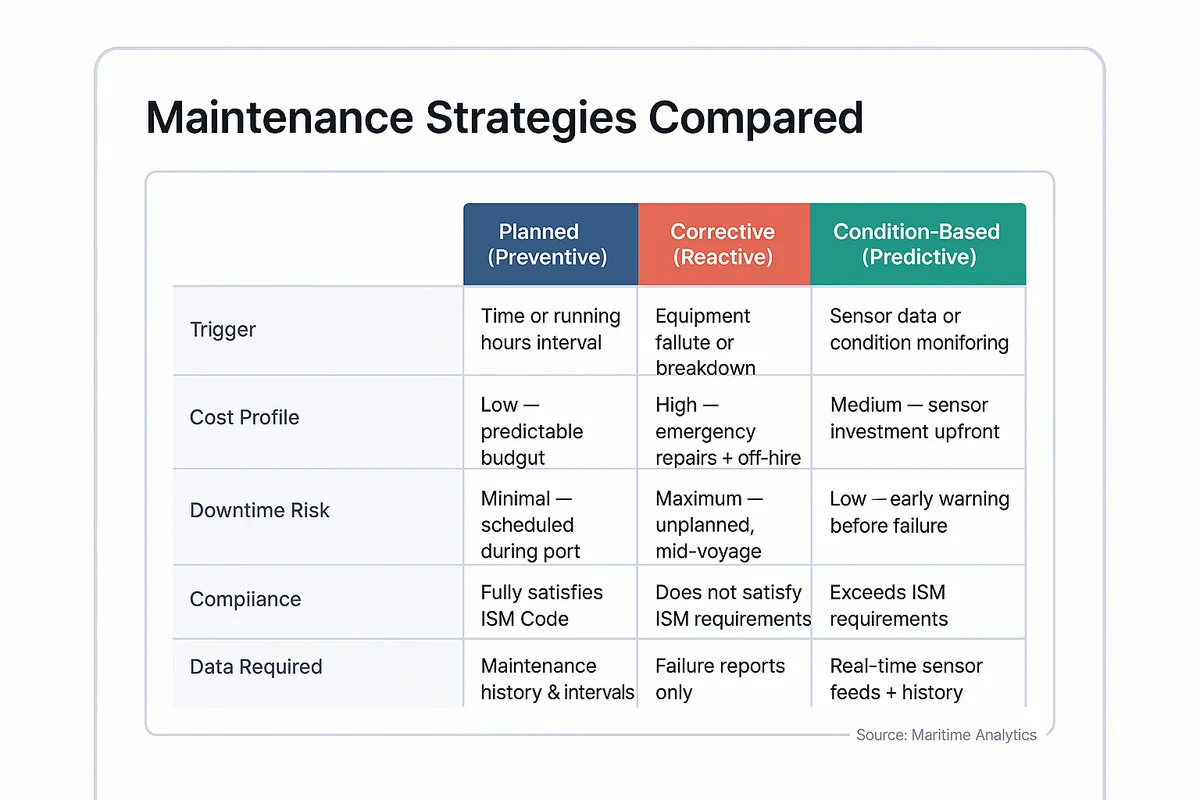
Three broad maintenance strategies exist, and most fleets use a combination of all three. Planned (preventive) maintenance follows fixed intervals — overhauling a component every 8,000 running hours or inspecting a system every six months regardless of its apparent condition.
This approach is predictable and ensures regular attention to equipment, but it can lead to over-maintenance of healthy machinery and unnecessary spare parts consumption.
Corrective (reactive) maintenance means fixing equipment after it fails. While this is the cheapest approach in terms of upfront maintenance spend, it is almost always the most expensive in total cost because unplanned breakdowns cause operational disruptions, emergency spare parts procurement at premium prices, and potential safety incidents.
For critical systems like propulsion, steering, and fire safety, a purely corrective approach is unacceptable.
Condition-based maintenance monitors the actual state of equipment through techniques such as vibration analysis, lubricating oil analysis, thermography, and ultrasonic testing. Maintenance is performed only when indicators show that degradation has reached a point where intervention is needed.
This is the most efficient strategy but requires investment in monitoring equipment and the expertise to interpret results. In practice, most ship operators apply planned maintenance to the majority of equipment, condition-based monitoring to high-value critical assets such as main engines and turbochargers, and accept corrective maintenance only for low-cost, non-critical items where the consequence of failure is minimal.
Maritime CMMS vs PMS — What Is the Difference?
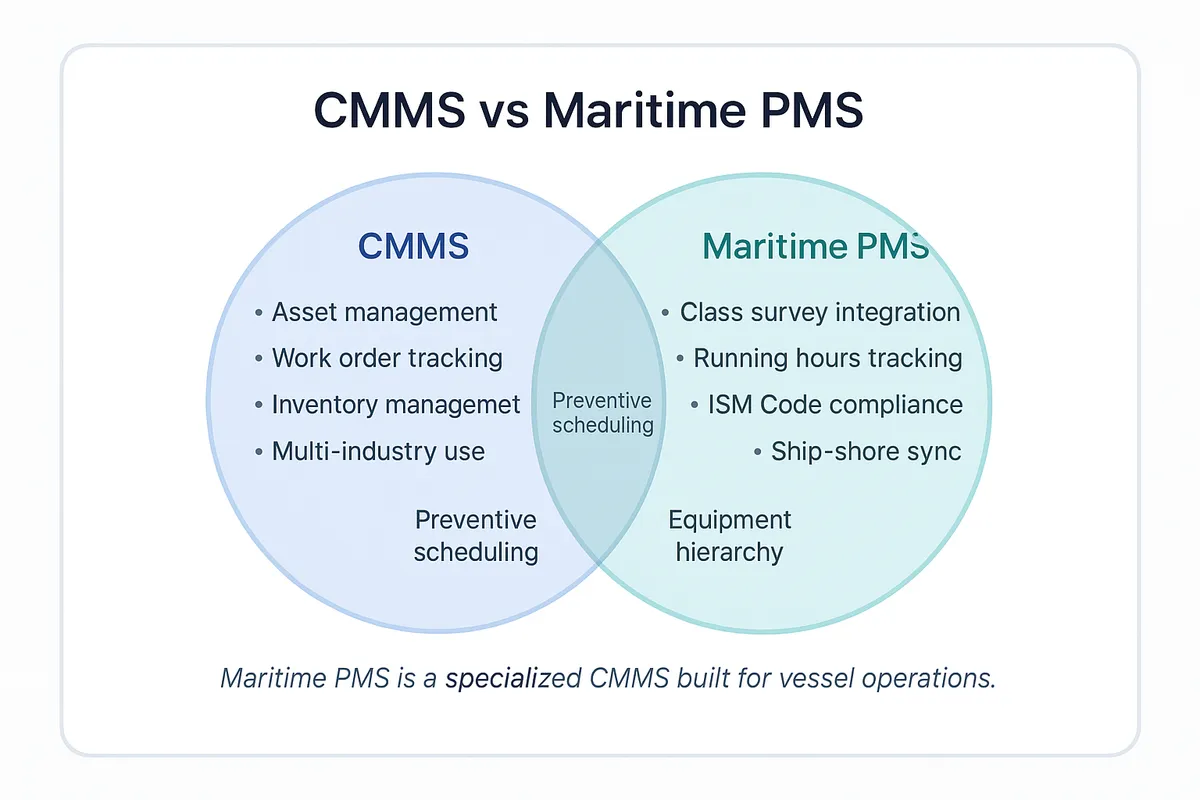
CMMS stands for Computerized Maintenance Management System, which is the term used across all industries — manufacturing, aviation, oil and gas, facilities management — for software that manages maintenance operations. PMS, or Planned Maintenance System, is the maritime industry's own term for essentially the same concept.
In practice, a maritime CMMS and a ship PMS are the same thing. The distinction matters mainly for search terminology: buyers searching for maintenance software may use either term depending on their background.
Where a maritime PMS diverges from a generic CMMS is in its shipping-specific capabilities. A generic CMMS does not understand class society survey requirements, running hours synchronisation from shipboard automation systems, or the complexities of ship-shore data exchange over satellite connections.
A purpose-built maritime PMS handles all of these natively — it tracks class survey items, integrates with onboard data loggers for automatic running hour updates, and synchronises maintenance records between ship and shore even when connectivity is intermittent.
From Paper to Cloud — The Evolution of PMS
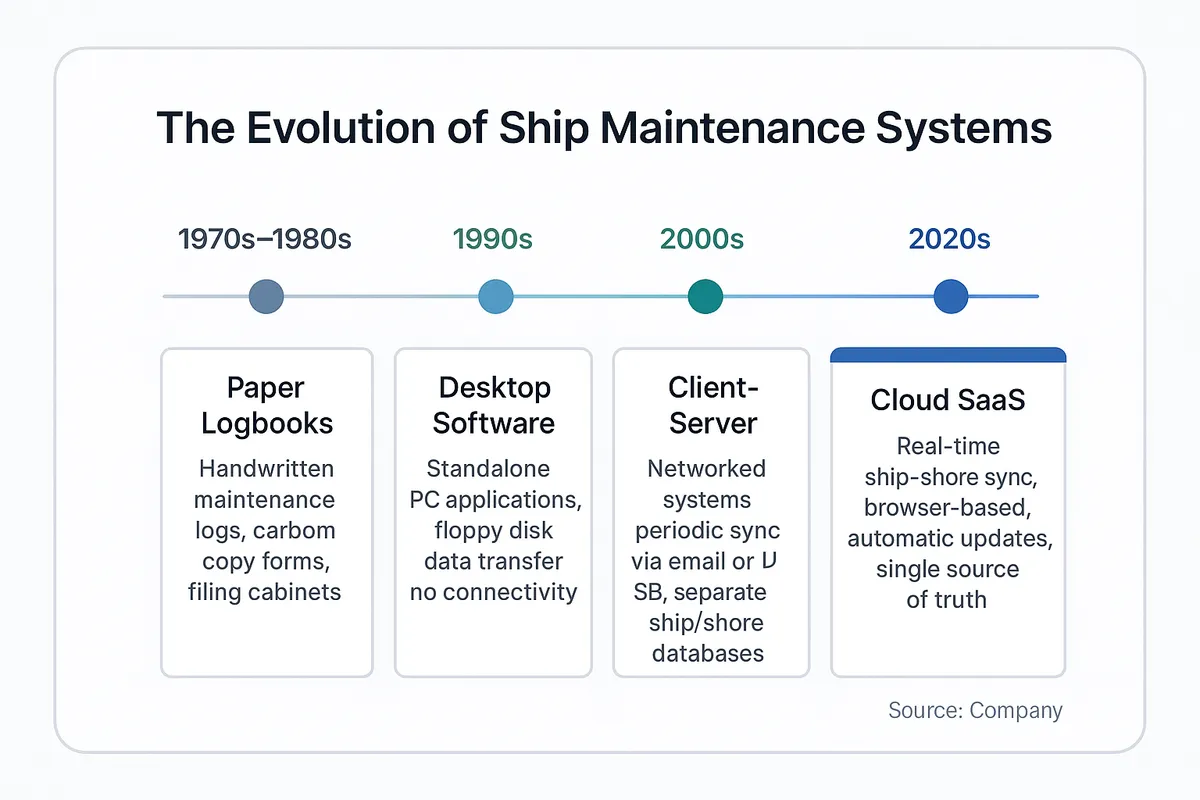
The first generation of ship maintenance management relied on paper-based card systems. Each piece of equipment had a card listing its scheduled maintenance tasks, and the chief engineer would manually track completion dates and intervals.
Information stayed on the ship, and shore management had limited visibility into what was happening in the engine room. Preparing for a class survey meant compiling stacks of paper records, often under time pressure.
The second generation introduced PC-based software running on standalone shipboard computers. This was a significant improvement in record-keeping and scheduling, but data exchange with the office still relied on sending database backups via email or on USB drives delivered during port calls.
Shore-based superintendents were always working with stale data, sometimes weeks or months out of date.
The current generation of cloud-based PMS eliminates this data lag entirely. Ship and shore access the same system in real time over satellite internet connections.
When the chief engineer completes a work order on board, the superintendent sees it immediately in the office. Running hours update automatically.
Spare parts stock levels are visible fleet-wide. Reports and dashboards aggregate data across the entire fleet without manual consolidation.
The shift from paper to cloud has transformed PMS from a shipboard record-keeping exercise into a genuine fleet management tool.
What to Look for in PMS Software
Selecting the right planned maintenance system for your fleet is a decision that will affect operations for years. The following criteria should guide your evaluation:
- Class society type approval — ensures the PMS meets the standards your classification society requires for Continuous Machinery Survey acceptance.
- Offline capability — ships lose internet connectivity regularly, so the system must function fully offline and synchronise when the connection returns.
- Ship-shore synchronisation — data should flow automatically and reliably between vessel and office without manual intervention.
- Integration with procurement and inventory — maintenance planning is only effective when spare parts availability is visible within the same system.
- Mobile and tablet support — engine room conditions demand a device-friendly interface, not a desktop-only application.
- Reporting depth — the system should produce the specific reports your class society, charterers, and management require without manual data manipulation.
- Data migration tools — most fleets are switching from an existing PMS, and the quality of migration tooling determines how painful the transition will be.
- Multi-fleet support — if you manage vessels for multiple owners, the system should support separate fleet configurations within a single platform.
How Navatom's Planned Maintenance System Works
Navatom's planned maintenance system module is part of a 30-module integrated vessel management platform. Running hours flow in from shipboard systems and trigger work orders automatically.
When a job requires spare parts, the system checks inventory levels across the fleet and creates purchase requisitions through the integrated procurement module. All maintenance records synchronise between ship and shore in real time, so superintendents and chief engineers always see the same data.
Because every module shares the same cloud architecture and database, maintenance data connects directly to ISM compliance workflows, certificate tracking, drydock planning, and fleet analytics. There are no imports, exports, or manual data transfers between systems.
The result is a complete, real-time picture of fleet maintenance health accessible from any web browser.
Frequently Asked Questions
Is a planned maintenance system required by law?
The ISM Code requires systematic maintenance of the ship and its equipment, and while it does not mandate specific software, class societies require verifiable maintenance records. A planned maintenance system is the universally accepted method for providing those records.
Most class-approved PMS programmes satisfy Continuous Machinery Survey requirements, making the software a practical necessity even if it is not technically a legal mandate.
What is the difference between PMS and CMMS?
PMS is the maritime industry term for what other industries call a Computerized Maintenance Management System (CMMS). A maritime PMS includes shipping-specific features that generic CMMS platforms lack: class survey integration, running hours tracking from onboard systems, ship-shore synchronisation over satellite connections, and regulatory compliance reporting for IMO and flag state requirements.
Can a cloud-based PMS work offline on board?
Yes. Modern cloud-based planned maintenance systems include offline capability for shipboard use.
Work orders, equipment records, and data entry all function without an internet connection. When connectivity is restored, the system synchronises changes automatically with the shore-based platform.
This hybrid approach gives ship staff the reliability of local software with the visibility and collaboration benefits of cloud architecture.
How long does PMS implementation take?
Implementation time depends on fleet size and whether you are migrating from an existing system. For a fleet of 10 to 20 vessels, expect four to eight weeks including data migration, system configuration, and crew training.
Cloud platforms generally implement faster than on-premise systems because there is no server infrastructure to set up. The completeness and quality of your existing maintenance data is typically the biggest factor in determining migration complexity.
What data needs to be migrated to a new PMS?
At minimum, you need to migrate the equipment tree (the full machinery hierarchy for each vessel), the spare parts catalogue, open work orders, and historical maintenance records. If your current system also manages certificates and running hours, those should be included as well.
Most PMS vendors provide data migration tools and dedicated support for the transition. The key is ensuring your source data is clean and complete before migration begins, as gaps in the original system will carry over to the new one.