AI in Ship Management: What It Actually Does (and What It Doesn't)
An honest, technically grounded tour of what maritime AI actually does in a ship-management office today — and, just as clearly, what it does not.
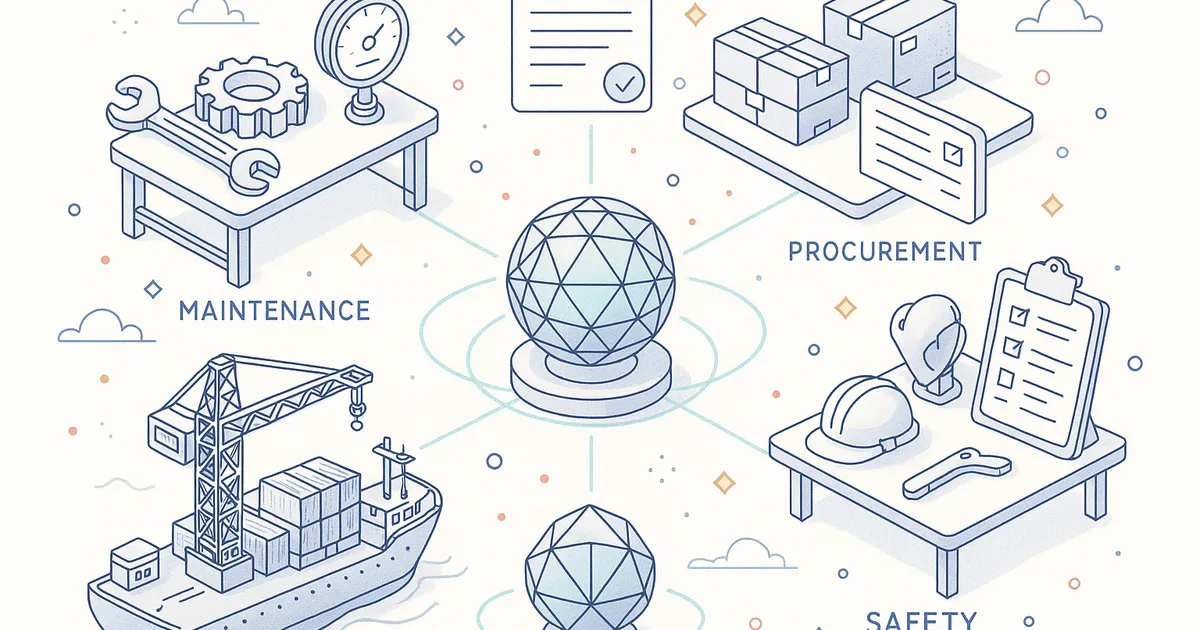
Ask ten fleet managers what AI in ship management means and you will get ten answers, most of them wrong. One imagines an autonomous bridge steering itself through the Malacca Strait. Another pictures a chatbot quietly running procurement while the superintendent sleeps. A third assumes it is a gimmick that produces confident nonsense. None of that describes what actually sits on a ship manager's desk in 2026.
The real picture is narrower, more useful, and far less dramatic. Today's maritime AI reads your manuals and your class rules and answers questions about them. It drafts an incident report or a purchase justification that a human then edits and signs. It flags the overdue job, the missing clause, the vessel that keeps burning more fuel than its sisters. It is a co-pilot, not an autopilot — and the difference is not marketing, it is the whole point.
This is the honest tour of what the technology does, and just as importantly what it does not. I will keep the hype at arm's length. Where I cite a number, I will tell you who measured it and how far to trust it. How to deploy any of this safely — the access controls, the audit trail, the review gates — is a separate discipline I have written about elsewhere. This piece is about capability: the mechanics, the genuine wins, and the hard limits.
What AI in ship management actually does today
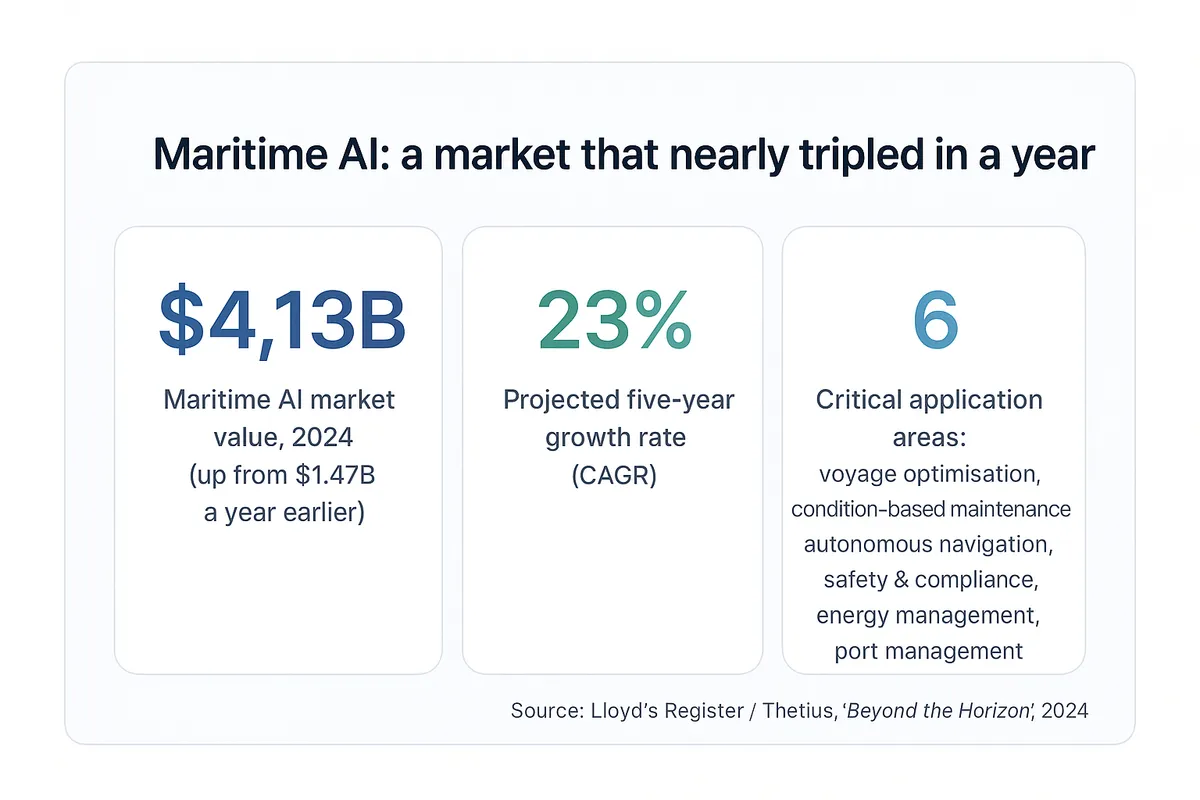
Start with the money, because it tells you where the effort is going. The maritime AI market reached USD 4.13 billion in 2024, nearly tripling from USD 1.47 billion a year earlier, with analysts projecting a 23% five-year growth rate. That figure comes from Beyond the Horizon, a study Thetius produced for Lloyd's Register, built on 604 market updates across 420 organisations — one of the few maritime-specific numbers you can actually trace to a source rather than a press release. It names six application areas: voyage optimisation, condition-based maintenance, autonomous navigation, safety and compliance, energy management, and port management.
Strip away the categories and most working deployments fall into a few honest buckets. The first is retrieval over documents. DNV's RuleAgent lets a surveyor ask a plain-language question across roughly 600,000 rule paragraphs and point back to the original source paragraph for verification. Marcura's chartering tool reviews a charter party in minutes; in one case it flagged four missing critical clauses that helped a dry-bulk operator avoid over USD 120,000 in potential losses — a vendor figure, so treat the number as illustrative, but the use case is real.
The second bucket is optimisation over operational data. ZeroNorth reports up to 15% fuel savings per voyage and says it optimised around 1.5 million voyages in 2024, tracking roughly 5,500 ships. The third is computer vision. A joint Orca AI and NorthStandard study of 139 container ships over 10.8 million nautical miles found a 52% reduction in high-severity close encounters within twelve months of installation. Orca's SeaPod digital watchkeeper fuses eight cameras to detect non-AIS targets up to four nautical miles out, in line with SOLAS Chapter V — advisory, not autonomous. It recommends; the bridge team decides.
The biggest money, though, is unglamorous. CMA CGM signed a five-year, EUR 100 million partnership to build tools for roughly a million customer emails a week, claims processing, and document management. Class societies are embedding AI into inspection — Bureau Veritas launched an AI, LiDAR and drone cargo-hold surveyor, and DNV and ABS run corrosion detection on tank surveys. Notice the pattern. The proven, funded uses are assistants over text and data, checked by an expert. Not robots taking the helm.
The mechanics: retrieval, grounding, and citations
Here is where I get technical, because the mechanics are what separate a useful assistant from a confident liar. A general-purpose language model knows a lot about the world and nothing specific about your fleet. Ask it about your safety management system and it will guess, and guess with full confidence — the Llamarine researchers built an entire maritime-specific model precisely because generic ones show limited effectiveness in specialised domains like navigation.
The fix is retrieval-augmented generation, and it is less mysterious than the acronym suggests. Before the model answers, the system searches your actual documents — manuals, procedures, class rules, incident history — pulls the relevant passages, and hands them to the model as the material to reason over. The model no longer draws on half-remembered training data. It reads the paragraph in front of it and answers from that. This is why RuleAgent can link every answer back to the source paragraph: the source is not decoration, it is the input.
Grounding and citation are the two properties that make this trustworthy. Grounding means the answer is constrained to your data. Citation means you can check it in seconds instead of taking the machine's word. If an assistant cannot show you where an answer came from, assume it invented it. In a time-pressured inspection between ports, the ability to verify — not just receive — an answer is the entire value.
Draft, don't decide: the human stays in the loop
The most honest study I have read on this came from DNV and SINTEF, who tested language models on a low-stakes task: drafting replies to stakeholder inquiries. Their conclusion was blunt. The models are not yet mature enough for safety-critical applications without human oversight, and final decision-making must remain with human experts. Even for routine correspondence, the drafts often required significant modification to meet maritime communication standards.
Sit with that. In a task with no lives at stake, expert rewriting was still consistently required. The value was not a finished product; it was a strong first draft that saved the expert from a blank page. That is the correct mental model for every AI output in ship management — a proposal, never a decision. The ISM Code has always insisted on clear lines of responsibility ashore and onboard; a drafting assistant does not dilute that, it just fills the page faster.
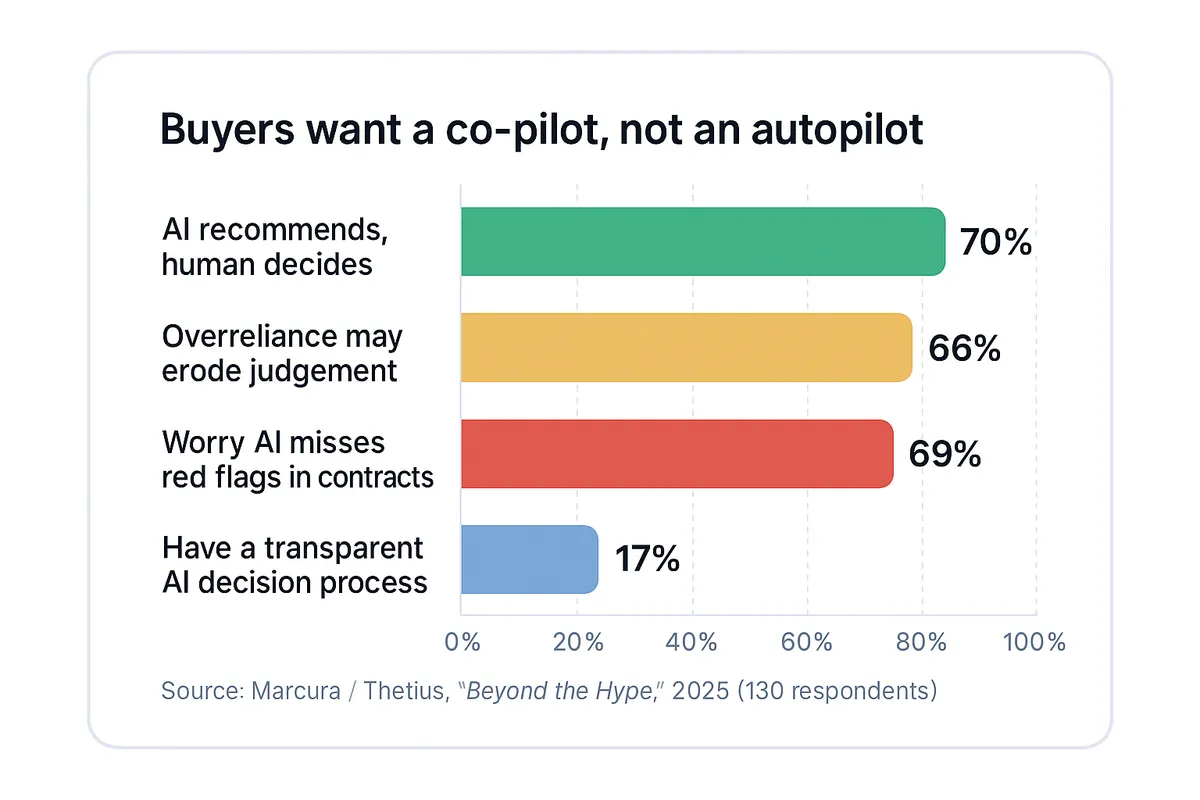
The market agrees, and the numbers are striking. In Thetius and Marcura's Beyond the Hype survey, 70% of maritime professionals said AI should recommend actions but humans must make the final call, and 66% worried that overreliance would erode human expertise. Only 17% reported transparent AI decision-making inside their own organisations. The people closest to the work do not want an autopilot. They want a fast, checkable assistant and a clear line of accountability that ends with a human name.
What AI in ship management does not do
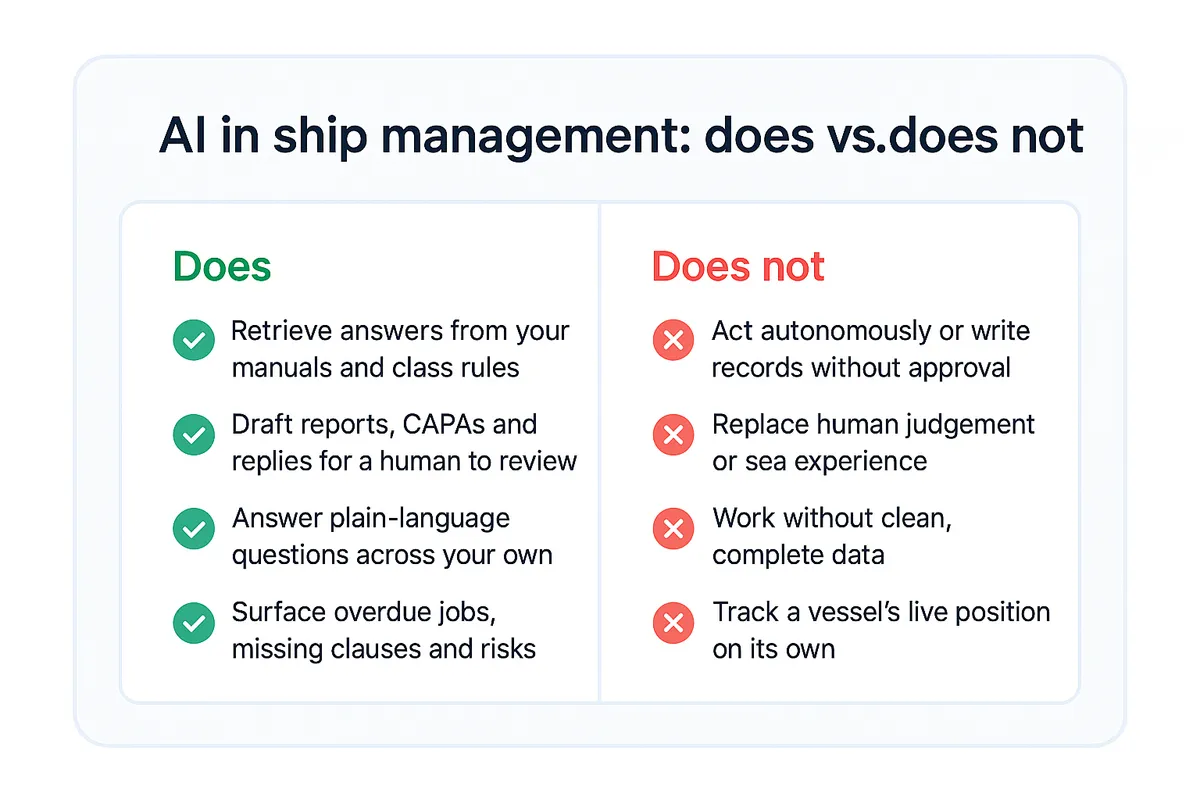
Now the limits, stated plainly, because vendors rarely will. AI in ship management does not act on its own. It does not book the spare, close the deficiency, or file the report without a person confirming it. Anything that writes to your records without a human in the loop is not a feature; it is a liability waiting for an audit.
It does not replace judgement. A model has no sea time. It has read about heavy weather; it has never felt a vessel labour in it. The Llamarine work exists because generic models lack the domain grounding maritime decisions require, and even domain-tuned models produce plausible errors. Treat every answer as a hypothesis to verify, not a verdict to obey.
It does not cure the oldest failure in shipping: trusting the machine over your own eyes. When the tanker Ovit grounded in the Dover Strait, the officer had followed the electronic chart track with the alarms switched off and took 19 minutes to realise the ship was aground. The MAIB noted it was the third such grounding where misuse of ECDIS was causal, despite dedicated training. Automation bias is not a software bug. It is a human habit, and a smarter assistant makes it easier to fall into, not harder.
And it does not work by magic over data it cannot see. A text assistant grounded in your systems does not know a vessel's live position, and it has no AIS or GPS feed to find out. It has no independent window on the world. It also should never become a hole in your confidentiality: pasting commercial or safety-sensitive fleet data into a public chatbot risks that data being absorbed into someone else's model — a basic cyber-seaworthiness failure that no clever prompt undoes.
Your assistant is only as good as your data
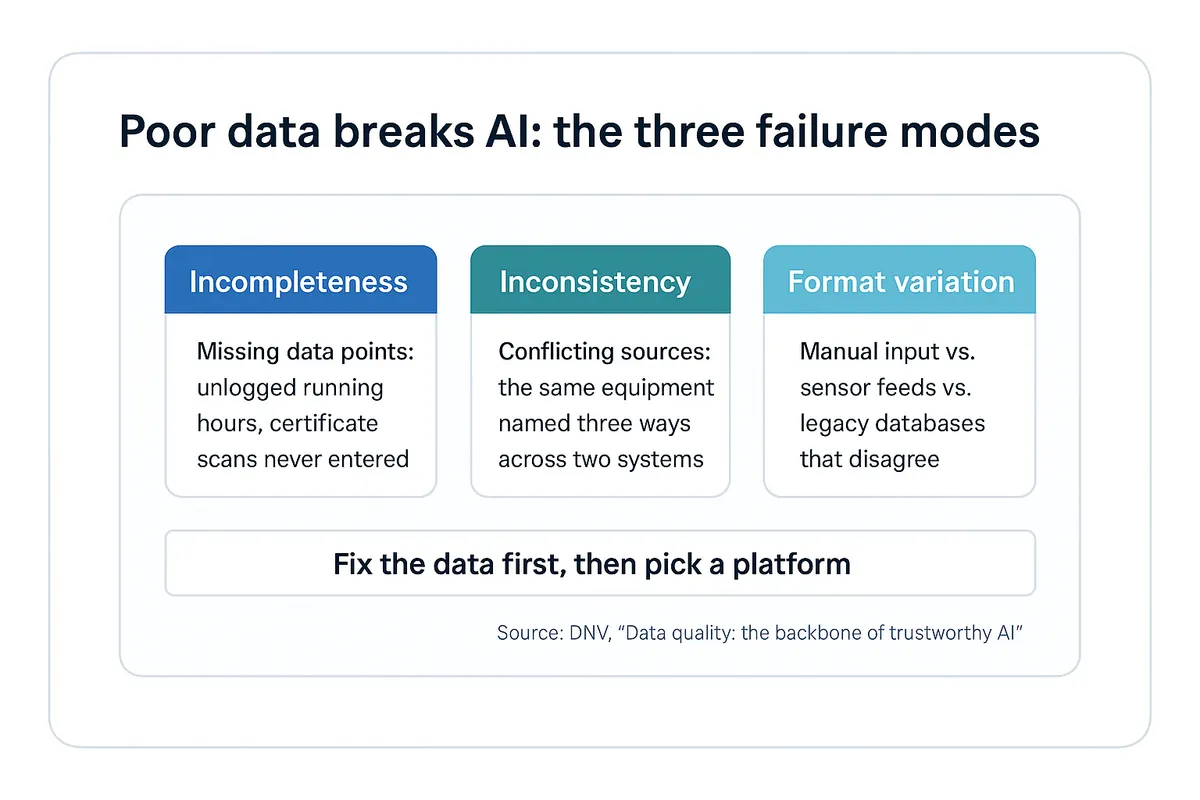
Every limit above collapses into one root cause. Data. DNV puts it as plainly as an engineer can: data is the backbone of a good AI system, and poor-quality data really does not work with AI. Garbage in, garbage out is not a slogan here; it is the operating reality.
DNV names three recurring problems, and any superintendent will recognise all three. Incompleteness — the running hours nobody logged, the certificate scan that never made it in. Inconsistency — the same equipment named three ways across two systems. Format variation — manual entries, sensor feeds, and a legacy database that disagree. Feed that to an assistant and it will answer fluently and wrongly, which is worse than not answering at all. This is why the sensible sequence is to fix the data first, then choose the tool — not the other way round.
Clean data also has to stay clean, which is why DNV treats AI assurance as continuous rather than a one-time certificate. Its recommended practice DNV-RP-0671 frames assurance as ongoing, because these systems evolve and so does the data underneath them. The uncomfortable corollary from Beyond the Hype: only 11% of maritime companies have formal policies to guide scaling AI, while 81% are already running pilots and 37% have witnessed an AI failure. The gap between enthusiasm and discipline is where the accidents live.
One assistant over unified data, not a zoo of bots
Which brings me to a design argument I feel strongly about. The lazy way to add AI to ship management is to bolt a single-purpose bot onto each screen — one for maintenance, one for procurement, one for crew, each with its own narrow view and its own way of being wrong. You end up with a zoo. Every animal needs feeding, none of them talk to each other, and the superintendent is still the integration layer.
The better architecture is one assistant grounded in unified data, permission-aware, with a human confirming every write. One place to ask a plain-language question that spans maintenance, procurement, crew and HSEQ, because the answer to a real question usually spans all of them. "Which vessels have overdue critical jobs and an open requisition for the part?" is not a maintenance question or a procurement question. It is both, and a zoo of bots cannot answer it.
This is the pattern we chose for Navatom's in-app assistant. It answers natural-language questions over a company's own live crew, vessel, planned-maintenance, procurement and HSEQ data through a set of read-only tools — reading overdue items and running-hours and downtime history, not forecasting failures it cannot see. It is grounded in the customer's own manuals and the regulations across its knowledge bases, and it cites its sources so a human can check them. When it helps close out a deficiency or investigation, it drafts the text; nothing is written until a person reviews and confirms it.
The guardrails are the product, not an afterthought. The assistant is tenant-isolated and permission-aware, so it can only see what the signed-in user is allowed to see — a crew record's rank and sign-on status, never another company's data. It runs on enterprise-grade foundation models with EU data residency, and your data never trains a model. Every interaction is audited. Quick, Balanced and Deep tiers let a user trade speed for reasoning depth over that same private data — never a web search. None of that is glamorous. All of it is what separates an assistant you can put in front of a fleet from a demo you can only put on a slide.
The bottom line
The short version, for anyone skimming:
- AI in ship management today is retrieval, drafting and question-answering over your own data — not autonomy.
- The credible operating model is co-pilot, not autopilot: the machine proposes, a named human decides. Seventy percent of the industry agrees.
- Grounding and citations are non-negotiable. If an answer has no source, assume it was invented.
- Your assistant is only as good as your data. Fix incompleteness, inconsistency and format chaos before you buy anything.
- One grounded assistant over unified data beats a zoo of single-purpose bots that cannot talk to each other.
- AI does not replace judgement, act without approval, or see anything your systems do not already hold.
Frequently asked questions
Is AI in ship management safe to rely on?
Only as a co-pilot. The strongest maritime-specific study, from DNV and SINTEF, found language models are not yet mature enough for safety-critical use without human oversight, and that final decisions must stay with human experts. Used as a drafting and retrieval aid with a person confirming every output, it is safe and genuinely useful. Used as an unsupervised decision-maker, it is not.
Does maritime AI need clean data to work?
Yes, completely. DNV calls data the backbone of any AI system and is blunt that poor-quality data does not work with AI. Incomplete logs, inconsistent naming and clashing data formats all produce confident, wrong answers. The realistic sequence is to fix data management first, then choose a platform — not the reverse.
Will AI replace superintendents and crew?
No, and the people doing the work do not want it to. In the Beyond the Hype survey, 66% worried that overreliance on AI would erode human expertise, and 70% insisted humans keep the final decision. AI removes the blank-page and needle-in-a-haystack work — drafting reports, finding the relevant clause or the overdue job. The judgement, and the accountability, stay human.
What is the difference between a single-purpose bot and a grounded assistant?
A single-purpose bot answers one narrow question from one system and cannot see the rest of your operation. A grounded assistant retrieves across your unified data — maintenance, procurement, crew, HSEQ — cites its sources, respects each user's permissions, and drafts changes a human approves. Real questions span departments, so the unified, grounded approach answers what a collection of disconnected bots cannot.