Predictive Maintenance in Shipping: The Honest Version
Predictive maintenance is the most oversold phrase in maritime tech. Here is what the rules actually require, what prediction really needs, and what delivers value today.

Predictive maintenance is the most oversold phrase in maritime technology. Every conference booth promises it. Every vendor deck has the same slide: a sensor catches a bearing three weeks before it fails and saves you a six-figure repair at sea. I have run a planned maintenance system on real vessels, and I want to give you the honest version — what these terms actually mean, what predictive maintenance genuinely requires, and why most fleets are nowhere near it and do not need to be to capture most of the value.
This is not an argument against technology. It is an argument against buying the wrong thing at the wrong time. The uncomfortable part is this: the maintenance regime the rules already demand — planned, preventive, interval-driven — delivers most of the safety and cost benefit, and the majority of owners still do not do it well. Chasing failure forecasting before your running-hours data is clean is like fitting a chart plotter to a vessel with no rudder.
So let us define the terms properly, read what regulation actually requires, and be specific about the gap between the sales pitch and the engine room.
The four kinds of maintenance, defined honestly
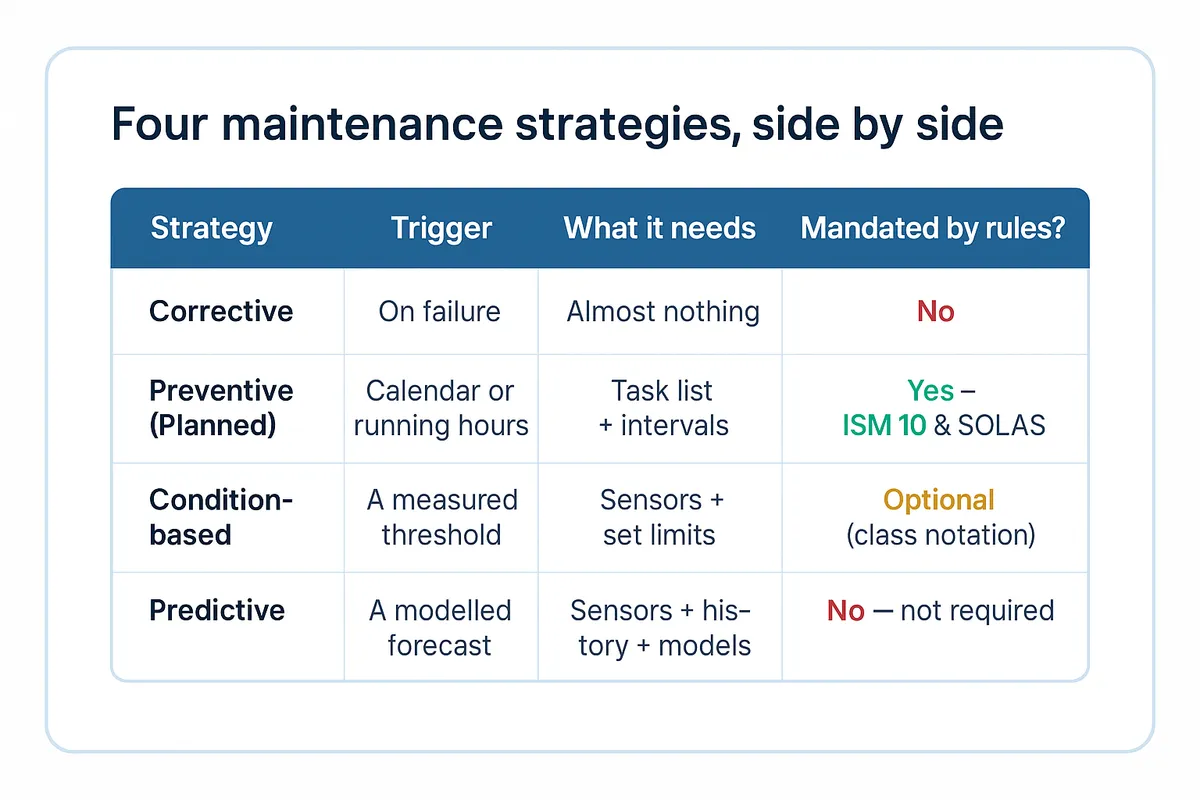
There are four maintenance strategies, and the industry blurs them on purpose because the blur sells software. Keep them separate and most of the confusion evaporates.
Corrective maintenance — also called reactive or run-to-failure — means you fix the thing when it breaks. It is the cheapest to plan and the most expensive when a main-engine component lets go 400 miles from the nearest port. Nobody runs a whole vessel this way, but plenty of individual equipment quietly sits in this category because it was never scheduled in the first place.
Preventive, or planned, maintenance means you service on a fixed schedule — every 3,000 running hours, every six months, whichever comes first. This is the workhorse. It is what a planned maintenance system automates: the task list, the intervals, the running-hours counters, the overdue flags. Done properly it prevents the vast majority of failures a calendar can anticipate, which is most of them.
Condition-based maintenance (CBM) adds a measurement. Instead of overhauling a pump because the clock says so, you monitor a real parameter — vibration, lube-oil particle count, bearing temperature — and act when it crosses a threshold. Class societies call this condition monitoring; Lloyd's Register formalises it as the MCM notation, where machinery ‘need only be opened out for examination when readings indicate deterioration.’
Predictive maintenance goes one step past that. It does not wait for a threshold. It uses the history of your data plus a model to estimate when a component will fail, so you can intervene on your own terms. Bureau Veritas calls condition-based and predictive the ‘most sophisticated tier,’ using onboard real-time data and ‘diagnosis and prognosis’ to ‘detect when a failure is about to occur.’ That prognosis step — the forecast — is the hard part, and it is where the marketing runs far ahead of the engine room.
What the rules actually require (and it isn't predictive)
Here is the fact that cuts through most vendor pitches: no regulation anywhere requires predictive maintenance. The entire statutory floor is built on planned, interval-driven work, and it always has been.
The core obligation is Section 10 of the ISM Code, ‘Maintenance of the Ship and Equipment.’ Clause 10.1 requires the Company to establish procedures to keep the vessel in conformity with the rules. Clause 10.2 spells out the method — inspections at ‘appropriate intervals,’ non-conformities reported with their possible cause, appropriate corrective action taken, and records maintained. That is a documented, calendar-driven inspection regime, in black and white.
The clause that comes closest to reliability engineering is 10.3, the critical-equipment provision. It tells the Company to identify equipment ‘the sudden operational failure of which may result in hazardous situations,’ and to promote its reliability — including ‘the regular testing of stand-by arrangements.’ Read it carefully: the prescribed measure is regular testing, a preventive act. Even the ISM Code's reliability clause reaches for the calendar, not a model.
SOLAS stacks more planned duties on top. Chapter I, Regulation 11 requires that ‘the condition of the ship and its equipment shall be maintained to conform with the provisions of the present regulations’ between surveys. Chapter II-2, Regulation 14 explicitly requires a written maintenance plan kept on board for fire-protection systems. Chapter III, Regulation 20 sets purely calendar-based checks for life-saving appliances — weekly, monthly, annual and five-yearly, including lifeboat release-gear tests and falls renewed at intervals not exceeding five years. None of it is condition-based. All of it is the clock.
Class survey credit tells the same story. Under IACS Unified Requirement Z20, an owner can run an approved Planned Maintenance Scheme so the chief engineer's overhauls earn survey credit — but the scheme is built on manufacturer recommendations, running hours or running cycles, which is preventive by definition. DNV, which offers exactly this arrangement, even concedes that fixed-interval schedules are ‘in many cases not an optimal solution’ because they are ‘not adjusted according to operational conditions and experience.’ Condition monitoring and predictive methods do exist in the class rulebooks — as an optional notation layered on the mandatory planned baseline, never a replacement for it.
What predictive maintenance actually requires
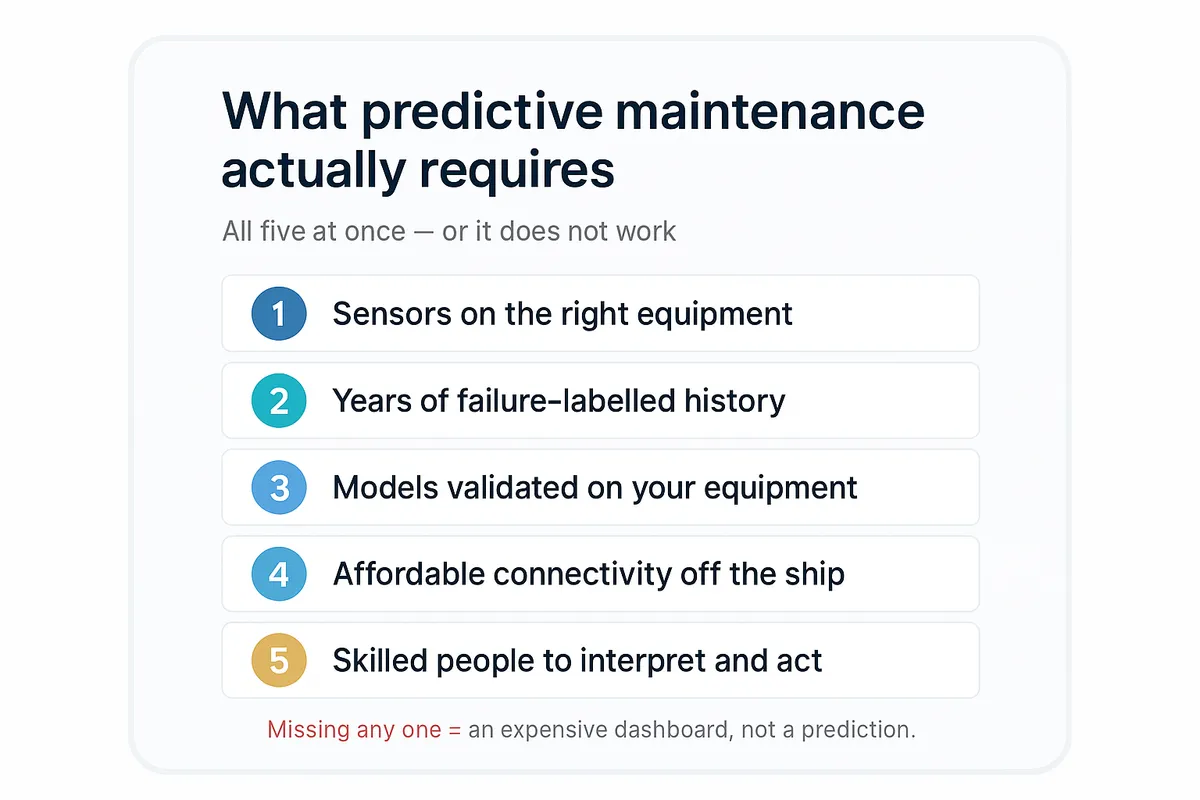
If you want real predictive maintenance — a model that tells you a specific component has, say, 200 hours left — you need five things in place at once. Miss any one and you have an expensive dashboard, not a prediction.
First, sensors on the right equipment, surviving a genuinely hostile environment. Second, years of historical data that includes actual failures, because a model cannot learn a pattern it has never seen. Third, a model validated against your equipment, not a generic curve lifted from a lab. Fourth, connectivity to move that data off the vessel at a cost that does not eat the saving. Fifth, people onboard and ashore who can interpret the output and act on it before the window closes.
The academic literature is blunt about how rare that combination is at sea. A 2025 review in the Journal of Marine Science and Engineering describes shipboard prediction as constrained by data scarcity, scarce labelled fault data, class imbalance and noisy sensor signals. Labelled failure data, the exact ingredient a predictive model needs, is the hardest thing to get, because a well-run fleet does not let its critical machinery fail often enough to build a training set. The better your maintenance, the thinner your failure data. That paradox sits at the heart of maritime prediction.
Your predictions are only as good as your data
This is the sentence I wish every buyer would tattoo on their hand before a demo. A predictive model is a machine for turning your data into a forecast. Feed it bad data and it will confidently forecast nonsense, with a clean interface and a percentage next to it.
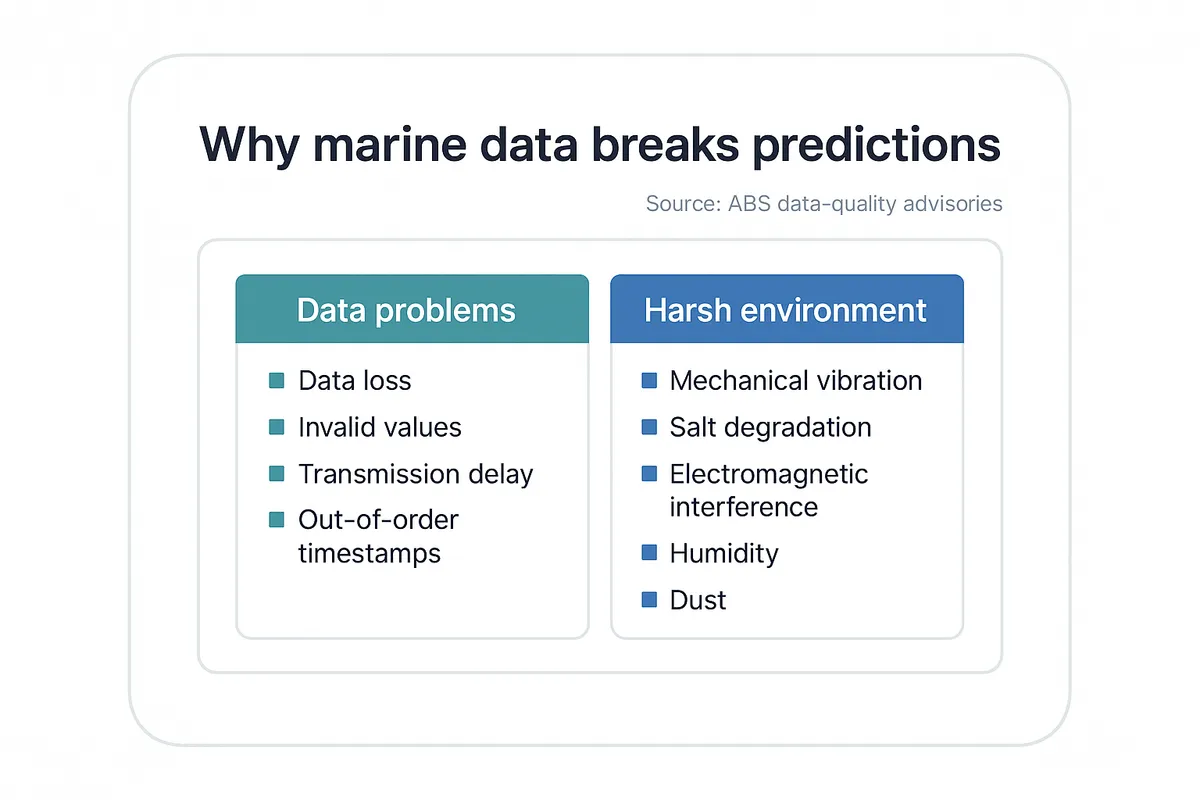
The American Bureau of Shipping put it plainly when it published two data-quality advisories built on ISO 8000 and ISO 14224: ‘High-quality data is the essential ingredient for high-quality analytics.’ ABS did not write that in the abstract. It documented what marine operational data actually looks like — routine data loss, invalid values, transmission delay, and timestamps arriving out of order — before it ever reaches a model.
Then there is the environment. Mechanical vibration, salt-induced degradation, electromagnetic interference, humidity and dust all corrupt sensor signals on a working vessel. The sensor that behaves perfectly on the test bench drifts within a season in an engine room. Your prediction inherits every one of those errors, and it cannot tell you which readings to distrust.
The candid stories bear this out. At an operators' roundtable reported by Riviera Maritime Media, participants described a predictive-maintenance system that ‘failed to predict a catastrophic connecting rod failure’ during operations off West Africa, and digital-twin projects that ‘faced challenges’ because ‘current systems cannot adequately account for complex sea states.’ The same session noted that engine data is ‘often locked behind proprietary systems’ and maintenance records stay ‘trapped within vendor-controlled platforms.’ You cannot predict on data you cannot even reach.
The ROI story, minus the marketing
The numbers in predictive-maintenance pitches deserve a hard look, because most of them are neither maritime nor what they claim to be. The famous ‘$20 billion a year in shipping downtime’ figure is untraceable to any primary source — not IMO, not a class society, not Lloyd's List. The nearest real number is Deloitte's, and it is for manufacturers, not ships.
Deloitte's own flagship figures are far more modest than the re-quotes suggest: predictive technologies deliver roughly 20 to 50 percent less maintenance-planning time, 10 to 20 percent higher equipment uptime, and 5 to 10 percent lower maintenance costs. Those are cross-industry averages drawn from chemical plants and railways — there is no shipping case in the analysis. Useful, real, and much smaller than the slide that promises a 70 percent cut in breakdowns.
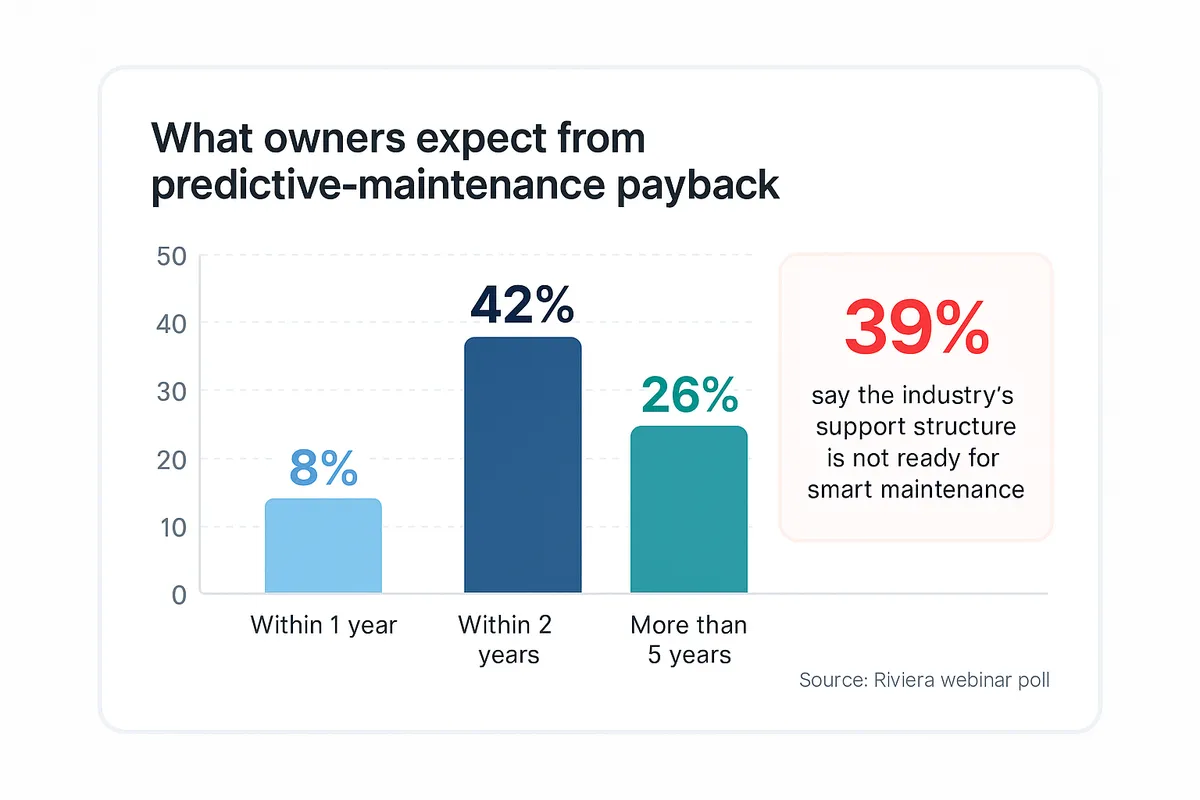
Owners themselves are sceptical about payback. In an industry webinar poll run by Riviera, only 8 percent expected a return within a year and 42 percent within two years, while 26 percent thought it takes more than five years — and 39 percent judged shipping's support structure simply not ready for smart maintenance. The barriers they named were the cost of equipment and installation, an unwillingness to change, and a lack of standardised data. That is the buyer telling you, in their own poll, that the technology is early.
When you ask what is actually running, the honesty is refreshing. As one condition-monitoring managing director told The Maritime Executive that every client asks about predictive maintenance, yet almost none use it as a replacement for preventive maintenance. The market is real and growing, but it is growing from a small base — early adoption, not standard practice, and certainly not a substitute for the planned regime underneath it.
Where the value actually is today: do the basics well
Strip out the hype and a clear priority order remains. Get your planned maintenance system genuinely clean — accurate running hours, correct intervals, nothing silently overdue — and add condition monitoring on the handful of critical machines where a measurable parameter gives real warning. That is where almost all of today's benefit lives, and it is achievable now, without a single predictive model.
This is the philosophy behind how we built maintenance in Navatom, and it is deliberately unglamorous. The core is a planned maintenance system that tracks jobs by calendar and running hours, flags what is overdue, and ties every task to the spare parts it consumes so the store and the schedule stay in sync. It is CMMS discipline first, not a forecasting engine, and we think that ordering is the whole point.
There is an AI assistant in the platform, and it is worth being precise about what it does, because this is exactly where vendors overreach. It does not predict failures. It answers questions over your own operational records — what is overdue across the fleet, what the running-hours history shows on a given engine, which jobs slipped last quarter — using read-only tools, and it cites the manuals and regulations it drew from. It proposes text for an issue or a corrective action; a human reviews and confirms before anything is written. It is tenant-isolated, permission-aware, fully audited, and it never trains on your data. That is reporting and drafting grounded in fact — not prognosis.
The distinction matters more than any feature list. Telling you the port generator is 40 hours past its service interval is a fact your data already contains. Telling you it will fail on Thursday is a forecast your data almost certainly cannot support. We do the first honestly and refuse to fake the second — and if you get the first right across a fleet, you have removed most of the failures a prediction would have caught anyway.
The bottom line
- Regulation requires preventive, planned maintenance — ISM Code Section 10, SOLAS I/11, II-2/14 and III/20. No rule anywhere requires predictive maintenance.
- The four strategies are distinct: corrective (fix on failure), preventive (fix on schedule), condition-based (fix on a measured threshold), predictive (fix on a modelled forecast). Do not let a pitch blur them together.
- Real predictive maintenance needs five things at once: sensors, years of failure-labelled history, validated models, affordable connectivity, and skilled people. Most fleets lack at least one.
- Your predictions are only as good as your data, and marine operational data is routinely lossy, noisy and mistimed — the reason ABS built its data-quality advisories in the first place.
- The credible ROI numbers are cross-industry and modest: 10 to 20 percent more uptime, 5 to 10 percent lower cost. Treat maritime-specific ‘$20 billion’ claims as folklore.
- Get planned maintenance and targeted condition monitoring right first. That captures most of the value today and is the only sound foundation for prediction later.
Frequently asked questions
Is predictive maintenance required by SOLAS or the ISM Code?
No. Neither mandates it. ISM Code Section 10 and SOLAS Chapters I, II-2 and III all require planned, interval-based maintenance and record-keeping. Class societies recognise condition-based and predictive methods as optional notations layered on that planned baseline — never as a substitute for it. Your compliance floor is preventive; predictive is an owner-elected enhancement on top.
What is the difference between condition-based and predictive maintenance?
Condition-based maintenance acts when a measured parameter — vibration, oil condition, temperature — crosses a set threshold. Predictive maintenance goes further and uses historical data plus a model to estimate when failure will occur, before any threshold is reached. CBM reacts to a reading you can see today; predictive forecasts a future state, which needs far more data, validation and connectivity to be trustworthy.
Does Navatom do predictive maintenance?
No, and we will not pretend otherwise. Navatom provides a planned maintenance system — running-hours tracking, interval scheduling, overdue detection and spare-parts linkage — plus an AI assistant that answers questions about your overdue jobs and running-hours history and drafts issue or corrective-action text for a human to approve. It reports and explains what your data already contains; it does not forecast failures or estimate remaining life.
Should a mid-size fleet invest in predictive maintenance now?
Usually not as a first move. Owners' own payback expectations are long — most expect two years or more, many over five — and the prerequisites are steep. The higher-return step is to make your planned maintenance genuinely clean and add condition monitoring on a few critical machines. That delivers most of the benefit and builds the data foundation any future predictive project will actually need to work.