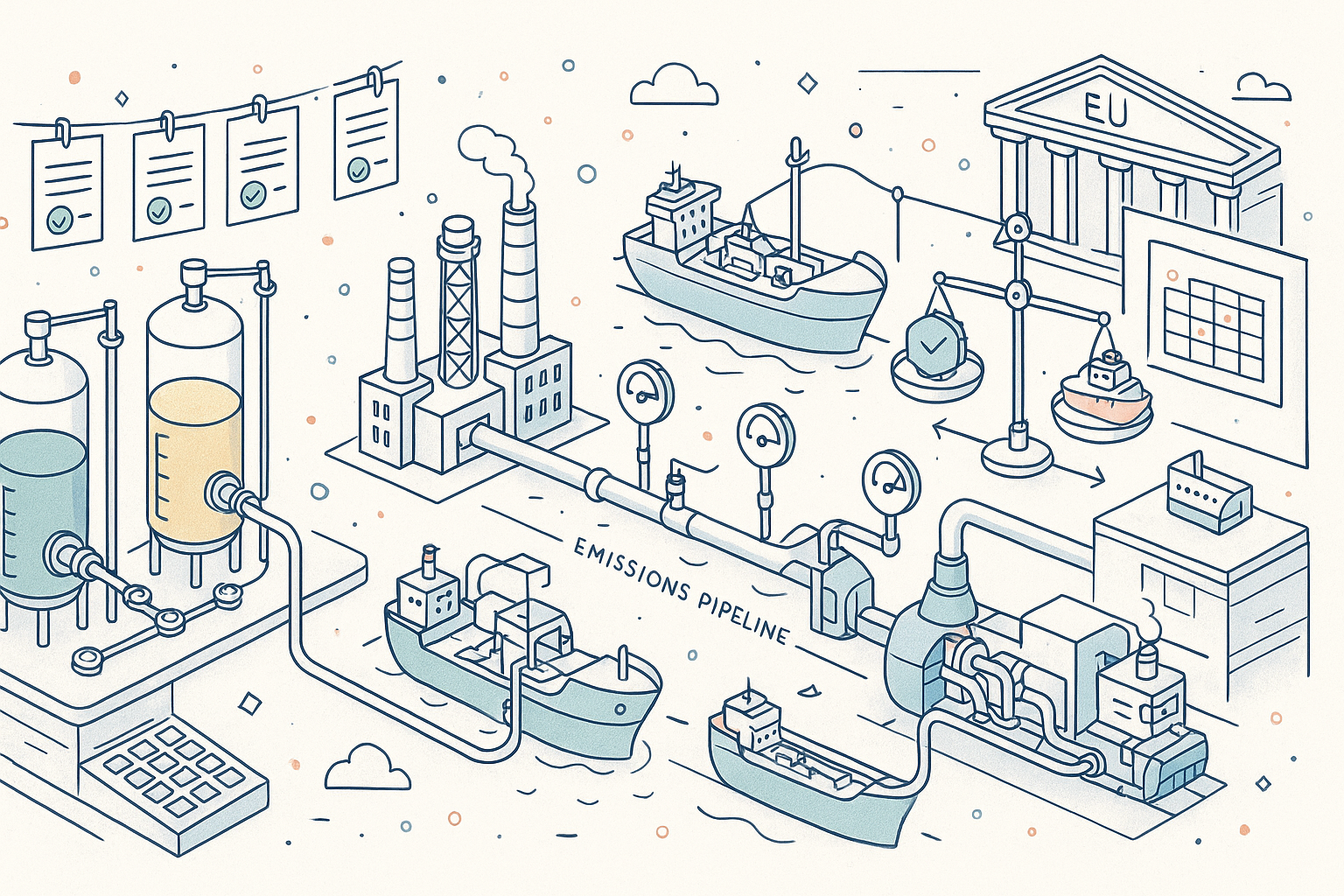
What Is FuelEU Maritime?
FuelEU Maritime, formally adopted as Regulation (EU) 2023/1805, is the European Union's most ambitious regulatory instrument for decarbonizing the maritime sector. Unlike earlier regulations that focused on monitoring and reporting emissions, FuelEU Maritime sets binding limits on the greenhouse gas intensity of energy used on board ships calling at EU and EEA ports.
The regulation entered into force on January 1, 2025, and applies to the same fleet as the EU MRV regulation — commercial ships of 5,000 gross tonnage and above.
What makes FuelEU Maritime distinctive is its well-to-wake approach to measuring greenhouse gas intensity. Rather than counting only the CO2 emitted from a ship's funnel, the regulation considers the full lifecycle of the fuel — from extraction or production, through processing and distribution, to final combustion on board.
This comprehensive methodology ensures that a shift from one fuel type to another is evaluated on its true climate impact, preventing situations where a fuel appears clean at the point of use but carries a heavy emissions burden from its production process.
The regulation sits alongside the EU Emissions Trading System and the EU MRV framework as part of the EU's Fit for 55 legislative package for maritime transport. While the ETS puts a price on carbon emissions and the MRV ensures transparency, FuelEU Maritime drives the actual fuel transition by requiring ships to use progressively cleaner energy.
Together, these three regulations create a comprehensive compliance landscape that ship operators must navigate as a unified challenge.
GHG Intensity Targets
FuelEU Maritime establishes a reduction trajectory for the well-to-wake GHG intensity of marine fuels that extends to 2050. Starting from a 2020 reference value of approximately 91.16 grams of CO2 equivalent per megajoule, the regulation mandates a 2% reduction from 2025, a 6% reduction from 2030, a 14.5% reduction from 2035, a 31% reduction from 2040, a 62% reduction from 2045, and an 80% reduction from 2050.
These progressively ambitious targets are designed to provide the maritime industry with a predictable pathway for fuel investment and fleet renewal decisions.
The initial 2% and 6% targets can be met through incremental measures such as improved fuel quality, LNG adoption, and biofuel blending. However, the steeper reductions from 2035 onward will require fundamental changes in marine energy — including hydrogen-based fuels, ammonia, methanol from renewable sources, and potentially on-board carbon capture.
Companies that begin planning their fuel transition strategy now, supported by accurate GHG intensity tracking, will be better positioned to manage the financial impact as targets tighten. The cost of compliance will also interact with EU ETS allowance obligations, creating a compound incentive for cleaner fuels.
It is worth noting that FuelEU Maritime's GHG intensity metric is conceptually different from the CII rating system. CII measures operational carbon intensity per unit of transport work, rewarding efficient ship operation.
FuelEU Maritime measures the inherent carbon intensity of the fuels used, regardless of how efficiently the ship operates. A vessel could achieve an excellent CII rating through slow steaming but still fail to meet FuelEU Maritime targets if it burns conventional heavy fuel oil. Both measures must be managed simultaneously.
Compliance Mechanisms
FuelEU Maritime provides two flexibility mechanisms to help companies manage compliance across their fleets: pooling and banking/borrowing. Pooling allows a company to aggregate the compliance balances of multiple ships, so that a vessel with surplus compliance — one whose fuel GHG intensity is below the limit — can offset a vessel with a deficit.
This mechanism is particularly valuable for operators with mixed fleets, where some vessels may already use cleaner fuels while others are still transitioning.
Banking and borrowing provide temporal flexibility. If a ship achieves a compliance surplus in one reporting period, the company can bank that surplus and apply it against a deficit in a subsequent period.
Conversely, a company can borrow against future compliance, taking on a deficit in the current period with the obligation to compensate it in the next. Borrowing is limited to prevent companies from perpetually deferring their obligations — the borrowed amount must be repaid in full in the immediately following period, with a 10% penalty applied.
Companies that are unable to achieve compliance through pooling, banking, or borrowing must pay a penalty calculated from the cost differential between the fuel they used and the compliant fuel they should have used. The penalty is structured to eliminate any financial advantage from non-compliance, making it economically rational to invest in cleaner fuels rather than paying fines.
For fleet managers, understanding and optimizing these mechanisms is essential to minimizing total compliance costs.
How Navatom Supports FuelEU Compliance
Navatom's Consumption and Waste module tracks every fuel type consumed across your fleet, applying the well-to-wake emission factors specified in Regulation (EU) 2023/1805 to calculate the GHG intensity of energy used on each voyage. The platform maintains a catalog of emission factors for conventional fuels, LNG, biofuels, methanol, and other alternative energy sources, updating these values as the regulation is amended.
This ensures that your GHG intensity calculations are always based on the latest regulatory data.
The fleet dashboard displays each vessel's compliance balance in real time, showing whether it is in surplus or deficit against the GHG intensity limit. Fleet managers can model pooling scenarios to find the optimal allocation of compliance across vessels, and the banking/borrowing tools help plan multi-year compliance strategies.
Before bunkering decisions are made, the platform can simulate how different fuel choices would affect the vessel's compliance position, enabling proactive fuel strategy planning.
When the reporting period closes, Navatom generates the required FuelEU Maritime documentation, including per-vessel GHG intensity reports, fleet pooling arrangements, and banking or borrowing declarations. The platform integrates this workflow with your existing EU MRV and EU ETS compliance processes, so that the same underlying fuel consumption data serves all three regulatory frameworks without duplication or inconsistency.