All 15 Features
Every feature in Consumption & Waste is built for daily maritime work — simple to use, fast to navigate, and fully integrated with the rest of Navatom.
24 Fuel & Lubricant Types
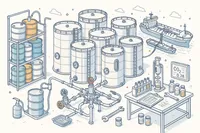
Track every fuel and lubricant grade your fleet uses with 24 built-in consumable types. Eight fossil fuels — MGO, MDO, IFO, MFO, HFO, LFO, LNG, and LPG — cover the full range of marine propulsion and auxiliary fuels.
Two sustainable fuels — Ethanol and Methanol — support the transition to alternative energy sources.
Ten lubricant grades — Engine Oil, Cylinder Oil, System Oil, Hydraulic Oil, Gear Oil, Air Compressor Oils, Refrigeration Oils, Gas Compressor Oils, Bearing and Circulating Oils, and Turbine Oils — cover every mechanical system onboard. Each type carries a predefined CO2 conversion factor (CF) enabling automatic emission calculation without manual lookup or configuration.
- 8 fossil fuels (MGO, MDO, IFO, MFO, HFO, LFO, LNG, LPG)
- 2 sustainable fuels (Ethanol, Methanol)
- 10+ lubricant grades (Engine, Cylinder, Hydraulic, etc.)
- Per-type CO2 conversion factors (CF)
- Ready for alternative fuel transition
10 Consumption & Waste Categories

Organize all consumables and waste streams into ten structured categories that mirror operational reality. Five consumable categories — Residual and Distillate Fuels, Lubricants, Additives, Fresh Water, and Technical Water — cover every input your vessels require.
Four waste categories — Sludge, Dirty Oil, Bilge, and Garbage — track every output that requires disposal or offloading.
Each category carries its own storage rules (single or multiple items per ship), rank-based access authorization, and unit of measurement defaults. Category-specific configuration ensures that engine officers manage fuel and lubricant records while deck officers handle water and waste — reflecting the real division of responsibility onboard.
- 5 consumable categories (Fuels, Lubricants, Additives, Water)
- 4 waste categories (Sludge, Dirty Oil, Bilge, Garbage)
- Category-specific storage rules
- Rank-based access per category
- Unit of measurement defaults
Five Transaction Log Types

Record every consumable movement with five purpose-built transaction types. Operational logs capture daily consumption during normal vessel operations.
Loss logs document unexpected depletion — leaks, spills, or measurement discrepancies. Addition logs record bunkering, freshwater loading, and lubricant top-ups.
Offboard logs track transfers to shore facilities, barges, or other vessels. Waste logs record sludge discharge, bilge water processing, and garbage disposal.
Each transaction type captures quantity, date, remarks, and the responsible officer — building a complete, categorized ledger of every consumable movement.
- Operational — daily consumption
- Loss — spills, leaks, discrepancies
- Addition — bunkering & top-ups
- Offboard — transfers to shore/barge
- Waste — sludge, bilge, garbage disposal
Five Units of Measurement

Measure consumables and waste in the unit that matches each category and operational context. Five supported units — Metric Tonnes (MT), Cubic Metres (M³), Litres, Kilograms (KG), and Gallons — cover every measurement standard used across global maritime operations.
Unit assignment is managed per item, ensuring that fuel quantities are tracked in MT while lubricant volumes use Litres and freshwater uses M³. Consistent unit enforcement across the fleet eliminates conversion errors, enables accurate aggregation in analytics, and ensures regulatory reports use the correct measurement basis.
- Metric Tonnes (MT) for fuels
- Cubic Metres (M³) for water
- Litres for lubricants
- Kilograms (KG) and Gallons
- Consistent unit enforcement fleet-wide
CO2 Emission Calculation

Calculate CO2 emissions automatically from fuel consumption data using per-fuel-type conversion factors (CF). Every one of the 24 fuel types carries its own CF value, enabling precise emission calculation without manual lookup tables or external spreadsheet formulas.
The system supports Energy Efficiency Operational Indicator (EEOI) calculation by linking fuel consumption to voyage distance and cargo data. Fleet managers can track emission intensity per voyage, per vessel, and across the entire fleet — providing the data foundation for IMO DCS, EU MRV, and CII compliance reporting.
- Per-fuel CO2 conversion factors (CF)
- Automatic EEOI calculation
- IMO DCS & EU MRV compliance
- CII reporting data foundation
- Voyage-linked emission intensity
PMS Equipment Integration
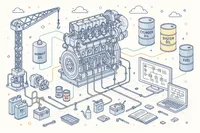
Link consumable items directly to the Planned Maintenance System equipment hierarchy. Attach specific fuel types to main engines, generators, and boilers.
Connect lubricant grades to the machinery that consumes them — cylinder oil to main engine cylinders, hydraulic oil to deck cranes, gear oil to reduction gearboxes.
Equipment integration creates a two-way relationship: engineers can see which consumables are associated with each piece of equipment, and consumption records automatically reference the equipment context. This linkage drives predictive maintenance insights — correlating lubricant consumption patterns with equipment condition and maintenance schedules.
- Link consumables to PMS equipment hierarchy
- Fuel-to-engine association
- Lubricant-to-machinery mapping
- Two-way equipment-consumable visibility
- Predictive maintenance correlation
Voyage & Noon Report Integration

Capture consumption data directly from voyage noon report forms, linking every fuel entry to the vessel's sailing state at the time of recording. When engineers submit noon reports during a voyage, consumption figures are automatically saved as CAW transaction logs with full voyage context — departure port, arrival port, sailing mode, and distance.
This integration eliminates double entry between the voyage reporting and consumption tracking workflows. Noon report consumption data flows into the CAW module for analytics, while the voyage module receives the fuel data it needs for speed-consumption correlation and EEOI calculation — a single entry powering multiple operational insights.
- Consumption captured from noon reports
- Automatic voyage context linkage
- Sailing state preservation (port, speed, mode)
- Eliminates double entry
- Feeds speed-consumption analytics
Rank-Based Access Control
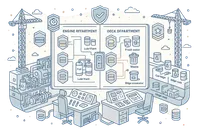
Enforce proper authority over consumable records with category-specific rank authorization. Engine officers — Chief Engineer, Second Engineer, and engine room ratings — manage fuel, lubricant, and additive categories.
Deck officers — Master, Chief Officer, and deck ratings — manage fresh water, technical water, and waste categories.
Rank-based access reflects the real division of responsibility onboard: the Chief Engineer owns bunker management while the Master oversees water and waste compliance. The system prevents unauthorized modifications, ensures accountability, and satisfies ISM Code requirements for clear responsibility assignment in safety-critical operations.
- Engine officers manage fuel & lubricants
- Deck officers manage water & waste
- Category-specific authorization
- ISM Code responsibility compliance
- Server-side enforcement on every write
Daily Amount Tracking

Track consumption at daily granularity with automatic delta calculation between today's amount and the running total. Every consumable item maintains both a current total quantity (ROB — Remaining on Board) and a daily operational amount, enabling engineers to monitor daily burn rates and identify anomalies immediately.
The per-date tracking model supports historical queries — look up the exact ROB for any item on any past date. Daily deltas feed into trend analysis, enabling shore management to spot overconsumption before it becomes a supply problem.
The system highlights significant daily variances against expected consumption rates for proactive fleet management.
- Daily delta vs. running total (ROB)
- Per-date historical queries
- Anomaly detection on daily variances
- Trend analysis for consumption rates
- Proactive overconsumption alerts
Speed-Consumption Analytics

Correlate vessel speed modes with fuel consumption to optimize voyage economics. The analytics engine cross-references CAW data with voyage sailing states, producing speed-consumption curves for Eco and Normal speed modes across Laden and Ballast conditions — the four key operational dimensions that determine fuel efficiency.
Fleet managers can compare actual consumption against charter party guarantees, identify vessels that overconsume at specific speeds, and make data-driven decisions about optimal sailing speeds. The Eco/Normal × Laden/Ballast matrix provides a complete picture of each vessel's fuel performance envelope.
- Eco/Normal speed mode correlation
- Laden/Ballast condition matrix
- Charter party guarantee comparison
- Vessel-to-vessel benchmarking
- Optimal speed recommendations
Fleet Fuel Analytics

Analyze fuel consumption patterns across your entire fleet with dedicated analytics dashboards. Per-voyage consumption breakdowns show fuel use by leg, port, and sailing mode.
Per-ship consumption summaries enable vessel-to-vessel benchmarking. Yearly trend charts reveal long-term efficiency improvements or degradation.
Five dedicated analytics handlers on the company side process consumption data into actionable intelligence — total consumption by fuel type, consumption per nautical mile, cost per voyage, emission intensity trends, and fleet-wide ROB status. Drill down from fleet overview to individual vessel to specific voyage for root-cause analysis.
- Per-voyage consumption breakdowns
- Per-ship consumption summaries
- Yearly trend charts
- Fleet-wide ROB status
- 5 dedicated analytics handlers
Comments & File Attachments

Document every consumable record with threaded comments and multi-file attachments. Add remarks to explain unusual consumption events — a bunker quality issue, a tank measurement discrepancy, or a waste discharge operation.
Attach supporting files: bunker delivery notes, fuel quality certificates, waste disposal receipts, and tank sounding records.
File uploads are powered by Uppy.js for reliable multi-file handling with progress tracking. Every comment and file action (add, edit, remove) is recorded in the event log with full user attribution.
The combination of structured transaction data and contextual documentation creates a complete record for regulatory compliance and operational review.
- Threaded comments per consumable item
- Multi-file upload via Uppy.js
- Bunker delivery notes & certificates
- Waste disposal receipts
- Full event logging per action
Storage Rule Configuration
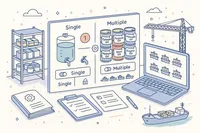
Configure whether each consumption category allows a single item or multiple items per ship. Single-item categories (e.g., Fresh Water) maintain one running total per vessel — simple and unambiguous.
Multiple-item categories (e.g., Lubricants) allow separate tracking of each grade — Cylinder Oil, System Oil, Hydraulic Oil — with independent quantities and transaction histories.
Storage rules are set at the category level and enforced fleet-wide, ensuring consistent data structure across all vessels. When a category is configured for single storage, the system prevents duplicate items.
When configured for multiple storage, it allows unlimited items with clear identification by type and equipment association.
- Single or multiple items per category
- Fleet-wide consistency enforcement
- Duplicate prevention for single-item categories
- Unlimited items for multi-item categories
Deprecation & Lifecycle Management

Manage the full lifecycle of consumable items with active and deprecated status tracking. When a fuel type is phased out, a lubricant grade is replaced, or an additive is no longer used, mark the item as Deprecated rather than deleting it.
Deprecated items retain their full transaction history for audit purposes while being hidden from active operational views.
Restore capability allows previously deprecated items to be reactivated when needed — a fuel type that returns to service or a lubricant grade that is re-sourced. The lifecycle model ensures clean operational views without sacrificing historical data integrity, satisfying both daily usability and long-term record-keeping requirements.
- Active & Deprecated item statuses
- Deprecated items retain full history
- Restore capability for reactivation
- Clean operational views preserved
Complete Audit Trail

Every action within the Consumption & Waste module is recorded across 16 event types. Item-level events — ItemAdded, ItemDeprecated, RemarksEdited, RemarksRemoved — track the lifecycle of each consumable.
Transaction events — LogAdded, LogEdited, LogDeleted — capture every quantity change with before-and-after values.
Collaboration events — FileAdded, FileRemoved, CommentAdded, CommentEdited, CommentRemoved — document all supporting activities. Equipment events — AddEquipment, RemovedEquipment — track PMS linkage changes.
Consumption-specific events — NewConsumption, AddConsumable, Offboard, NewWaste, and their edit variants — provide granular operational audit coverage. Every event carries full user attribution, timestamp, and contextual data.
- 16 event types
- Item lifecycle events (add, deprecate, remarks)
- Transaction events (log add, edit, delete)
- Equipment & collaboration events
- Full user attribution per event
24 Fuel & Lubricant Types
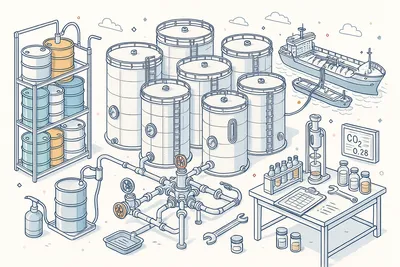
Track every fuel and lubricant grade your fleet uses with 24 built-in consumable types. Eight fossil fuels — MGO, MDO, IFO, MFO, HFO, LFO, LNG, and LPG — cover the full range of marine propulsion and auxiliary fuels.
Two sustainable fuels — Ethanol and Methanol — support the transition to alternative energy sources.
Ten lubricant grades — Engine Oil, Cylinder Oil, System Oil, Hydraulic Oil, Gear Oil, Air Compressor Oils, Refrigeration Oils, Gas Compressor Oils, Bearing and Circulating Oils, and Turbine Oils — cover every mechanical system onboard. Each type carries a predefined CO2 conversion factor (CF) enabling automatic emission calculation without manual lookup or configuration.
- 8 fossil fuels (MGO, MDO, IFO, MFO, HFO, LFO, LNG, LPG)
- 2 sustainable fuels (Ethanol, Methanol)
- 10+ lubricant grades (Engine, Cylinder, Hydraulic, etc.)
- Per-type CO2 conversion factors (CF)
- Ready for alternative fuel transition
10 Consumption & Waste Categories
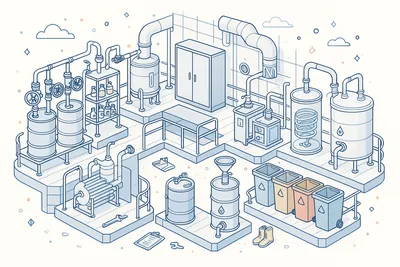
Organize all consumables and waste streams into ten structured categories that mirror operational reality. Five consumable categories — Residual and Distillate Fuels, Lubricants, Additives, Fresh Water, and Technical Water — cover every input your vessels require.
Four waste categories — Sludge, Dirty Oil, Bilge, and Garbage — track every output that requires disposal or offloading.
Each category carries its own storage rules (single or multiple items per ship), rank-based access authorization, and unit of measurement defaults. Category-specific configuration ensures that engine officers manage fuel and lubricant records while deck officers handle water and waste — reflecting the real division of responsibility onboard.
- 5 consumable categories (Fuels, Lubricants, Additives, Water)
- 4 waste categories (Sludge, Dirty Oil, Bilge, Garbage)
- Category-specific storage rules
- Rank-based access per category
- Unit of measurement defaults
Five Transaction Log Types

Record every consumable movement with five purpose-built transaction types. Operational logs capture daily consumption during normal vessel operations.
Loss logs document unexpected depletion — leaks, spills, or measurement discrepancies. Addition logs record bunkering, freshwater loading, and lubricant top-ups.
Offboard logs track transfers to shore facilities, barges, or other vessels. Waste logs record sludge discharge, bilge water processing, and garbage disposal.
Each transaction type captures quantity, date, remarks, and the responsible officer — building a complete, categorized ledger of every consumable movement.
- Operational — daily consumption
- Loss — spills, leaks, discrepancies
- Addition — bunkering & top-ups
- Offboard — transfers to shore/barge
- Waste — sludge, bilge, garbage disposal
Five Units of Measurement
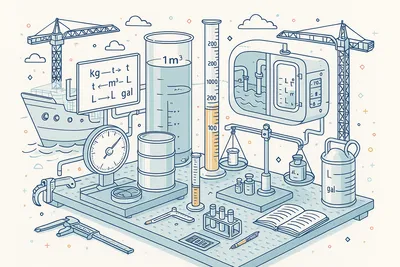
Measure consumables and waste in the unit that matches each category and operational context. Five supported units — Metric Tonnes (MT), Cubic Metres (M³), Litres, Kilograms (KG), and Gallons — cover every measurement standard used across global maritime operations.
Unit assignment is managed per item, ensuring that fuel quantities are tracked in MT while lubricant volumes use Litres and freshwater uses M³. Consistent unit enforcement across the fleet eliminates conversion errors, enables accurate aggregation in analytics, and ensures regulatory reports use the correct measurement basis.
- Metric Tonnes (MT) for fuels
- Cubic Metres (M³) for water
- Litres for lubricants
- Kilograms (KG) and Gallons
- Consistent unit enforcement fleet-wide
CO2 Emission Calculation

Calculate CO2 emissions automatically from fuel consumption data using per-fuel-type conversion factors (CF). Every one of the 24 fuel types carries its own CF value, enabling precise emission calculation without manual lookup tables or external spreadsheet formulas.
The system supports Energy Efficiency Operational Indicator (EEOI) calculation by linking fuel consumption to voyage distance and cargo data. Fleet managers can track emission intensity per voyage, per vessel, and across the entire fleet — providing the data foundation for IMO DCS, EU MRV, and CII compliance reporting.
- Per-fuel CO2 conversion factors (CF)
- Automatic EEOI calculation
- IMO DCS & EU MRV compliance
- CII reporting data foundation
- Voyage-linked emission intensity
PMS Equipment Integration
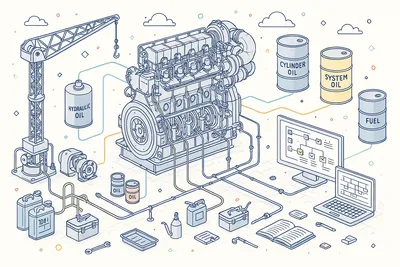
Link consumable items directly to the Planned Maintenance System equipment hierarchy. Attach specific fuel types to main engines, generators, and boilers.
Connect lubricant grades to the machinery that consumes them — cylinder oil to main engine cylinders, hydraulic oil to deck cranes, gear oil to reduction gearboxes.
Equipment integration creates a two-way relationship: engineers can see which consumables are associated with each piece of equipment, and consumption records automatically reference the equipment context. This linkage drives predictive maintenance insights — correlating lubricant consumption patterns with equipment condition and maintenance schedules.
- Link consumables to PMS equipment hierarchy
- Fuel-to-engine association
- Lubricant-to-machinery mapping
- Two-way equipment-consumable visibility
- Predictive maintenance correlation
Voyage & Noon Report Integration

Capture consumption data directly from voyage noon report forms, linking every fuel entry to the vessel's sailing state at the time of recording. When engineers submit noon reports during a voyage, consumption figures are automatically saved as CAW transaction logs with full voyage context — departure port, arrival port, sailing mode, and distance.
This integration eliminates double entry between the voyage reporting and consumption tracking workflows. Noon report consumption data flows into the CAW module for analytics, while the voyage module receives the fuel data it needs for speed-consumption correlation and EEOI calculation — a single entry powering multiple operational insights.
- Consumption captured from noon reports
- Automatic voyage context linkage
- Sailing state preservation (port, speed, mode)
- Eliminates double entry
- Feeds speed-consumption analytics
Rank-Based Access Control
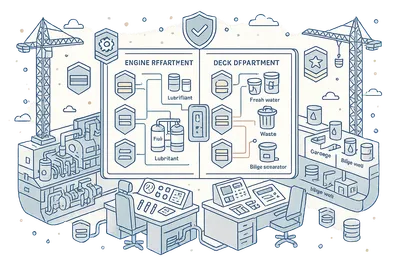
Enforce proper authority over consumable records with category-specific rank authorization. Engine officers — Chief Engineer, Second Engineer, and engine room ratings — manage fuel, lubricant, and additive categories.
Deck officers — Master, Chief Officer, and deck ratings — manage fresh water, technical water, and waste categories.
Rank-based access reflects the real division of responsibility onboard: the Chief Engineer owns bunker management while the Master oversees water and waste compliance. The system prevents unauthorized modifications, ensures accountability, and satisfies ISM Code requirements for clear responsibility assignment in safety-critical operations.
- Engine officers manage fuel & lubricants
- Deck officers manage water & waste
- Category-specific authorization
- ISM Code responsibility compliance
- Server-side enforcement on every write
Daily Amount Tracking
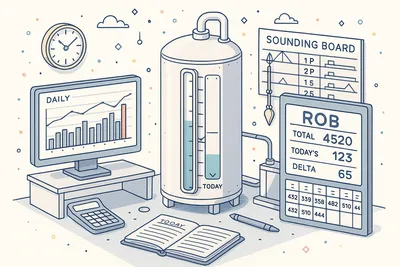
Track consumption at daily granularity with automatic delta calculation between today's amount and the running total. Every consumable item maintains both a current total quantity (ROB — Remaining on Board) and a daily operational amount, enabling engineers to monitor daily burn rates and identify anomalies immediately.
The per-date tracking model supports historical queries — look up the exact ROB for any item on any past date. Daily deltas feed into trend analysis, enabling shore management to spot overconsumption before it becomes a supply problem.
The system highlights significant daily variances against expected consumption rates for proactive fleet management.
- Daily delta vs. running total (ROB)
- Per-date historical queries
- Anomaly detection on daily variances
- Trend analysis for consumption rates
- Proactive overconsumption alerts
Speed-Consumption Analytics
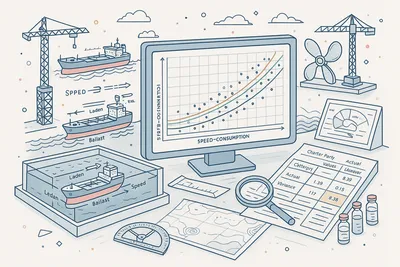
Correlate vessel speed modes with fuel consumption to optimize voyage economics. The analytics engine cross-references CAW data with voyage sailing states, producing speed-consumption curves for Eco and Normal speed modes across Laden and Ballast conditions — the four key operational dimensions that determine fuel efficiency.
Fleet managers can compare actual consumption against charter party guarantees, identify vessels that overconsume at specific speeds, and make data-driven decisions about optimal sailing speeds. The Eco/Normal × Laden/Ballast matrix provides a complete picture of each vessel's fuel performance envelope.
- Eco/Normal speed mode correlation
- Laden/Ballast condition matrix
- Charter party guarantee comparison
- Vessel-to-vessel benchmarking
- Optimal speed recommendations
Fleet Fuel Analytics

Analyze fuel consumption patterns across your entire fleet with dedicated analytics dashboards. Per-voyage consumption breakdowns show fuel use by leg, port, and sailing mode.
Per-ship consumption summaries enable vessel-to-vessel benchmarking. Yearly trend charts reveal long-term efficiency improvements or degradation.
Five dedicated analytics handlers on the company side process consumption data into actionable intelligence — total consumption by fuel type, consumption per nautical mile, cost per voyage, emission intensity trends, and fleet-wide ROB status. Drill down from fleet overview to individual vessel to specific voyage for root-cause analysis.
- Per-voyage consumption breakdowns
- Per-ship consumption summaries
- Yearly trend charts
- Fleet-wide ROB status
- 5 dedicated analytics handlers
Comments & File Attachments

Document every consumable record with threaded comments and multi-file attachments. Add remarks to explain unusual consumption events — a bunker quality issue, a tank measurement discrepancy, or a waste discharge operation.
Attach supporting files: bunker delivery notes, fuel quality certificates, waste disposal receipts, and tank sounding records.
File uploads are powered by Uppy.js for reliable multi-file handling with progress tracking. Every comment and file action (add, edit, remove) is recorded in the event log with full user attribution.
The combination of structured transaction data and contextual documentation creates a complete record for regulatory compliance and operational review.
- Threaded comments per consumable item
- Multi-file upload via Uppy.js
- Bunker delivery notes & certificates
- Waste disposal receipts
- Full event logging per action
Storage Rule Configuration
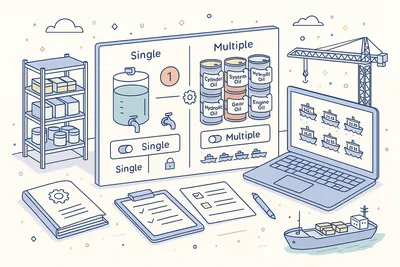
Configure whether each consumption category allows a single item or multiple items per ship. Single-item categories (e.g., Fresh Water) maintain one running total per vessel — simple and unambiguous.
Multiple-item categories (e.g., Lubricants) allow separate tracking of each grade — Cylinder Oil, System Oil, Hydraulic Oil — with independent quantities and transaction histories.
Storage rules are set at the category level and enforced fleet-wide, ensuring consistent data structure across all vessels. When a category is configured for single storage, the system prevents duplicate items.
When configured for multiple storage, it allows unlimited items with clear identification by type and equipment association.
- Single or multiple items per category
- Fleet-wide consistency enforcement
- Duplicate prevention for single-item categories
- Unlimited items for multi-item categories
Deprecation & Lifecycle Management
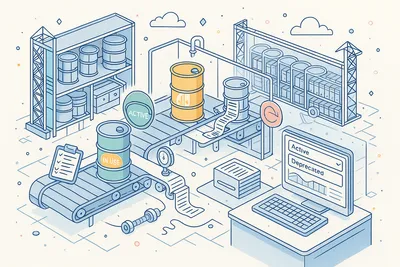
Manage the full lifecycle of consumable items with active and deprecated status tracking. When a fuel type is phased out, a lubricant grade is replaced, or an additive is no longer used, mark the item as Deprecated rather than deleting it.
Deprecated items retain their full transaction history for audit purposes while being hidden from active operational views.
Restore capability allows previously deprecated items to be reactivated when needed — a fuel type that returns to service or a lubricant grade that is re-sourced. The lifecycle model ensures clean operational views without sacrificing historical data integrity, satisfying both daily usability and long-term record-keeping requirements.
- Active & Deprecated item statuses
- Deprecated items retain full history
- Restore capability for reactivation
- Clean operational views preserved
Complete Audit Trail

Every action within the Consumption & Waste module is recorded across 16 event types. Item-level events — ItemAdded, ItemDeprecated, RemarksEdited, RemarksRemoved — track the lifecycle of each consumable.
Transaction events — LogAdded, LogEdited, LogDeleted — capture every quantity change with before-and-after values.
Collaboration events — FileAdded, FileRemoved, CommentAdded, CommentEdited, CommentRemoved — document all supporting activities. Equipment events — AddEquipment, RemovedEquipment — track PMS linkage changes.
Consumption-specific events — NewConsumption, AddConsumable, Offboard, NewWaste, and their edit variants — provide granular operational audit coverage. Every event carries full user attribution, timestamp, and contextual data.
- 16 event types
- Item lifecycle events (add, deprecate, remarks)
- Transaction events (log add, edit, delete)
- Equipment & collaboration events
- Full user attribution per event
Technical
Under the Hood
Architecture and engineering behind Consumption & Waste — data handling, real-time sync, and interface design.
CO2 Emission Factor Engine
Twenty-four fuel-specific CO2 conversion factor (CF) values are embedded in the system for automatic EEOI calculation. Each fuel type — from HFO to Methanol — carries its IMO-standard CF value, enabling emission computation without external lookup tables.
The engine integrates with voyage distance data for per-nautical-mile emission intensity.
Voyage-Integrated Consumption Logging
Consumption entries captured during voyage noon reports are automatically linked to the vessel's SavedSailingState — preserving departure port, arrival port, sailing mode, speed, and distance context. This linkage powers speed-consumption correlation analytics and eliminates double entry between voyage and consumption workflows.
Rank-Authorized Category Access
Category-specific rank authorization enforces proper authority at the data level. Engine officers manage fuel, lubricant, and additive categories while deck officers manage water and waste.
Authorization is checked on every write operation, preventing unauthorized modifications regardless of client-side UI state.
Speed-Consumption Correlation Analytics
Five dedicated analytics handlers compute speed-consumption correlations across the Eco/Normal × Laden/Ballast matrix. Per-voyage and per-ship breakdowns enable fleet managers to benchmark fuel efficiency across vessels, identify overconsumption patterns, and optimize sailing speed profiles for charter party compliance.
Dual-Context Ship+Company Architecture
The module operates across two contexts — ship-side with 8 action handlers for onboard operations, and company-side with 12 action handlers including 5 dedicated analytics endpoints. Both contexts share the same 7 core domain models and 2 support enums, ensuring data consistency between vessel and shore.
Immutable Event Logging
Sixteen event types capture every action in a tamper-proof log — from ItemAdded and NewConsumption to Offboard and NewWaste, including edit variants for full before-and-after tracking. The log powers audit trail compliance, real-time notifications, and operational analytics across the entire fleet.
Same Category
Related Modules
Other Operation modules that integrate with Consumption & Waste.
Plan and manage drydock projects, specifications, and yard coordination end to end.
Solutions
Explore Solutions
Compliance and operational solutions powered by Consumption & Waste.
CII & EEXI Compliance
Navatom provides real-time Carbon Intensity Indicator monitoring, EEXI baseline management, and SEEMP integration to help ship managers maintain favorable efficiency ratings and avoid corrective action requirements.
Maritime Data Integrity & Retention
Navatom has never lost customer data. Years of maintenance records, voyage reports, crew documents, and compliance evidence — stored indefinitely, accessible instantly, and preserved with complete integrity.
EU ETS for Shipping
Navatom integrates EU Emissions Trading System compliance into your fleet operations, calculating allowance obligations from verified MRV data, tracking carbon costs per voyage, and forecasting ETS expenditure across your fleet.
EU MRV Reporting
Navatom automates EU MRV emissions monitoring, reporting, and verification for ships calling at EU/EEA ports, ensuring full compliance with Regulation (EU) 2015/757 and its 2023 amendments.
Fleet Scalability & Rapid Onboarding
Add vessels to Navatom in minutes, not months. As a maritime cloud platform, Navatom requires no installation, no infrastructure scaling, and no IT projects — whether you are onboarding your second vessel or your two-hundredth.
FuelEU Maritime Compliance
Navatom helps ship operators meet FuelEU Maritime requirements by tracking well-to-wake GHG intensity, monitoring compliance balances, and supporting fleet pooling strategies under Regulation (EU) 2023/1805.
IMO DCS Reporting
Navatom automates IMO Data Collection System reporting by capturing fuel consumption, distance, and hours underway from daily operations and generating flag state submissions in compliance with MARPOL Annex VI Regulation 22A.
Ship Management for Large Fleets
Navatom is an integrated ship management platform that manages large fleets with the same ease as small ones — 30+ modules, instant vessel onboarding, years of operational data retained without performance loss, and a zero data loss track record since launch.
Ship Management for Small Fleets
Navatom gives small fleet operators access to the same 30+ integrated ship management modules used by large fleets — with no installation, per-ship pricing, and the ability to start from just one vessel.
Ready to try Consumption & Waste?
Start your free trial today and see how Consumption & Waste fits into your fleet operations.