What Is SIRE 2.0?
The Ship Inspection Report Programme, or SIRE, is OCIMF's vessel inspection scheme used by oil majors, terminals, and charterers to assess the operational standards of tankers, barges, and offshore vessels. SIRE 2.0, launched in 2023, represents a fundamental redesign of the original programme that had been in use since 1993.
The new version replaces the fixed Vessel Inspection Questionnaire (VIQ) with a risk-focused inspection methodology that evaluates how well a vessel's crew actually performs its operations, rather than simply checking whether documented procedures exist.
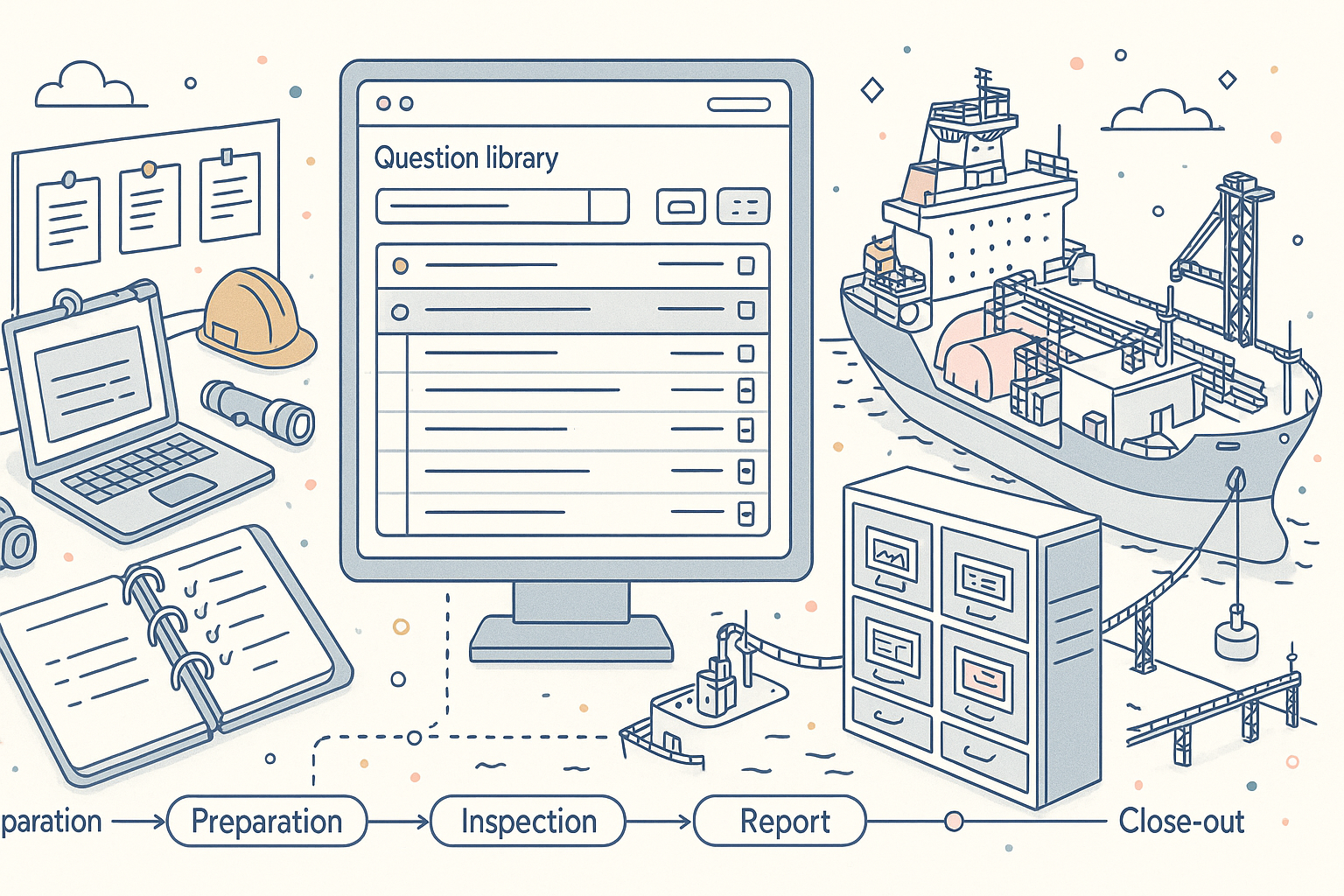
Under SIRE 2.0, each inspection is tailored to the specific vessel and its operational context. Inspectors draw from a question bank organized by operational domains, such as navigation, cargo operations, mooring, and safety management, selecting questions based on the vessel type, trade route, and risk profile.
This means that two inspections of the same vessel may focus on different areas depending on the circumstances. The inspection also incorporates a stronger emphasis on the human element, assessing crew competence through direct observation and questioning rather than relying solely on documentation review.
SIRE 2.0 introduces a more granular assessment scale. Instead of the binary pass-fail observations used in the original programme, inspectors now rate their findings on a scale that captures the degree to which the vessel meets expected standards.
This provides charterers and operators with a more nuanced picture of vessel performance. The data generated by SIRE 2.0 inspections is also more structured, enabling better benchmarking and trend analysis across the OCIMF membership.
The transition to SIRE 2.0 has been one of the most significant changes in the tanker vetting landscape in three decades. For operators, it means that the old approach of preparing a crew for a predictable questionnaire no longer works.
Instead, operators must ensure that their management systems are genuinely embedded in daily operations and that crew members can demonstrate competence under observation, not just on paper.
Key Differences from the Original SIRE
The most fundamental difference is the shift from a comprehensive, fixed questionnaire to focused, risk-targeted inspections. The original SIRE programme used a Vessel Inspection Questionnaire containing several hundred sequentially numbered questions that inspectors worked through systematically.
Every inspection covered the same ground, regardless of the vessel's particular risk profile. SIRE 2.0 replaces this with a question bank organized by operational domain, from which inspectors select questions relevant to the specific inspection context.
This makes inspections more unpredictable for operators, as the crew cannot anticipate exactly which areas will be examined.
The human element assessment is another major departure. Under the original programme, inspectors primarily reviewed documentation and physical conditions.
SIRE 2.0 places significantly more weight on observing crew members performing actual tasks and assessing their competence through direct questioning. Inspectors may ask a deck officer to demonstrate how they conduct a pre-arrival checklist, or observe an engineering officer performing a routine maintenance task.
This focus on demonstrated competence rather than documented procedures means that crew training, familiarization, and day-to-day practice become central to inspection readiness.
The assessment methodology has also changed. The original SIRE used binary observations: either a satisfactory or unsatisfactory condition was noted.
SIRE 2.0 uses a graduated assessment that captures the degree of compliance. This means that a vessel may receive a moderate finding rather than a clean pass, providing charterers with more information for their vetting decisions.
The graduated scale also reduces the tendency toward defensive observation reporting that sometimes characterized the original programme.
Data integration with TMSA is tighter under SIRE 2.0. The operator's TMSA self-assessment informs the inspection planning process, helping inspectors identify areas where the operator claims high maturity and areas where performance may be weaker.
This alignment means that operators who overstate their TMSA maturity face increased scrutiny during SIRE inspections, creating a natural incentive for honest self-assessment. The integration also means that strong TMSA implementation translates more directly into positive SIRE outcomes than it did under the original programme.
Finally, SIRE 2.0 generates more structured, machine-readable data. Inspection results are stored in a standardized format that enables trend analysis, fleet benchmarking, and risk profiling at a level not possible with the free-text observation reports of the original programme.
For operators, this means that their inspection performance is more visible and more easily compared against industry peers, raising the stakes for consistent operational excellence.
Preparing Your Fleet
Documentation readiness is the foundation of SIRE 2.0 preparation. All Safety Management System procedures, work instructions, risk assessments, and operational checklists must be current, approved, and accessible to the crew who use them.
Under the risk-focused approach, inspectors may examine any operational area in depth, so there is no safe corner where outdated documentation can hide. Companies should conduct a thorough review of their SMS documentation, ensuring that every procedure reflects actual practice and that crew members know where to find the documents relevant to their duties.
Non-conformity resolution demands particular attention. Inspectors will examine the vessel's record of findings from previous inspections, audits, and port state control detentions.
Every open finding must have a documented corrective action plan with clear responsibility, deadlines, and evidence of progress. Closed findings should show the root cause analysis, the corrective action taken, and verification that the action was effective.
A pattern of unresolved or recurring findings signals systemic weakness to inspectors and can significantly affect the inspection outcome.
Crew competency is perhaps the area most affected by the SIRE 2.0 transition. Because inspectors now assess competence through direct observation and questioning, crew members must be genuinely familiar with the procedures they are responsible for, not just aware that procedures exist.
This means that training records, familiarization records, and drill participation records must be complete and current. More importantly, the crew must be able to demonstrate their competence in practice.
Companies should conduct regular internal drills and assessments that simulate the kind of observation-based assessment that SIRE 2.0 inspectors perform.
Equipment readiness rounds out the preparation requirements. Maintenance records must demonstrate that equipment is maintained according to the manufacturer's recommendations and the company's planned maintenance schedule.
Test certificates, calibration records, and condition monitoring data should be readily accessible. Critical equipment should have defined failure modes and contingency procedures.
Inspectors may focus on any equipment system, so selective preparation is no longer viable; the entire maintenance programme must be robust and well-documented.
Risk assessment records complete the picture. SIRE 2.0 inspectors expect to see evidence that the vessel has a systematic process for identifying hazards, assessing risks, and implementing control measures for all routine and non-routine operations.
This includes operational risk assessments, permit-to-work records, toolbox talk documentation, and records of how risk assessment outcomes have influenced operational decisions. The depth of risk assessment evidence is a strong indicator of management system maturity and is scrutinized closely during inspections.
How Software Supports SIRE 2.0 Readiness
Ship management software supports SIRE 2.0 readiness by ensuring that operational data is complete, current, and accessible at all times, not just when an inspection is imminent. The unpredictable nature of SIRE 2.0 inspections means that a vessel must be continuously ready rather than periodically prepared.
Software that captures operational data as a natural part of daily workflows makes this continuous readiness achievable without imposing additional administrative burden on the crew.
Centralized documentation management ensures that SMS procedures, work instructions, and operational records are accessible from both shore and ship. When an inspector asks to see a specific procedure, the crew can retrieve the current, controlled version immediately rather than searching through filing cabinets or outdated binders.
The system's version control guarantees that obsolete documents are not in operational use, eliminating one of the most common inspection findings under both the original SIRE and SIRE 2.0.
Non-conformity tracking with closure evidence is critical for demonstrating that findings are managed systematically. Software that maintains a complete lifecycle record for each finding, from initial report through investigation, corrective action, and verified closure, provides exactly the kind of evidence that SIRE 2.0 inspectors look for.
The ability to show the status of all open and recently closed findings in a single view demonstrates management system maturity and proactive safety management.
Training and drill records maintained in a management platform are readily available for inspector review. The system can show each crew member's certification status, training history, familiarization records, and drill participation.
For the competence-based assessment that SIRE 2.0 emphasizes, this evidence chain links formal training to practical application, demonstrating that competence development is systematic rather than ad hoc.
Maintenance history stored in a planned maintenance system demonstrates equipment reliability and proactive asset management. Inspectors can see completed maintenance jobs, overdue items, equipment failure trends, and spare parts availability.
This data tells a story about how well the vessel is maintained over time, which is far more compelling than a snapshot of current conditions. The integration of maintenance data with non-conformity records also shows how equipment-related findings are tracked and resolved within the broader management system.
How Navatom Helps
Navatom's integrated platform addresses SIRE 2.0 readiness across every operational domain that inspectors may examine. Because all modules share a common data layer, the evidence produced during daily operations is automatically available for inspection purposes.
There is no need to assemble data from separate systems or reconcile conflicting records, which is a common source of stress and errors during pre-inspection preparation.
The Audit Management module tracks inspection findings and corrective actions with a structured workflow that mirrors what SIRE 2.0 inspectors expect to see. Findings from any source, whether SIRE inspections, port state control, internal audits, or oil major vetting reviews, are recorded in a consistent format with root cause analysis, corrective action assignment, and verified closure.
The module maintains a complete history of each finding, enabling the operator to demonstrate a pattern of timely and effective corrective action across multiple inspection cycles.
The Non-Conformity module ensures that nothing falls through the cracks. Every non-conformity, whether raised during an inspection, an internal audit, or a routine observation by crew, enters the same tracking system.
Automated reminders prevent overdue items from being forgotten, and the escalation workflow ensures that persistent or critical findings receive management attention. For SIRE 2.0, where inspectors specifically look for evidence that findings are managed systematically, this closed-loop approach is essential.
The Document Management module provides controlled, versioned SMS documentation that is accessible to crew and shore personnel alike. Every document has a defined approval workflow, distribution list, and acknowledgment tracking.
When inspectors ask to see a specific procedure, the crew can retrieve it instantly from the system, along with evidence that they have read and acknowledged the current version. This level of document control is a baseline expectation under SIRE 2.0 and one that paper-based systems consistently fail to deliver.
The Training Management module maintains comprehensive crew competency records, including certifications, course completions, onboard familiarization, and competency assessments. The Drills and Emergency module shows a complete record of emergency preparedness activities with outcomes, participants, and follow-up actions.
The Risk Assessment module demonstrates that hazard identification and risk evaluation are embedded in operational decision-making. Together, these modules provide the evidence of management system maturity that SIRE 2.0 is designed to assess.
Because Navatom is a cloud platform, all data is available in real time from anywhere. During an inspection, shore management can see exactly what the inspector is reviewing and provide support as needed.
After an inspection, findings flow immediately into the corrective action workflow without delay. This real-time connectivity between shore and ship eliminates the communication gaps that often lead to unresolved findings and repeated observations.
For operators also pursuing TMSA improvement, the same data that supports SIRE 2.0 readiness serves as evidence for TMSA self-assessment, creating a unified compliance framework across both OCIMF programmes.