All 16 Features
Every feature in Deficiencies is built for daily maritime work — simple to use, fast to navigate, and fully integrated with the rest of Navatom.
Six-Stage Issue Lifecycle
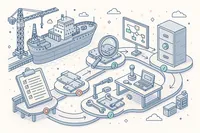
Every deficiency follows a controlled six-stage progression from initial discovery through to verified resolution. The lifecycle ensures that no issue can be prematurely closed without completing the required investigation, corrective action, and verification steps.
Clear status visibility at every stage means your DPA, fleet superintendent, and vessel master always know exactly where each deficiency stands. Overdue items are immediately visible, and stage transitions are enforced to maintain process discipline across your entire fleet.
- Controlled progression from discovery to closure
- Stage transition enforcement
- Overdue visibility at every stage
- No premature closure without verification
Rules-Based Root Cause Analysis
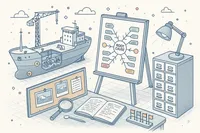
Investigate the real cause behind every deficiency using twelve predefined root cause categories. Rather than relying on free-text descriptions that vary between investigators, the rules-based system ensures consistent, comparable analysis across all vessels and all deficiency types.
Each root cause category is designed around recognized maritime investigation frameworks. When your team selects a root cause, the system captures not just what went wrong, but why — building a fleet-wide knowledge base that reveals systemic patterns and prevents recurrence.
- 12 predefined root cause categories
- Consistent analysis across all vessels
- Fleet-wide root cause pattern detection
- Maritime investigation framework alignment
Interim, Corrective & Preventive Actions

Address deficiencies at three levels: interim actions contain the immediate risk, corrective actions fix the specific problem, and preventive actions address the underlying system weakness. Each action type has its own assignment, deadline, evidence requirements, and verification workflow.
This three-tier approach mirrors best practice in maritime safety management. An interim action might restrict equipment use while a corrective action replaces a faulty component and a preventive action updates the maintenance schedule to prevent recurrence. All three are tracked independently with full accountability.
- Interim actions contain immediate risk
- Corrective actions fix the specific problem
- Preventive actions address system weakness
- Independent tracking per action type
Audit Finding Conversion
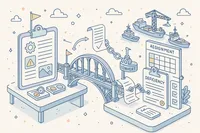
When an audit finding warrants formal tracking, convert it into a deficiency with a single action. The conversion carries forward all evidence, observations, and context from the original finding, creating a fully documented deficiency record ready for root cause analysis and corrective action.
No duplicate data entry, no lost context. The permanent link between the audit finding and the resulting deficiency means your compliance team can trace any corrective action back to the specific assessment observation that triggered it.
- One-action finding conversion
- Evidence & context carry-forward
- Permanent finding-deficiency linkage
- No duplicate data entry
Priority & Severity Classification

Classify every deficiency by both priority and severity to ensure the most critical issues receive immediate attention. Priority determines how urgently the issue must be addressed; severity captures the potential impact on safety, compliance, or operations.
This dual classification drives your team's workflow: high-priority, high-severity deficiencies appear at the top of every list and dashboard. Lower-severity observations are still tracked but don't crowd out the issues that need immediate action.
- Dual priority and severity ratings
- Critical issues surface automatically
- Dashboard-driven urgency ranking
- Proportionate response guidance
Equipment & Ship Section Linkage
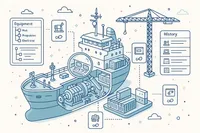
Connect every deficiency directly to the equipment item or ship section where it was found. This linkage transforms your deficiency records from a flat list of issues into an equipment-aware intelligence system that reveals which assets generate the most problems.
When a deficiency is linked to a specific piece of equipment, your maintenance team gains immediate context: What other deficiencies has this equipment had? Is there a pattern?
Should the maintenance schedule be adjusted? Equipment linkage turns individual deficiencies into actionable maintenance intelligence.
- Direct equipment item linkage
- Ship section identification
- Equipment deficiency history
- Maintenance intelligence integration
Ship & Office Issue Tracking

Track deficiencies from both ship and office environments in a single unified system. Issues discovered onboard are visible to shore management immediately, and office-initiated deficiencies are communicated to vessel crews without manual handoff.
The dual-context approach ensures that your DPA sees the same deficiency data as the vessel master. Whether an issue is raised by a crew member during a routine check or by a superintendent during a vessel visit, it enters the same workflow with the same accountability.
- Unified ship and shore visibility
- No manual handoff required
- Real-time status synchronization
- DPA and master see same data
Crew Assignment & Responsibility

Assign clear responsibility for every deficiency to specific crew members or shore personnel. Each assignment includes the scope of responsibility, expected actions, and deadlines. Responsible parties receive notifications and can update progress directly from their workstation.
Multiple assignments per deficiency support complex resolution scenarios — an engineer may handle the corrective action while a safety officer oversees the investigation and the master verifies completion. Everyone knows their role and deadline.
- Named responsibility per deficiency
- Multiple assignments supported
- Deadline and scope tracking
- Notification on assignment
Postponement Management

When a deficiency cannot be resolved within the original timeline, the postponement process captures the reason, the new target date, and the approval. Every postponement is recorded with full justification and authorization, maintaining accountability while acknowledging operational reality.
Postponement history is permanently visible in the deficiency record. Auditors and inspectors can see not just the current deadline, but every previous deadline and the documented reason for each extension. No hidden delays, no unexplained timeline changes.
- Documented reason for every extension
- Authorization tracking
- Full postponement history preserved
- Auditor-visible timeline changes
Confidential Reporting

Enable crew members to report deficiencies confidentially when the nature of the issue requires discretion. Confidential reports are visible only to authorized personnel, encouraging honest reporting of safety concerns without fear of reprisal.
A healthy safety culture depends on open reporting. Confidential reporting removes barriers that might prevent crew members from flagging critical safety issues, equipment problems, or procedural gaps that they observe in their daily work.
- Restricted visibility for sensitive issues
- Authorized personnel access only
- Encourages honest safety reporting
- No-reprisal reporting environment
Rich Descriptions & File Attachments

Document every deficiency with detailed descriptions and supporting evidence. Attach photographs, inspection reports, certificates, technical drawings, and any other files that help investigators understand and resolve the issue.
Rich documentation turns a brief deficiency note into a complete investigation package. When a corrective action team picks up the deficiency, they have all the context they need — photographs of the condition, relevant documents, and detailed observations — without chasing additional information.
- Detailed narrative descriptions
- Photo and document attachments
- Technical drawing support
- Complete investigation package
Threaded Comments & Collaboration

Discuss deficiencies in context with threaded comments attached directly to each record. Ship and shore personnel can exchange updates, ask questions, and share progress without switching to email or messaging applications.
The comment thread becomes part of the permanent deficiency record. Every discussion, decision, and clarification is captured in chronological order, creating a complete narrative of how the issue was investigated and resolved.
- In-context discussion threads
- Ship-shore collaboration
- Permanent comment record
- Chronological decision narrative
Complete Audit Trail
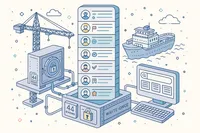
Every action on a deficiency is recorded in a tamper-proof event log with forty-four tracked event types. From initial creation through status changes, root cause updates, corrective action assignments, equipment linkage, and final closure — the audit trail captures it all.
The event log is not just a technical record — it is your compliance evidence. When an inspector asks "who approved this closure?" or "when was the root cause updated?", the answer is immediately available with full user attribution and timestamps.
- 44 tracked event types
- Full user attribution per event
- Tamper-proof event records
- Instant compliance evidence
Analytics & Dashboard
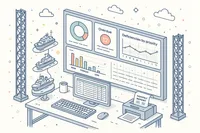
Monitor your deficiency program with dashboards that track closure rates, overdue items, deficiencies by priority and severity, and trend analysis over time. Fleet-wide views compare vessel performance and identify systemic patterns.
Analytics transform individual deficiency records into operational intelligence. Which deficiency categories are growing?
Which vessels have the highest closure rates? Where are corrective actions overdue? The dashboard answers these questions at a glance.
- Closure rate tracking
- Overdue item monitoring
- Priority & severity breakdowns
- Fleet-wide trend analysis
Fleet-Wide Archive & History

Access the complete history of every deficiency across your entire fleet. Closed deficiencies remain searchable and filterable, building an institutional knowledge base that supports trend analysis, recurring issue identification, and continuous improvement.
When a similar deficiency appears on another vessel, your team can search the archive for previous resolution approaches. The fleet-wide history turns past experience into a competitive advantage for safety and operational excellence.
- Full fleet deficiency history
- Searchable closed records
- Previous resolution lookup
- Trend analysis support
Calendar Integration & Scheduling

Schedule deficiency-related activities — inspections, corrective action deadlines, verification checks — directly into the Navatom calendar system. Calendar events keep your team aligned on upcoming deadlines and planned resolution activities.
Recurring deficiency reviews and follow-up inspections can be scheduled as repeating calendar events. Fleet-wide calendar visibility ensures that shore management and vessel crews share the same timeline for deficiency resolution.
- Deadline calendar events
- Recurring review scheduling
- Fleet-wide calendar visibility
- Corrective action timeline tracking
Six-Stage Issue Lifecycle
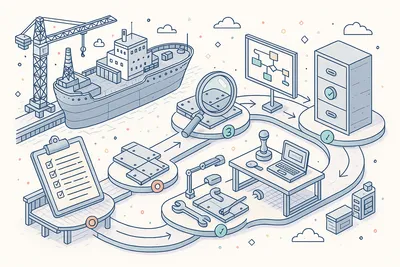
Every deficiency follows a controlled six-stage progression from initial discovery through to verified resolution. The lifecycle ensures that no issue can be prematurely closed without completing the required investigation, corrective action, and verification steps.
Clear status visibility at every stage means your DPA, fleet superintendent, and vessel master always know exactly where each deficiency stands. Overdue items are immediately visible, and stage transitions are enforced to maintain process discipline across your entire fleet.
- Controlled progression from discovery to closure
- Stage transition enforcement
- Overdue visibility at every stage
- No premature closure without verification
Rules-Based Root Cause Analysis
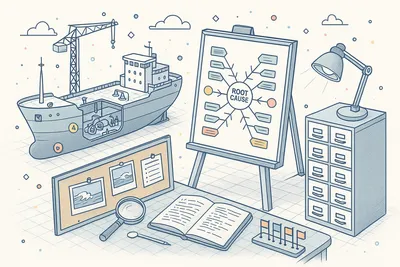
Investigate the real cause behind every deficiency using twelve predefined root cause categories. Rather than relying on free-text descriptions that vary between investigators, the rules-based system ensures consistent, comparable analysis across all vessels and all deficiency types.
Each root cause category is designed around recognized maritime investigation frameworks. When your team selects a root cause, the system captures not just what went wrong, but why — building a fleet-wide knowledge base that reveals systemic patterns and prevents recurrence.
- 12 predefined root cause categories
- Consistent analysis across all vessels
- Fleet-wide root cause pattern detection
- Maritime investigation framework alignment
Interim, Corrective & Preventive Actions
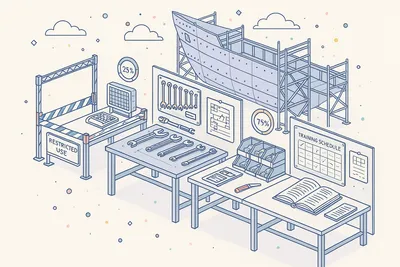
Address deficiencies at three levels: interim actions contain the immediate risk, corrective actions fix the specific problem, and preventive actions address the underlying system weakness. Each action type has its own assignment, deadline, evidence requirements, and verification workflow.
This three-tier approach mirrors best practice in maritime safety management. An interim action might restrict equipment use while a corrective action replaces a faulty component and a preventive action updates the maintenance schedule to prevent recurrence. All three are tracked independently with full accountability.
- Interim actions contain immediate risk
- Corrective actions fix the specific problem
- Preventive actions address system weakness
- Independent tracking per action type
Audit Finding Conversion
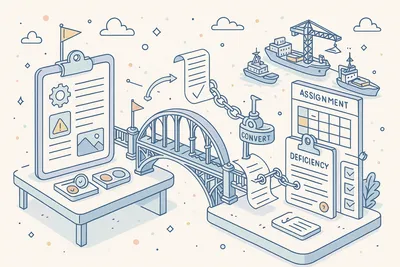
When an audit finding warrants formal tracking, convert it into a deficiency with a single action. The conversion carries forward all evidence, observations, and context from the original finding, creating a fully documented deficiency record ready for root cause analysis and corrective action.
No duplicate data entry, no lost context. The permanent link between the audit finding and the resulting deficiency means your compliance team can trace any corrective action back to the specific assessment observation that triggered it.
- One-action finding conversion
- Evidence & context carry-forward
- Permanent finding-deficiency linkage
- No duplicate data entry
Priority & Severity Classification
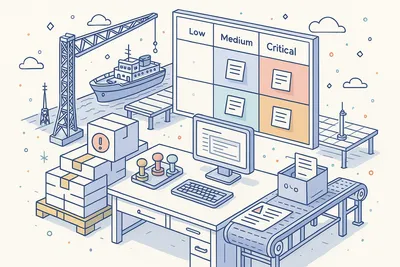
Classify every deficiency by both priority and severity to ensure the most critical issues receive immediate attention. Priority determines how urgently the issue must be addressed; severity captures the potential impact on safety, compliance, or operations.
This dual classification drives your team's workflow: high-priority, high-severity deficiencies appear at the top of every list and dashboard. Lower-severity observations are still tracked but don't crowd out the issues that need immediate action.
- Dual priority and severity ratings
- Critical issues surface automatically
- Dashboard-driven urgency ranking
- Proportionate response guidance
Equipment & Ship Section Linkage
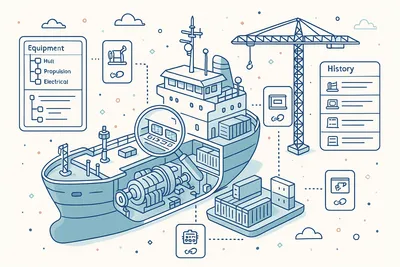
Connect every deficiency directly to the equipment item or ship section where it was found. This linkage transforms your deficiency records from a flat list of issues into an equipment-aware intelligence system that reveals which assets generate the most problems.
When a deficiency is linked to a specific piece of equipment, your maintenance team gains immediate context: What other deficiencies has this equipment had? Is there a pattern?
Should the maintenance schedule be adjusted? Equipment linkage turns individual deficiencies into actionable maintenance intelligence.
- Direct equipment item linkage
- Ship section identification
- Equipment deficiency history
- Maintenance intelligence integration
Ship & Office Issue Tracking

Track deficiencies from both ship and office environments in a single unified system. Issues discovered onboard are visible to shore management immediately, and office-initiated deficiencies are communicated to vessel crews without manual handoff.
The dual-context approach ensures that your DPA sees the same deficiency data as the vessel master. Whether an issue is raised by a crew member during a routine check or by a superintendent during a vessel visit, it enters the same workflow with the same accountability.
- Unified ship and shore visibility
- No manual handoff required
- Real-time status synchronization
- DPA and master see same data
Crew Assignment & Responsibility
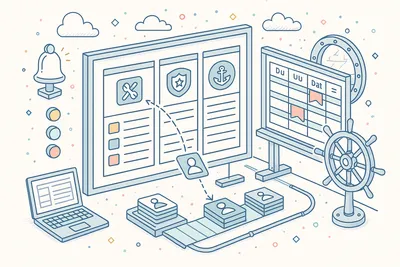
Assign clear responsibility for every deficiency to specific crew members or shore personnel. Each assignment includes the scope of responsibility, expected actions, and deadlines. Responsible parties receive notifications and can update progress directly from their workstation.
Multiple assignments per deficiency support complex resolution scenarios — an engineer may handle the corrective action while a safety officer oversees the investigation and the master verifies completion. Everyone knows their role and deadline.
- Named responsibility per deficiency
- Multiple assignments supported
- Deadline and scope tracking
- Notification on assignment
Postponement Management
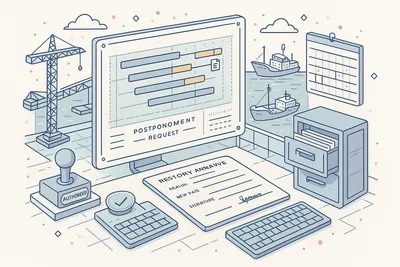
When a deficiency cannot be resolved within the original timeline, the postponement process captures the reason, the new target date, and the approval. Every postponement is recorded with full justification and authorization, maintaining accountability while acknowledging operational reality.
Postponement history is permanently visible in the deficiency record. Auditors and inspectors can see not just the current deadline, but every previous deadline and the documented reason for each extension. No hidden delays, no unexplained timeline changes.
- Documented reason for every extension
- Authorization tracking
- Full postponement history preserved
- Auditor-visible timeline changes
Confidential Reporting
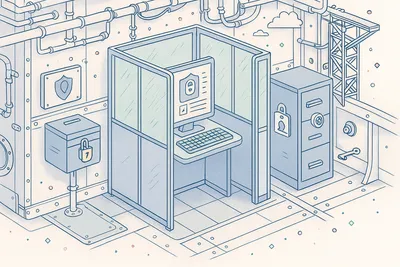
Enable crew members to report deficiencies confidentially when the nature of the issue requires discretion. Confidential reports are visible only to authorized personnel, encouraging honest reporting of safety concerns without fear of reprisal.
A healthy safety culture depends on open reporting. Confidential reporting removes barriers that might prevent crew members from flagging critical safety issues, equipment problems, or procedural gaps that they observe in their daily work.
- Restricted visibility for sensitive issues
- Authorized personnel access only
- Encourages honest safety reporting
- No-reprisal reporting environment
Rich Descriptions & File Attachments

Document every deficiency with detailed descriptions and supporting evidence. Attach photographs, inspection reports, certificates, technical drawings, and any other files that help investigators understand and resolve the issue.
Rich documentation turns a brief deficiency note into a complete investigation package. When a corrective action team picks up the deficiency, they have all the context they need — photographs of the condition, relevant documents, and detailed observations — without chasing additional information.
- Detailed narrative descriptions
- Photo and document attachments
- Technical drawing support
- Complete investigation package
Threaded Comments & Collaboration

Discuss deficiencies in context with threaded comments attached directly to each record. Ship and shore personnel can exchange updates, ask questions, and share progress without switching to email or messaging applications.
The comment thread becomes part of the permanent deficiency record. Every discussion, decision, and clarification is captured in chronological order, creating a complete narrative of how the issue was investigated and resolved.
- In-context discussion threads
- Ship-shore collaboration
- Permanent comment record
- Chronological decision narrative
Complete Audit Trail
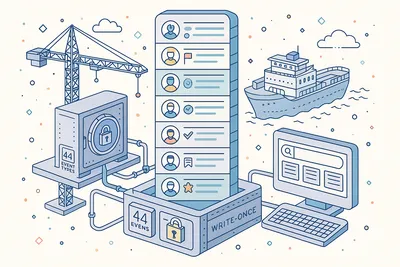
Every action on a deficiency is recorded in a tamper-proof event log with forty-four tracked event types. From initial creation through status changes, root cause updates, corrective action assignments, equipment linkage, and final closure — the audit trail captures it all.
The event log is not just a technical record — it is your compliance evidence. When an inspector asks "who approved this closure?" or "when was the root cause updated?", the answer is immediately available with full user attribution and timestamps.
- 44 tracked event types
- Full user attribution per event
- Tamper-proof event records
- Instant compliance evidence
Analytics & Dashboard
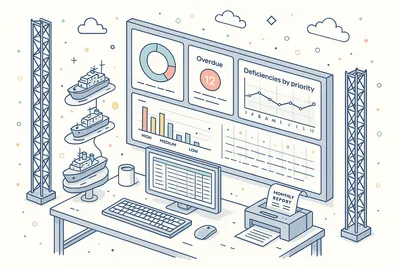
Monitor your deficiency program with dashboards that track closure rates, overdue items, deficiencies by priority and severity, and trend analysis over time. Fleet-wide views compare vessel performance and identify systemic patterns.
Analytics transform individual deficiency records into operational intelligence. Which deficiency categories are growing?
Which vessels have the highest closure rates? Where are corrective actions overdue? The dashboard answers these questions at a glance.
- Closure rate tracking
- Overdue item monitoring
- Priority & severity breakdowns
- Fleet-wide trend analysis
Fleet-Wide Archive & History
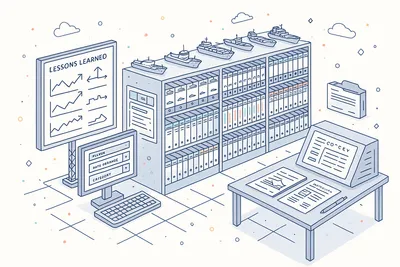
Access the complete history of every deficiency across your entire fleet. Closed deficiencies remain searchable and filterable, building an institutional knowledge base that supports trend analysis, recurring issue identification, and continuous improvement.
When a similar deficiency appears on another vessel, your team can search the archive for previous resolution approaches. The fleet-wide history turns past experience into a competitive advantage for safety and operational excellence.
- Full fleet deficiency history
- Searchable closed records
- Previous resolution lookup
- Trend analysis support
Calendar Integration & Scheduling

Schedule deficiency-related activities — inspections, corrective action deadlines, verification checks — directly into the Navatom calendar system. Calendar events keep your team aligned on upcoming deadlines and planned resolution activities.
Recurring deficiency reviews and follow-up inspections can be scheduled as repeating calendar events. Fleet-wide calendar visibility ensures that shore management and vessel crews share the same timeline for deficiency resolution.
- Deadline calendar events
- Recurring review scheduling
- Fleet-wide calendar visibility
- Corrective action timeline tracking
Technical
Under the Hood
Architecture and engineering behind Deficiencies — data handling, real-time sync, and interface design.
High-Performance Issue Grids with Advanced Filtering
All deficiency views use high-performance data grids with advanced filtering by status, priority, severity, vessel, equipment, and date range. Browse thousands of deficiency records without performance degradation.
Rules-Based Root Cause Engine
Twelve predefined root cause categories drive consistent investigation across the fleet. The engine enforces structured analysis rather than free-text descriptions, enabling fleet-wide root cause pattern detection.
Audit-to-Deficiency Conversion Workflow
Audit findings convert to formal deficiencies through an automated workflow that carries forward all evidence, observations, and regulatory references. The conversion maintains permanent bidirectional linkage for full traceability.
Automated Lifecycle Management
The six-stage lifecycle is managed by an automated workflow that enforces stage transition rules, validates data completeness at each gate, and triggers notifications for responsible parties.
Immutable Event Logging
Every action generates a tamper-proof event record with forty-four distinct event types. The event log powers the audit trail, analytics, notifications, and compliance reporting — fully auditable and tamper-evident.
Office-Ship Synchronization
Deficiency data synchronizes between office and vessel systems over satellite links with automatic conflict resolution. Vessels can log, investigate, and update deficiencies offline, with changes merging seamlessly when connectivity is restored.
Configurable Analytics Framework
Dashboard widgets and analytics are built on a configurable framework that aggregates deficiency data across multiple dimensions — status, priority, severity, vessel, equipment category, and time period.
Same Category
Related Modules
Other Issues modules that integrate with Deficiencies.
Capture near-miss reports to promote proactive safety culture across the fleet.
Document technical findings from surveys, inspections, and maintenance activities.
Ready to try Deficiencies?
Start your free trial today and see how Deficiencies fits into your fleet operations.