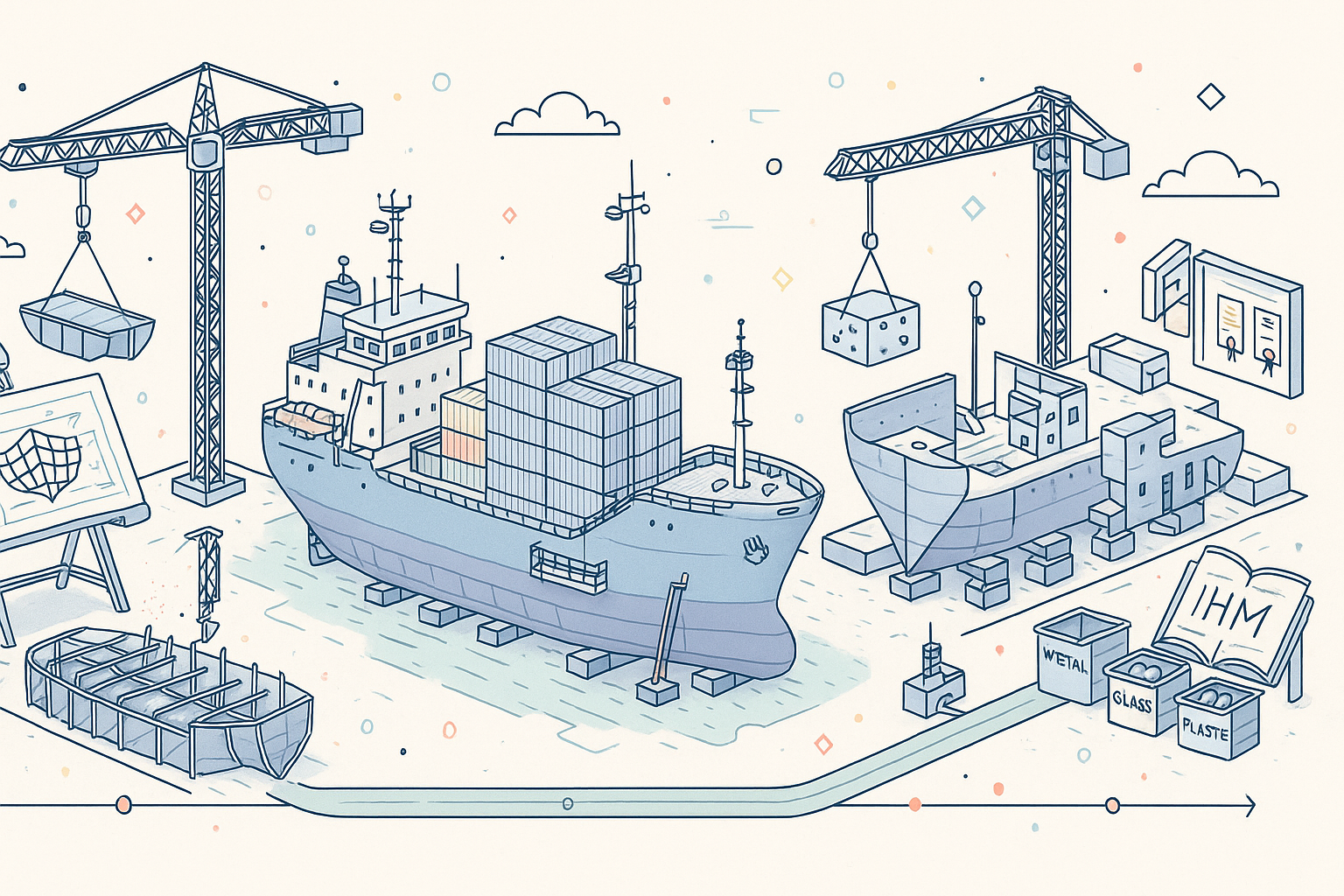
What Is Vessel Lifecycle Management?
Vessel lifecycle management encompasses the complete oversight of a ship from the moment it enters a fleet through its eventual disposal or recycling. Unlike traditional ship management, which tends to treat maintenance, compliance, and financial management as separate disciplines, vessel lifecycle management takes a holistic view.
Every decision about a vessel — whether to repair or replace a piece of equipment, when to schedule drydocking, how to plan for end-of-life — is informed by the vessel's complete history and current condition across all operational dimensions.
The maritime industry has historically managed vessels through fragmented systems: a planned maintenance system here, a spreadsheet for certificates there, a separate database for spare parts, and paper files for drydock records. This fragmentation means that critical information is scattered across departments and systems, making it difficult to build a complete picture of a vessel's condition.
When a superintendent needs to decide whether a vessel is ready for a charter inspection or an upcoming class survey, they must manually gather data from multiple sources — a time-consuming and error-prone process.
Digital vessel lifecycle management eliminates these silos by bringing all operational data into a single platform. When maintenance records, certificate statuses, spare parts inventories, drydock histories, and running costs are connected, fleet managers can make faster, better-informed decisions.
The result is lower operating costs, fewer compliance gaps, and vessels that maintain their value throughout their service life.
The Five Lifecycle Stages
Every vessel passes through five fundamental lifecycle stages, each with distinct management requirements. The first stage, commissioning, covers the period when a vessel enters the fleet — whether through new construction, purchase, or charter-in.
During commissioning, the ship management team establishes baseline records: equipment inventories, initial survey reports, class and statutory certificates, crew assignments, and maintenance plans. The quality of data captured during commissioning directly affects the efficiency of every subsequent stage.
The second stage, operations, is the longest and most complex. It encompasses daily fleet management activities: voyage planning, cargo operations, crew rotations, regulatory compliance, and routine maintenance execution.
During the operational stage, the vessel generates enormous volumes of data — noon reports, maintenance work orders, deficiency records, inspection findings, and consumption logs. A well-designed vessel lifecycle management system captures all of this data and makes it available for analysis and decision-making in real time.
The third and fourth stages — maintenance and drydocking — are closely related but distinct in scope. Routine maintenance is continuous, governed by manufacturer recommendations, class requirements, and operational experience.
Drydocking is periodic, typically every two-and-a-half to five years, and involves major repairs, hull treatment, and equipment overhauls that cannot be performed afloat. The fifth stage, disposal or recycling, covers the end of a vessel's commercial life.
This stage requires careful documentation for regulatory compliance, particularly under the Hong Kong Convention and EU Ship Recycling Regulation. Effective vessel lifecycle management ensures that data accumulated over decades of operation is preserved and accessible when needed for disposal compliance.
Integrated Digital Management
The power of a cloud-based vessel lifecycle management platform lies in integration. When a planned maintenance system is connected to spare parts inventory, the maintenance team can see immediately whether the parts needed for an upcoming job are on board, on order, or need to be procured.
When running cost tracking is connected to maintenance records, management can identify which equipment is consuming the most budget and whether repair-or-replace decisions are justified by the data. When certificate management is linked to maintenance execution, the system can flag when a maintenance deficiency could affect the validity of a class certificate.
Drydock planning benefits enormously from integrated data. Navatom's dry dock module draws on maintenance history, outstanding deficiency records, class survey requirements, and spare parts availability to help superintendents build accurate drydock specifications.
Instead of starting from scratch before each drydock, the system accumulates relevant data continuously so that when the time comes, the specification is already half-written. This level of preparation reduces yard time, minimizes change orders, and keeps drydock budgets under control.
Integration also means that data entered once is available everywhere it is needed. When a chief engineer closes a maintenance work order on board, that information is immediately visible to the superintendent ashore, reflected in the vessel's maintenance compliance statistics, and factored into running cost calculations.
There is no manual re-entry, no emailing of spreadsheets, and no risk of data discrepancies between shipboard and shore-side records. This is the core promise of digital vessel lifecycle management: a single source of truth that spans the entire organization.
How Navatom Supports Vessel Lifecycle
Navatom was built from the ground up as an integrated ship management platform with over 30 modules that work together. Unlike legacy systems that were designed as standalone tools and later bolted together through integrations, every Navatom module shares a common data model, a unified user interface, and real-time data synchronization.
This architectural approach means that vessel lifecycle management is not an add-on feature — it is the natural outcome of how the platform operates.
Fleet-wide dashboards provide real-time visibility into vessel condition, maintenance compliance, certificate status, and cost performance across all lifecycle stages. Superintendents can drill down from a fleet overview to a specific vessel, from the vessel to a particular equipment group, and from there to individual maintenance jobs, spare parts, or inspection findings.
This multi-level visibility makes it possible to spot trends early — a piece of equipment that is generating increasing maintenance costs, a vessel that is falling behind on its planned maintenance schedule, or a certificate renewal that is approaching faster than expected.
Because Navatom is cloud-based, all of this capability is available without any server infrastructure or software installation. Shore-based staff access the platform from any web browser, while crew on board use the same interface whether connected or working offline.
Data synchronizes automatically when connectivity is available, ensuring that the shore office and the vessel are always working from the same information. For fleet operators seeking a comprehensive approach to vessel lifecycle management, Navatom provides the integrated platform needed to manage every stage — from the day a vessel joins the fleet to the day it leaves.