All 13 Features
Every feature in Certificates is built for daily maritime work — simple to use, fast to navigate, and fully integrated with the rest of Navatom.
Hierarchical Certificate Tree

Organize your vessel's certificates in a hierarchical folder tree with unlimited nesting depth. Categories can contain sub-categories, which can contain further sub-categories — mirroring any classification structure from simple two-level groupings to complex multi-tier regulatory frameworks.
Drag-and-drop reordering lets you reorganize the tree without losing any certificate data. Each category carries its own status and metadata, and the tree structure is independent per vessel, allowing different certificate organizations for different vessel types.
- Unlimited category nesting depth
- Drag-and-drop reordering
- Per-vessel independent trees
- Active & deleted category statuses
Four Certificate Term Types

Classify every certificate with one of four term types — NoTerm for certificates without expiry, Interim for temporary or provisional certificates, ShortTerm for certificates with abbreviated validity periods, and FullTerm for standard full-duration certificates. Term type drives how the system calculates expiry warnings and renewal urgency.
Each term type carries different visual indicators and alert thresholds. Interim certificates trigger earlier renewal warnings than FullTerm certificates.
NoTerm certificates are tracked for existence and validity without date-based alerts. The classification ensures your team applies the right attention to each document.
- NoTerm for non-expiring certificates
- Interim for provisional documents
- ShortTerm for abbreviated validity
- FullTerm for standard duration
- Term-specific expiry thresholds
Certificate Renewal & Version History

Renew certificates with a single action while preserving complete version history. When a certificate is renewed, the previous version is archived as a historical record and the new version becomes the active definition.
Every field — title, dates, sub-items, attachments — is captured in the historical snapshot.
Review the full renewal chain at any time to see how a certificate has evolved. Regulatory auditors can inspect the complete history of any certificate, including the exact dates each version was active, who renewed it, and what changed between versions.
- One-action certificate renewal
- Full previous version archival
- Complete renewal chain access
- Field-level version comparison
- Regulatory-grade history trail
Four Sub-Item Types

Track the audits, surveys, reports, and equipment inspections that each certificate depends on using four dedicated sub-item types. Each sub-item carries its own dates, status, and documentation — creating a structured breakdown of the work that supports certificate validity.
Sub-items transform a certificate from a simple document record into a complete compliance package. When a class survey is due for a certificate, it appears as a tracked sub-item with its own timeline.
When an equipment inspection is completed, the evidence attaches directly to the relevant sub-item.
- Audit sub-items per certificate
- Survey tracking with dates
- Report documentation linkage
- Equipment inspection records
- Independent sub-item status tracking
Expiry Date Monitoring & Badges

Visual badge indicators on every certificate show expiry status at a glance — green for valid, amber for approaching expiry, red for overdue, and grey for no-term certificates. The badge system works across list views, tree views, and dashboard widgets, ensuring critical expiry information is always visible.
Configurable threshold windows determine when certificates transition from valid to approaching-expiry status. Your fleet manager sees a color-coded overview of every vessel's certificate health without opening a single document.
- Color-coded expiry badges
- Green/amber/red/grey indicators
- Configurable threshold windows
- List, tree & dashboard visibility
Confirmation Workflow

Critical certificates require explicit confirmation before they are considered fully validated. The confirmation workflow adds an approval step that ensures authorized personnel have reviewed and accepted the certificate details — dates, attachments, and sub-item completion — before the certificate is marked as confirmed.
Unconfirmed certificates appear in the WaitingConfirmation dashboard widget, creating a clear action queue for your compliance team. Both certificates and categories support confirmation, ensuring that structural changes to the certificate tree also receive proper sign-off.
- Explicit sign-off for critical certificates
- Certificate & category confirmation
- WaitingConfirmation widget queue
- User attribution on confirmations
Calendar Integration

Certificate expiry dates automatically appear in the Navatom calendar system, creating a unified view of upcoming renewals alongside other vessel events. Calendar entries include certificate name, vessel, term type, and days remaining — giving planners the context they need without leaving the calendar view.
Calendar visibility ensures that certificate renewals are planned alongside drydocking schedules, crew changes, and port calls. When an expiry date changes due to renewal or amendment, the calendar event updates automatically.
- Automatic expiry calendar events
- Certificate name & vessel context
- Days-remaining display
- Auto-update on date changes
- Unified planning view
Six Expiry Dashboard Widgets

Monitor your fleet's certificate health with six purpose-built dashboard widgets. DueADay shows certificates expiring within 24 hours.
DueAWeek covers the seven-day window. EndsInDays provides a configurable lookahead.
Overdue highlights certificates past their expiry date. TotalItems gives a fleet-wide count. WaitingConfirmation tracks certificates pending sign-off.
Each widget drills down to the underlying certificate list with a single click. Dashboard views aggregate across vessels, giving fleet managers a single screen that answers the question: "Are any certificates at risk across my entire fleet?"
- DueADay — 24-hour expiry window
- DueAWeek — 7-day lookahead
- EndsInDays — configurable range
- Overdue certificate tracking
- TotalItems & WaitingConfirmation
Per-Ship Certificate Management

Every vessel in your fleet maintains its own independent certificate tree with its own category structure, certificates, and sub-items. The per-ship architecture ensures that vessel-specific certificates — unique to a ship's flag state, classification society, and trade area — are organized exactly as needed for that vessel.
Switch between vessels to view, manage, and compare their certificate portfolios. The per-ship model also enables vessel-level compliance reporting: how many certificates does this vessel have?
How many are approaching expiry? Are any overdue?
- Independent tree per vessel
- Vessel-specific certificate portfolios
- Ship-level compliance reporting
- Cross-vessel comparison views
Fleet-Wide Certificate Copy

Replicate certificate structures from one vessel to another with the fleet-wide copy capability. When you add a new vessel to your fleet, copy the certificate tree from an existing similar vessel to bootstrap its certificate portfolio — categories, certificate definitions, and sub-item structures transfer in a single operation.
The copy function saves hours of manual setup and ensures consistency across vessels of the same type. After copying, each vessel's tree is independent, so vessel-specific adjustments don't affect the source.
- Full tree replication across ships
- Categories, certificates & sub-items
- Single-operation transfer
- Independent post-copy management
Comments & File Attachments

Attach supporting documents, photographs, and scanned copies directly to each certificate. File attachments create a complete digital archive that mirrors (and replaces) the physical certificate binder.
Comments provide a threaded discussion history for each certificate, capturing the context behind decisions and changes.
When a port state inspector requests evidence, your team pulls the original scan, the renewal correspondence, and the survey report from a single certificate record — no searching through email, shared drives, or physical files.
- Per-certificate file attachments
- Scanned copy & photo uploads
- Threaded comment discussions
- Complete digital certificate archive
Complete Audit Trail

Every action on every certificate is recorded in a comprehensive event log with 19 event types. Certificate creation, updates, renewals, sub-item changes, file uploads, comments, confirmations, and deletions are all tracked with full user attribution and timestamps.
The audit trail serves both internal governance and external compliance. When an auditor asks "Who renewed this certificate and when?", the answer is a single click away.
The log is append-only — events cannot be edited or deleted, ensuring tamper-proof accountability.
- 19 tracked event types
- Full user attribution per event
- Append-only tamper-proof log
- CRUD, renewal & confirmation events
- Regulatory-grade accountability
Print & PDF Export

Generate professional printable certificate reports for any vessel with a single click. The exported report includes the complete certificate tree — categories, certificates with dates and terms, sub-item details, and status badges — formatted for port state submissions, classification society reviews, or internal management reporting.
Printed reports follow maritime industry conventions, ensuring your documentation meets the standards expected by regulatory authorities. Use exports for vessel handover packages, pre-arrival checklists, and annual compliance reviews.
- One-click certificate report generation
- Full tree export with statuses
- Port state submission format
- Vessel handover documentation
Hierarchical Certificate Tree

Organize your vessel's certificates in a hierarchical folder tree with unlimited nesting depth. Categories can contain sub-categories, which can contain further sub-categories — mirroring any classification structure from simple two-level groupings to complex multi-tier regulatory frameworks.
Drag-and-drop reordering lets you reorganize the tree without losing any certificate data. Each category carries its own status and metadata, and the tree structure is independent per vessel, allowing different certificate organizations for different vessel types.
- Unlimited category nesting depth
- Drag-and-drop reordering
- Per-vessel independent trees
- Active & deleted category statuses
Four Certificate Term Types

Classify every certificate with one of four term types — NoTerm for certificates without expiry, Interim for temporary or provisional certificates, ShortTerm for certificates with abbreviated validity periods, and FullTerm for standard full-duration certificates. Term type drives how the system calculates expiry warnings and renewal urgency.
Each term type carries different visual indicators and alert thresholds. Interim certificates trigger earlier renewal warnings than FullTerm certificates.
NoTerm certificates are tracked for existence and validity without date-based alerts. The classification ensures your team applies the right attention to each document.
- NoTerm for non-expiring certificates
- Interim for provisional documents
- ShortTerm for abbreviated validity
- FullTerm for standard duration
- Term-specific expiry thresholds
Certificate Renewal & Version History

Renew certificates with a single action while preserving complete version history. When a certificate is renewed, the previous version is archived as a historical record and the new version becomes the active definition.
Every field — title, dates, sub-items, attachments — is captured in the historical snapshot.
Review the full renewal chain at any time to see how a certificate has evolved. Regulatory auditors can inspect the complete history of any certificate, including the exact dates each version was active, who renewed it, and what changed between versions.
- One-action certificate renewal
- Full previous version archival
- Complete renewal chain access
- Field-level version comparison
- Regulatory-grade history trail
Four Sub-Item Types

Track the audits, surveys, reports, and equipment inspections that each certificate depends on using four dedicated sub-item types. Each sub-item carries its own dates, status, and documentation — creating a structured breakdown of the work that supports certificate validity.
Sub-items transform a certificate from a simple document record into a complete compliance package. When a class survey is due for a certificate, it appears as a tracked sub-item with its own timeline.
When an equipment inspection is completed, the evidence attaches directly to the relevant sub-item.
- Audit sub-items per certificate
- Survey tracking with dates
- Report documentation linkage
- Equipment inspection records
- Independent sub-item status tracking
Expiry Date Monitoring & Badges

Visual badge indicators on every certificate show expiry status at a glance — green for valid, amber for approaching expiry, red for overdue, and grey for no-term certificates. The badge system works across list views, tree views, and dashboard widgets, ensuring critical expiry information is always visible.
Configurable threshold windows determine when certificates transition from valid to approaching-expiry status. Your fleet manager sees a color-coded overview of every vessel's certificate health without opening a single document.
- Color-coded expiry badges
- Green/amber/red/grey indicators
- Configurable threshold windows
- List, tree & dashboard visibility
Confirmation Workflow

Critical certificates require explicit confirmation before they are considered fully validated. The confirmation workflow adds an approval step that ensures authorized personnel have reviewed and accepted the certificate details — dates, attachments, and sub-item completion — before the certificate is marked as confirmed.
Unconfirmed certificates appear in the WaitingConfirmation dashboard widget, creating a clear action queue for your compliance team. Both certificates and categories support confirmation, ensuring that structural changes to the certificate tree also receive proper sign-off.
- Explicit sign-off for critical certificates
- Certificate & category confirmation
- WaitingConfirmation widget queue
- User attribution on confirmations
Calendar Integration

Certificate expiry dates automatically appear in the Navatom calendar system, creating a unified view of upcoming renewals alongside other vessel events. Calendar entries include certificate name, vessel, term type, and days remaining — giving planners the context they need without leaving the calendar view.
Calendar visibility ensures that certificate renewals are planned alongside drydocking schedules, crew changes, and port calls. When an expiry date changes due to renewal or amendment, the calendar event updates automatically.
- Automatic expiry calendar events
- Certificate name & vessel context
- Days-remaining display
- Auto-update on date changes
- Unified planning view
Six Expiry Dashboard Widgets

Monitor your fleet's certificate health with six purpose-built dashboard widgets. DueADay shows certificates expiring within 24 hours.
DueAWeek covers the seven-day window. EndsInDays provides a configurable lookahead.
Overdue highlights certificates past their expiry date. TotalItems gives a fleet-wide count. WaitingConfirmation tracks certificates pending sign-off.
Each widget drills down to the underlying certificate list with a single click. Dashboard views aggregate across vessels, giving fleet managers a single screen that answers the question: "Are any certificates at risk across my entire fleet?"
- DueADay — 24-hour expiry window
- DueAWeek — 7-day lookahead
- EndsInDays — configurable range
- Overdue certificate tracking
- TotalItems & WaitingConfirmation
Per-Ship Certificate Management

Every vessel in your fleet maintains its own independent certificate tree with its own category structure, certificates, and sub-items. The per-ship architecture ensures that vessel-specific certificates — unique to a ship's flag state, classification society, and trade area — are organized exactly as needed for that vessel.
Switch between vessels to view, manage, and compare their certificate portfolios. The per-ship model also enables vessel-level compliance reporting: how many certificates does this vessel have?
How many are approaching expiry? Are any overdue?
- Independent tree per vessel
- Vessel-specific certificate portfolios
- Ship-level compliance reporting
- Cross-vessel comparison views
Fleet-Wide Certificate Copy
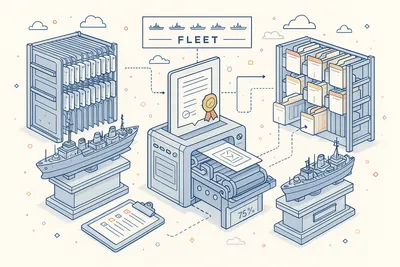
Replicate certificate structures from one vessel to another with the fleet-wide copy capability. When you add a new vessel to your fleet, copy the certificate tree from an existing similar vessel to bootstrap its certificate portfolio — categories, certificate definitions, and sub-item structures transfer in a single operation.
The copy function saves hours of manual setup and ensures consistency across vessels of the same type. After copying, each vessel's tree is independent, so vessel-specific adjustments don't affect the source.
- Full tree replication across ships
- Categories, certificates & sub-items
- Single-operation transfer
- Independent post-copy management
Comments & File Attachments

Attach supporting documents, photographs, and scanned copies directly to each certificate. File attachments create a complete digital archive that mirrors (and replaces) the physical certificate binder.
Comments provide a threaded discussion history for each certificate, capturing the context behind decisions and changes.
When a port state inspector requests evidence, your team pulls the original scan, the renewal correspondence, and the survey report from a single certificate record — no searching through email, shared drives, or physical files.
- Per-certificate file attachments
- Scanned copy & photo uploads
- Threaded comment discussions
- Complete digital certificate archive
Complete Audit Trail

Every action on every certificate is recorded in a comprehensive event log with 19 event types. Certificate creation, updates, renewals, sub-item changes, file uploads, comments, confirmations, and deletions are all tracked with full user attribution and timestamps.
The audit trail serves both internal governance and external compliance. When an auditor asks "Who renewed this certificate and when?", the answer is a single click away.
The log is append-only — events cannot be edited or deleted, ensuring tamper-proof accountability.
- 19 tracked event types
- Full user attribution per event
- Append-only tamper-proof log
- CRUD, renewal & confirmation events
- Regulatory-grade accountability
Print & PDF Export

Generate professional printable certificate reports for any vessel with a single click. The exported report includes the complete certificate tree — categories, certificates with dates and terms, sub-item details, and status badges — formatted for port state submissions, classification society reviews, or internal management reporting.
Printed reports follow maritime industry conventions, ensuring your documentation meets the standards expected by regulatory authorities. Use exports for vessel handover packages, pre-arrival checklists, and annual compliance reviews.
- One-click certificate report generation
- Full tree export with statuses
- Port state submission format
- Vessel handover documentation
Technical
Under the Hood
Architecture and engineering behind Certificates — data handling, real-time sync, and interface design.
Unlimited-Depth Hierarchical Tree with Drag-and-Drop
The certificate tree supports unlimited category nesting with real-time drag-and-drop reordering. The tree renders efficiently regardless of depth, and structural changes are persisted immediately with optimistic UI updates.
Versioned Certificate Definitions with Renewal Chain
Each certificate maintains a linked chain of versioned definitions. Renewal creates a new active version and archives the previous one, preserving complete history.
The version chain supports unlimited renewals with instant access to any historical version.
Granular Event Logging with 19 Event Types
Every certificate action is recorded with one of 19 distinct event types — covering CRUD operations, sub-item changes, file attachments, comments, confirmations, and renewals. The append-only log provides tamper-proof accountability for regulatory compliance.
Fleet Copy with Structure Preservation
The CopyToHandler replicates an entire certificate tree — categories, certificates, sub-items, and metadata — from one vessel to another in a single transactional operation. Category hierarchy and ordering are preserved exactly.
Real-Time Expiry Calculation Engine
Six dashboard widgets compute expiry status in real time across the entire fleet. " without manual checking.
Confirmation Workflow with Dual-Entity Support
Both certificates and categories support confirmation workflows with separate confirmation states, timestamps, and user attribution. The workflow enforces that critical documents receive explicit sign-off before being considered validated.
Office-Ship Synchronization
Certificate data synchronizes between office and vessel over satellite links with automatic conflict resolution. Vessels can manage certificates offline, with changes merging seamlessly when connectivity is restored.
Same Category
Related Modules
Other Documentation modules that integrate with Certificates.
Create, distribute, and manage controlled manuals and procedures across the fleet.
Distribute company circulars and notices with read-receipt tracking and acknowledgements.
Design and deploy custom digital forms for inspections, checklists, and reporting.
Solutions
Explore Solutions
Compliance and operational solutions powered by Certificates.
Maritime Data Integrity & Retention
Navatom has never lost customer data. Years of maintenance records, voyage reports, crew documents, and compliance evidence — stored indefinitely, accessible instantly, and preserved with complete integrity.
EU MRV Reporting
Navatom automates EU MRV emissions monitoring, reporting, and verification for ships calling at EU/EEA ports, ensuring full compliance with Regulation (EU) 2015/757 and its 2023 amendments.
Fleet Scalability & Rapid Onboarding
Add vessels to Navatom in minutes, not months. As a maritime cloud platform, Navatom requires no installation, no infrastructure scaling, and no IT projects — whether you are onboarding your second vessel or your two-hundredth.
IMO DCS Reporting
Navatom automates IMO Data Collection System reporting by capturing fuel consumption, distance, and hours underway from daily operations and generating flag state submissions in compliance with MARPOL Annex VI Regulation 22A.
Ship Management for Large Fleets
Navatom is an integrated ship management platform that manages large fleets with the same ease as small ones — 30+ modules, instant vessel onboarding, years of operational data retained without performance loss, and a zero data loss track record since launch.
Ship Management for Small Fleets
Navatom gives small fleet operators access to the same 30+ integrated ship management modules used by large fleets — with no installation, per-ship pricing, and the ability to start from just one vessel.
Vessel Lifecycle Management
Manage every stage of a vessel's life — from commissioning through operations, maintenance, drydocking, and disposal — with Navatom's integrated cloud platform.
Ready to try Certificates?
Start your free trial today and see how Certificates fits into your fleet operations.