All 18 Features
Every feature in Planned Maintenance System is built for daily maritime work — simple to use, fast to navigate, and fully integrated with the rest of Navatom.
Hierarchical Equipment Structure Tree

Organize every piece of machinery on your fleet using an unlimited-depth hierarchy: Categories group equipment families, Equipment nodes represent physical assets, and Sub-Equipment handles components within a unit. Each maintenance definition and its triggers attach directly to the equipment they govern, creating a single navigable tree that mirrors your vessel's actual arrangement.
The tree is the backbone of the entire PMS module — every maintenance job, running hour log, spare part BOM, and downtime record lives inside it. Deep copy functionality lets you replicate a branch from one vessel to another, eliminating redundant setup across sister ships.
- Unlimited-depth Category → Equipment → Sub-Equipment hierarchy
- Maintenance definitions attached directly to equipment nodes
- Deep copy branches between vessels
- Import/export tree structure between ships
- Company-designed, ship-published architecture
Dual-Dimension Maintenance Scheduling

Every maintenance definition can carry two independent triggers simultaneously: a calendar-based interval measured in days, and a running-hours-based interval measured against a counter. Both triggers are evaluated continuously, and whichever threshold is reached first drives the next due date calculation.
The "show-only-in-range" visibility window (defaulting to 70% of elapsed interval) controls when a task surfaces in planners' views — so the maintenance list never floods with far-future jobs. Counter-type overhauls reset the running hour counter upon completion, ensuring recurrence is calculated correctly after major maintenance events.
- Calendar-based day intervals and counter-based running hour triggers
- Both dimensions active simultaneously on same definition
- Show-only-in-range visibility window (70% threshold)
- Overhaul counter reset on completion
- Dual trigger evaluation — whichever fires first wins
4-Stage Dual Approval Workflow

Completed maintenance passes through a configurable four-stage sign-off chain: Ship Responsible, Ship Approver, Company Reviewer, and Company Approver. Each stage independently configures its execution method — All (every designated person must approve), One (any single designee suffices), or NotRequired (stage is bypassed entirely).
The seven-status workflow (Waiting, In Progress, Waiting for Ship Approval, Waiting for Office Approval, Ship Not Approved, Office Not Approved, Office Approved) captures every position in the pipeline. This architecture accommodates everything from single-vessel operators who bypass all approval stages to large fleet managers who require dual office sign-off on every maintenance record.
- Ship Responsible → Ship Approver → Company Reviewer → Company Approver
- Each stage: All, One, or NotRequired execution method
- Seven-status workflow with full transition validation
- Configurable per equipment and maintenance definition
- Supports zero-approval to full four-tier sign-off
Maintenance Log & Work Record
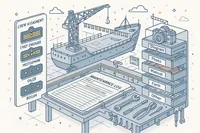
When a maintenance task is executed, a Maintenance Log captures the full record of what was done. The log includes work description, crew assignments from 29 supported ranks across Deck and Engine departments, five attachment types (Diagram, Photo, Manual, Form, Other), and structured approval tracking. A distributed lock prevents concurrent starts of the same job.
Twenty-one Maintenance Log Event Types track every action from creation through final office approval, creating a tamper-evident record ready for class society inspection. Each log carries a snapshot of the maintenance definition and equipment state at the time of completion.
- 29 crew ranks across Deck and Engine departments
- 5 evidence attachment types: Diagram, Photo, Manual, Form, Other
- 21 Maintenance Log Event Types tracked
- Distributed lock prevents concurrent job starts
- Equipment and definition snapshot preserved at completion
Megger Test Data Capture

Electrical insulation testing (megger testing) demands precision beyond a simple pass/fail checkbox. Navatom captures all six resistance readings — RS, ST, RT, RE, SE, and TE — alongside ampere and voltage values, measurement condition (cold or hot), and the final determination (pass or fail).
Every reading is stored as a structured numeric record rather than a free-text note.
This purpose-built data capture ensures your electrical survey records are machine-readable, trend-able, and immediately presentable to class surveyors. A separate Megger Tests list view aggregates all test results across the fleet for cross-vessel trend analysis.
- 6 resistance readings: RS, ST, RT, RE, SE, TE
- Ampere, voltage, and tester voltage fields
- Cold/Hot condition classification
- Structured Pass/Fail determination
- Fleet-wide trend analysis via dedicated list view
Running Hour Tracking & Automation

Running hour counters form the backbone of counter-based maintenance scheduling. Crew enter readings directly via dedicated ship-side entry forms, or approve officer-submitted readings through a structured request/approval flow.
A full Running Hour Logbook maintains the complete chronological record of every counter value ever recorded.
For vessels equipped with compatible third-party monitoring systems, the automation layer accepts pushed counter data without manual entry, eliminating transcription errors and ensuring trigger calculations always use the most current machinery state.
- Manual crew entry and officer request/approval flow
- Third-party monitoring system integration
- Full Running Hour Logbook with chronological history
- Violation detection warns when updates trigger overdue status
- Add and Reset counter types (reset after overhaul)
Equipment Explorer & Dual-Panel View

The Equipment Explorer presents the hierarchical equipment tree on the left alongside a contextual detail panel on the right, allowing superintendents and chief engineers to navigate the entire PMS structure without losing their place. Selecting any node in the tree instantly loads its equipment details, maintenance definitions, running hour history, and spare parts in the right panel.
High-performance server-side rendering handles fleets with tens of thousands of equipment records and hundreds of thousands of maintenance definitions without browser memory constraints. Twelve composable query filters allow any combination of equipment type, status, category, vessel, and date range to surface exactly the records needed.
- Hierarchical tree navigation on left panel
- Contextual equipment/maintenance detail on right panel
- 12 composable query filters across all dimensions
- High-performance server-side pagination
- Multi-equipment selection for comparison
Structured Maintenance Postponement

When operational reality prevents executing a maintenance task on schedule, the postponement workflow captures exactly why and by how much. Three postponement types — Dry Dock (deferred to the next scheduled drydock period), To Date (explicit new due date), and Additional Work Hour (counter-based extension) — cover every legitimate scenario.
Each postponement request records one of 12 structured reasons: Voyage Complications, Weather Conditions, Man Power, No Expertise, Parts Available, Inaccessible, Misuse, Management Hold Order, Officer Hold Order, Policies, Priority, or Other. Postponement requests go through an approve/reject workflow before the due date changes, creating an auditable record of every schedule deviation.
- Three types: Dry Dock, To Date, Additional Work Hour
- 12 structured postpone reasons
- Request → Approve/Reject workflow
- Due date unchanged until postponement approved
- Drydock type integrates with Drydock module
Equipment Downtime Tracking

Track every period an equipment item is unavailable, classifying each event as Planned or Unplanned. Planned downtime covers scheduled overhauls, drydock periods, and dry-run maintenance windows. Unplanned downtime captures breakdowns, failures, and emergency stops.
Monthly downtime distribution charts give technical superintendents fleet-wide visibility into availability trends. Linking downtime events to the parent equipment record — along with related deficiencies and maintenance logs — allows correlation between downtime patterns and maintenance history, surfacing recurring failure modes that demand preventive action.
- Planned and Unplanned downtime classification
- Monthly downtime distribution charts
- Link related deficiencies to downtime periods
- Link related maintenance logs to downtime periods
- Non-overlapping date range validation
Integrated Spare Parts Bill of Materials
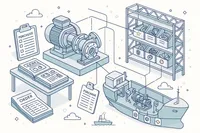
Every equipment item carries its own spare parts Bill of Materials linking directly to the Material module's catalog. Each spare part link assigns a criticality level — VITAL, ESSENTIAL, or DESIRABLE — giving procurement teams instant priority classification without consulting separate systems.
This bidirectional integration means that when a maintenance job is planned, the spare parts required are already listed against the equipment. Procurement can generate purchase requisitions directly from the BOM without manual part number lookups.
Conversely, when a part arrives in Inventory, the equipment it supports is immediately visible.
- Equipment-level BOM linked to Material module catalog
- VITAL / ESSENTIAL / DESIRABLE criticality levels
- Direct procurement requisition from BOM
- Bidirectional visibility between PMS and Inventory
- Min/max quantity tracking per equipment
21-Reason Overdue Classification System

When a maintenance task passes its due date without completion, the system demands a structured explanation. Twenty-one overdue reason codes span seven categories: PMS (definition or scheduling errors), Operation (voyage and operational constraints), IMS (inventory and spare part issues), ThirdParty (contractor or survey delays), Crew (personnel or competency issues), Software (system-related causes), and Computer (hardware or connectivity problems).
This taxonomy transforms overdue reporting from a binary "late/not late" metric into a fleet reliability intelligence tool. Aggregate by reason category to distinguish systemic planning failures from one-off operational disruptions, and target corrective efforts where they will have the greatest impact.
- 7 categories: PMS, Operation, IMS, ThirdParty, Crew, Software, Computer
- 21 specific reason codes across all categories
- Required before overdue task sent for approval
- Fleet-wide overdue reason analytics
- Root-cause analysis for systemic improvement
PMS Publish & Office-Ship Synchronization

Company designs the PMS structure — equipment categories, equipment items, maintenance definitions, triggers, and assignments — in the office Structure editor. When the design is ready, a single Publish action deploys the entire structure to the target vessel, synchronizing definitions over satellite or broadband connections.
Ship-side deployments merge incoming structural changes without disturbing in-flight maintenance logs. Bidirectional synchronization uses conflict resolution rules that always preserve completed maintenance records.
Vessels operate independently when needed, with changes merging automatically when connectivity is available.
- Company designs structure, publishes to vessels
- Single-action fleet-wide PMS deployment
- Bidirectional satellite synchronization
- Conflict resolution preserves completed records
- Real-time fleet-wide synchronization
Trigger & Child Maintenance Chains

Maintenance definitions can trigger child definitions automatically. When a parent maintenance is completed, its child tasks become active — enabling multi-step maintenance procedures where a performance test follows an overhaul, or a visual check follows a calibration.
The trigger chain uses a parent-child hierarchy, where parent definitions list their triggered children and children reference their triggering parent. Child maintenances appear in the maintenance list with clear parent linkage, so crew know exactly which higher-level job they are supporting.
- Parent maintenance triggers child tasks on completion
- Parent-child hierarchy
- Multi-step procedures (overhaul → test → check)
- Child tasks inherit parent scheduling context
- Clear parent linkage visible in maintenance list
Dual Equipment Criticality Classification
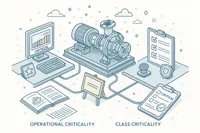
Equipment criticality in Navatom is not a single binary flag. Each equipment item carries two independent criticality dimensions: critical (operational criticality to the vessel) and classCritical (criticality from the classification society's perspective). These two dimensions are evaluated separately and can diverge.
This distinction matters for maintenance prioritization and survey planning. Class-critical equipment demands class-traceable maintenance records and defined intervals.
Operationally critical equipment demands higher postponement scrutiny. Filtering and analytics respect both dimensions independently.
- Independent operational and class criticality flags
- Critical: operational importance to vessel
- ClassCritical: classification society requirement
- Both dimensions filter and analyze independently
- Drives postponement scrutiny and survey planning
Full Maintenance History & Archive

Every completed maintenance log is preserved permanently in the archive with its full record — work logs, crew assignments, attachments, approval chain, readings, and the 29 Maintenance History Event Types that capture every action taken from creation to closure. The archive is searchable, filterable, and exportable.
Historical records serve multiple purposes: class society surveys, insurance claims, flag state inspections, and internal performance analysis. Because the archive is immutable and comprehensively logged, any reconstruction of what happened — and when, and by whom — is possible years after the fact.
- 29 Maintenance History Event Types recorded
- Immutable, tamper-proof event log
- Full work logs, attachments, and approval chain preserved
- Searchable and filterable archive
- Reconstruction possible years after the fact
Centralized Maintenance Approval Queue

Office-side reviewers and approvers work from a dedicated Approval Queue that aggregates all maintenance logs awaiting their action across the entire fleet. A single view surfaces every pending record, with filtering by vessel, equipment category, maintenance type, and urgency.
Approval actions — accept, reject, or return for correction — are executed directly from the queue without navigating into individual vessel records. Rejected logs automatically notify the originating ship with the rejection reason, feeding back into the ship-side correction workflow.
- Fleet-wide queue across all pending logs
- Filter by vessel, category, type, urgency
- Accept, reject, or return from queue directly
- Rejection auto-notifies originating ship
- No per-vessel navigation required
PMS Analytics & Dashboard Widgets

Ten dedicated dashboard widgets provide real-time KPIs for fleet maintenance health: overdue counts, upcoming maintenance by interval, completion rates by vessel, equipment downtime distribution, running hour trend lines, approval pipeline depth, and postponement frequency. Each widget drills down into the underlying maintenance records.
The Analytics section surfaces aggregate views across the fleet — overdue trend analysis by vessel, overdue breakdown by maintenance type and crew rank, and crew task distribution by department. These views give technical superintendents the intelligence to move from reactive firefighting to proactive fleet reliability management.
- 10 dedicated dashboard widgets
- Overdue count, upcoming maintenance, completion rate KPIs
- Overdue breakdown by maintenance type and crew rank
- Crew task distribution by department analytics
- Drill-down from any widget to underlying records
PMS Structure Import, Export & Deep Copy
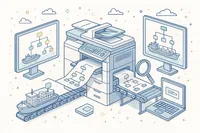
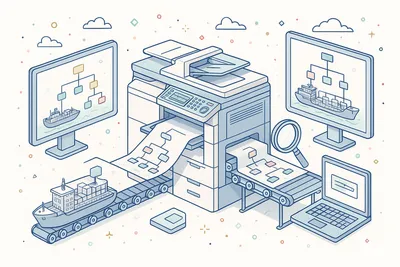
The PMS tree is not built from scratch for every vessel. Category trees and equipment structures are importable and exportable between vessels, enabling rapid fleet-wide deployment of a standard PMS template.
The import process validates incoming data against the current schema before committing, preventing corrupt structures from reaching production.
Deep copy functionality allows any branch of the equipment tree — including all maintenance definitions, triggers, spare parts BOMs, and running hour configurations — to be duplicated from one vessel to another. This is essential for managing sister ships and near-identical vessel classes without manual re-entry.
- Category tree import/export between vessels
- Deep copy any branch with full definitions and BOMs
- Schema validation before import commit
- Sister-ship deployment in minutes not weeks
- No manual re-entry for near-identical vessel classes
Hierarchical Equipment Structure Tree
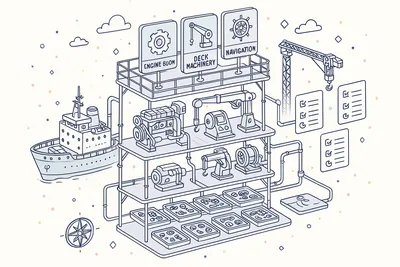
Organize every piece of machinery on your fleet using an unlimited-depth hierarchy: Categories group equipment families, Equipment nodes represent physical assets, and Sub-Equipment handles components within a unit. Each maintenance definition and its triggers attach directly to the equipment they govern, creating a single navigable tree that mirrors your vessel's actual arrangement.
The tree is the backbone of the entire PMS module — every maintenance job, running hour log, spare part BOM, and downtime record lives inside it. Deep copy functionality lets you replicate a branch from one vessel to another, eliminating redundant setup across sister ships.
- Unlimited-depth Category → Equipment → Sub-Equipment hierarchy
- Maintenance definitions attached directly to equipment nodes
- Deep copy branches between vessels
- Import/export tree structure between ships
- Company-designed, ship-published architecture
Dual-Dimension Maintenance Scheduling

Every maintenance definition can carry two independent triggers simultaneously: a calendar-based interval measured in days, and a running-hours-based interval measured against a counter. Both triggers are evaluated continuously, and whichever threshold is reached first drives the next due date calculation.
The "show-only-in-range" visibility window (defaulting to 70% of elapsed interval) controls when a task surfaces in planners' views — so the maintenance list never floods with far-future jobs. Counter-type overhauls reset the running hour counter upon completion, ensuring recurrence is calculated correctly after major maintenance events.
- Calendar-based day intervals and counter-based running hour triggers
- Both dimensions active simultaneously on same definition
- Show-only-in-range visibility window (70% threshold)
- Overhaul counter reset on completion
- Dual trigger evaluation — whichever fires first wins
4-Stage Dual Approval Workflow

Completed maintenance passes through a configurable four-stage sign-off chain: Ship Responsible, Ship Approver, Company Reviewer, and Company Approver. Each stage independently configures its execution method — All (every designated person must approve), One (any single designee suffices), or NotRequired (stage is bypassed entirely).
The seven-status workflow (Waiting, In Progress, Waiting for Ship Approval, Waiting for Office Approval, Ship Not Approved, Office Not Approved, Office Approved) captures every position in the pipeline. This architecture accommodates everything from single-vessel operators who bypass all approval stages to large fleet managers who require dual office sign-off on every maintenance record.
- Ship Responsible → Ship Approver → Company Reviewer → Company Approver
- Each stage: All, One, or NotRequired execution method
- Seven-status workflow with full transition validation
- Configurable per equipment and maintenance definition
- Supports zero-approval to full four-tier sign-off
Maintenance Log & Work Record
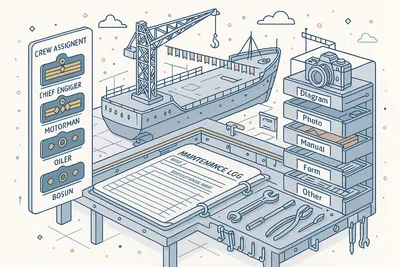
When a maintenance task is executed, a Maintenance Log captures the full record of what was done. The log includes work description, crew assignments from 29 supported ranks across Deck and Engine departments, five attachment types (Diagram, Photo, Manual, Form, Other), and structured approval tracking. A distributed lock prevents concurrent starts of the same job.
Twenty-one Maintenance Log Event Types track every action from creation through final office approval, creating a tamper-evident record ready for class society inspection. Each log carries a snapshot of the maintenance definition and equipment state at the time of completion.
- 29 crew ranks across Deck and Engine departments
- 5 evidence attachment types: Diagram, Photo, Manual, Form, Other
- 21 Maintenance Log Event Types tracked
- Distributed lock prevents concurrent job starts
- Equipment and definition snapshot preserved at completion
Megger Test Data Capture

Electrical insulation testing (megger testing) demands precision beyond a simple pass/fail checkbox. Navatom captures all six resistance readings — RS, ST, RT, RE, SE, and TE — alongside ampere and voltage values, measurement condition (cold or hot), and the final determination (pass or fail).
Every reading is stored as a structured numeric record rather than a free-text note.
This purpose-built data capture ensures your electrical survey records are machine-readable, trend-able, and immediately presentable to class surveyors. A separate Megger Tests list view aggregates all test results across the fleet for cross-vessel trend analysis.
- 6 resistance readings: RS, ST, RT, RE, SE, TE
- Ampere, voltage, and tester voltage fields
- Cold/Hot condition classification
- Structured Pass/Fail determination
- Fleet-wide trend analysis via dedicated list view
Running Hour Tracking & Automation

Running hour counters form the backbone of counter-based maintenance scheduling. Crew enter readings directly via dedicated ship-side entry forms, or approve officer-submitted readings through a structured request/approval flow.
A full Running Hour Logbook maintains the complete chronological record of every counter value ever recorded.
For vessels equipped with compatible third-party monitoring systems, the automation layer accepts pushed counter data without manual entry, eliminating transcription errors and ensuring trigger calculations always use the most current machinery state.
- Manual crew entry and officer request/approval flow
- Third-party monitoring system integration
- Full Running Hour Logbook with chronological history
- Violation detection warns when updates trigger overdue status
- Add and Reset counter types (reset after overhaul)
Equipment Explorer & Dual-Panel View

The Equipment Explorer presents the hierarchical equipment tree on the left alongside a contextual detail panel on the right, allowing superintendents and chief engineers to navigate the entire PMS structure without losing their place. Selecting any node in the tree instantly loads its equipment details, maintenance definitions, running hour history, and spare parts in the right panel.
High-performance server-side rendering handles fleets with tens of thousands of equipment records and hundreds of thousands of maintenance definitions without browser memory constraints. Twelve composable query filters allow any combination of equipment type, status, category, vessel, and date range to surface exactly the records needed.
- Hierarchical tree navigation on left panel
- Contextual equipment/maintenance detail on right panel
- 12 composable query filters across all dimensions
- High-performance server-side pagination
- Multi-equipment selection for comparison
Structured Maintenance Postponement
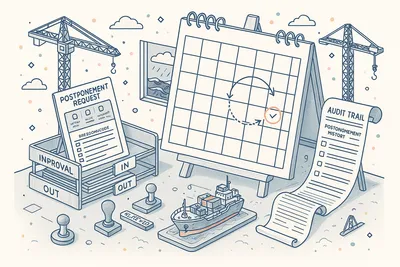
When operational reality prevents executing a maintenance task on schedule, the postponement workflow captures exactly why and by how much. Three postponement types — Dry Dock (deferred to the next scheduled drydock period), To Date (explicit new due date), and Additional Work Hour (counter-based extension) — cover every legitimate scenario.
Each postponement request records one of 12 structured reasons: Voyage Complications, Weather Conditions, Man Power, No Expertise, Parts Available, Inaccessible, Misuse, Management Hold Order, Officer Hold Order, Policies, Priority, or Other. Postponement requests go through an approve/reject workflow before the due date changes, creating an auditable record of every schedule deviation.
- Three types: Dry Dock, To Date, Additional Work Hour
- 12 structured postpone reasons
- Request → Approve/Reject workflow
- Due date unchanged until postponement approved
- Drydock type integrates with Drydock module
Equipment Downtime Tracking
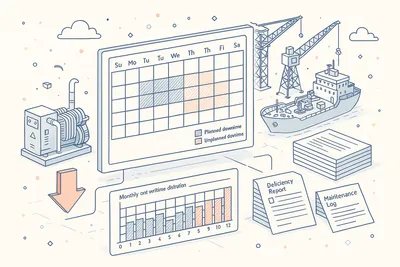
Track every period an equipment item is unavailable, classifying each event as Planned or Unplanned. Planned downtime covers scheduled overhauls, drydock periods, and dry-run maintenance windows. Unplanned downtime captures breakdowns, failures, and emergency stops.
Monthly downtime distribution charts give technical superintendents fleet-wide visibility into availability trends. Linking downtime events to the parent equipment record — along with related deficiencies and maintenance logs — allows correlation between downtime patterns and maintenance history, surfacing recurring failure modes that demand preventive action.
- Planned and Unplanned downtime classification
- Monthly downtime distribution charts
- Link related deficiencies to downtime periods
- Link related maintenance logs to downtime periods
- Non-overlapping date range validation
Integrated Spare Parts Bill of Materials
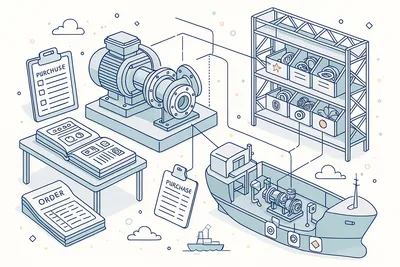
Every equipment item carries its own spare parts Bill of Materials linking directly to the Material module's catalog. Each spare part link assigns a criticality level — VITAL, ESSENTIAL, or DESIRABLE — giving procurement teams instant priority classification without consulting separate systems.
This bidirectional integration means that when a maintenance job is planned, the spare parts required are already listed against the equipment. Procurement can generate purchase requisitions directly from the BOM without manual part number lookups.
Conversely, when a part arrives in Inventory, the equipment it supports is immediately visible.
- Equipment-level BOM linked to Material module catalog
- VITAL / ESSENTIAL / DESIRABLE criticality levels
- Direct procurement requisition from BOM
- Bidirectional visibility between PMS and Inventory
- Min/max quantity tracking per equipment
21-Reason Overdue Classification System
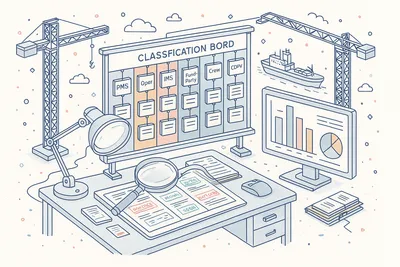
When a maintenance task passes its due date without completion, the system demands a structured explanation. Twenty-one overdue reason codes span seven categories: PMS (definition or scheduling errors), Operation (voyage and operational constraints), IMS (inventory and spare part issues), ThirdParty (contractor or survey delays), Crew (personnel or competency issues), Software (system-related causes), and Computer (hardware or connectivity problems).
This taxonomy transforms overdue reporting from a binary "late/not late" metric into a fleet reliability intelligence tool. Aggregate by reason category to distinguish systemic planning failures from one-off operational disruptions, and target corrective efforts where they will have the greatest impact.
- 7 categories: PMS, Operation, IMS, ThirdParty, Crew, Software, Computer
- 21 specific reason codes across all categories
- Required before overdue task sent for approval
- Fleet-wide overdue reason analytics
- Root-cause analysis for systemic improvement
PMS Publish & Office-Ship Synchronization

Company designs the PMS structure — equipment categories, equipment items, maintenance definitions, triggers, and assignments — in the office Structure editor. When the design is ready, a single Publish action deploys the entire structure to the target vessel, synchronizing definitions over satellite or broadband connections.
Ship-side deployments merge incoming structural changes without disturbing in-flight maintenance logs. Bidirectional synchronization uses conflict resolution rules that always preserve completed maintenance records.
Vessels operate independently when needed, with changes merging automatically when connectivity is available.
- Company designs structure, publishes to vessels
- Single-action fleet-wide PMS deployment
- Bidirectional satellite synchronization
- Conflict resolution preserves completed records
- Real-time fleet-wide synchronization
Trigger & Child Maintenance Chains
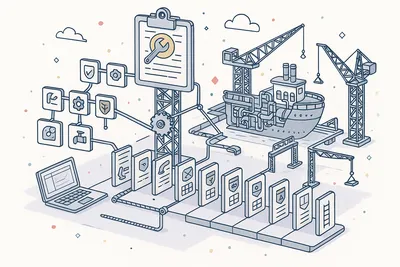
Maintenance definitions can trigger child definitions automatically. When a parent maintenance is completed, its child tasks become active — enabling multi-step maintenance procedures where a performance test follows an overhaul, or a visual check follows a calibration.
The trigger chain uses a parent-child hierarchy, where parent definitions list their triggered children and children reference their triggering parent. Child maintenances appear in the maintenance list with clear parent linkage, so crew know exactly which higher-level job they are supporting.
- Parent maintenance triggers child tasks on completion
- Parent-child hierarchy
- Multi-step procedures (overhaul → test → check)
- Child tasks inherit parent scheduling context
- Clear parent linkage visible in maintenance list
Dual Equipment Criticality Classification
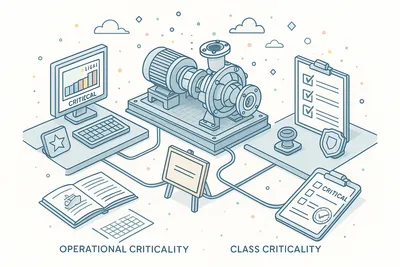
Equipment criticality in Navatom is not a single binary flag. Each equipment item carries two independent criticality dimensions: critical (operational criticality to the vessel) and classCritical (criticality from the classification society's perspective). These two dimensions are evaluated separately and can diverge.
This distinction matters for maintenance prioritization and survey planning. Class-critical equipment demands class-traceable maintenance records and defined intervals.
Operationally critical equipment demands higher postponement scrutiny. Filtering and analytics respect both dimensions independently.
- Independent operational and class criticality flags
- Critical: operational importance to vessel
- ClassCritical: classification society requirement
- Both dimensions filter and analyze independently
- Drives postponement scrutiny and survey planning
Full Maintenance History & Archive

Every completed maintenance log is preserved permanently in the archive with its full record — work logs, crew assignments, attachments, approval chain, readings, and the 29 Maintenance History Event Types that capture every action taken from creation to closure. The archive is searchable, filterable, and exportable.
Historical records serve multiple purposes: class society surveys, insurance claims, flag state inspections, and internal performance analysis. Because the archive is immutable and comprehensively logged, any reconstruction of what happened — and when, and by whom — is possible years after the fact.
- 29 Maintenance History Event Types recorded
- Immutable, tamper-proof event log
- Full work logs, attachments, and approval chain preserved
- Searchable and filterable archive
- Reconstruction possible years after the fact
Centralized Maintenance Approval Queue

Office-side reviewers and approvers work from a dedicated Approval Queue that aggregates all maintenance logs awaiting their action across the entire fleet. A single view surfaces every pending record, with filtering by vessel, equipment category, maintenance type, and urgency.
Approval actions — accept, reject, or return for correction — are executed directly from the queue without navigating into individual vessel records. Rejected logs automatically notify the originating ship with the rejection reason, feeding back into the ship-side correction workflow.
- Fleet-wide queue across all pending logs
- Filter by vessel, category, type, urgency
- Accept, reject, or return from queue directly
- Rejection auto-notifies originating ship
- No per-vessel navigation required
PMS Analytics & Dashboard Widgets

Ten dedicated dashboard widgets provide real-time KPIs for fleet maintenance health: overdue counts, upcoming maintenance by interval, completion rates by vessel, equipment downtime distribution, running hour trend lines, approval pipeline depth, and postponement frequency. Each widget drills down into the underlying maintenance records.
The Analytics section surfaces aggregate views across the fleet — overdue trend analysis by vessel, overdue breakdown by maintenance type and crew rank, and crew task distribution by department. These views give technical superintendents the intelligence to move from reactive firefighting to proactive fleet reliability management.
- 10 dedicated dashboard widgets
- Overdue count, upcoming maintenance, completion rate KPIs
- Overdue breakdown by maintenance type and crew rank
- Crew task distribution by department analytics
- Drill-down from any widget to underlying records
PMS Structure Import, Export & Deep Copy
The PMS tree is not built from scratch for every vessel. Category trees and equipment structures are importable and exportable between vessels, enabling rapid fleet-wide deployment of a standard PMS template.
The import process validates incoming data against the current schema before committing, preventing corrupt structures from reaching production.
Deep copy functionality allows any branch of the equipment tree — including all maintenance definitions, triggers, spare parts BOMs, and running hour configurations — to be duplicated from one vessel to another. This is essential for managing sister ships and near-identical vessel classes without manual re-entry.
- Category tree import/export between vessels
- Deep copy any branch with full definitions and BOMs
- Schema validation before import commit
- Sister-ship deployment in minutes not weeks
- No manual re-entry for near-identical vessel classes
Technical
Under the Hood
Architecture and engineering behind Planned Maintenance System — data handling, real-time sync, and interface design.
Hierarchical Tree with High-Performance Data Grids
The equipment tree and all maintenance list views use server-side pagination with composable query filters. Twelve independent filter dimensions — vessel, category, equipment status, maintenance type, scheduling dimension, overdue status, criticality, and more — can be combined freely across fleets of any size without client memory constraints.
Dual-Trigger Due Date Calculation Engine
A dedicated scheduling engine evaluates calendar-based and running-hours-based triggers independently for every maintenance definition and computes the effective next due date as the minimum of the two. Counter resets after overhaul events and the show-only-in-range threshold are factored into every recalculation.
Configurable Multi-Stage Approval Workflow
The maintenance log approval pipeline is implemented as a server-side workflow with seven states and four configurable stages. Each stage independently selects its execution method (All / One / NotRequired), enabling the same workflow to collapse to zero approval stages or expand to a full four-tier dual-office sign-off depending on company configuration.
Running Hour Automation Integration Layer
A dedicated automation record layer accepts pushed running hour readings from compatible third-party vessel monitoring systems. Pushed readings feed the same trigger evaluation pipeline as manually entered readings, ensuring counter-based due dates are always current without manual crew entry.
Tamper-Proof Maintenance Architecture
All three core entities — Maintenance Definition, Maintenance Log, and Equipment — maintain tamper-proof event logs with 29, 21, and 20+ event types respectively. Events are the authoritative record for audit trails, compliance reporting, and analytics aggregation, and are tamper-evident by design.
Deep Copy & Template Propagation Engine
Any branch of the equipment hierarchy can be deep-copied between vessels, including all child equipment, maintenance definitions, trigger configurations, spare parts BOMs, and running hour settings. The copy engine resolves cross-references and relationships in a single operation, producing a structurally identical but independently managed copy on the target vessel.
Office-Ship Publish & Synchronization Pipeline
Company-managed PMS structures are version-controlled and published to vessel deployments via a dedicated publish pipeline. Ship-side deployments merge incoming structural changes without disturbing in-flight maintenance logs.
Bidirectional synchronization over satellite links uses conflict resolution rules that always preserve completed maintenance records.
Structured Megger Test Data Model
Megger test results are stored as a structured sub-document with six typed resistance fields (RS, ST, RT, RE, SE, TE), ampere, voltage, condition enum, and pass/fail determination — not as free text or attachments. This makes results queryable, trend-able, and presentable to class surveyors in structured tabular form without data extraction.
Same Category
Related Modules
Other Technical Management modules that integrate with Planned Maintenance System.
Handle technical enquiries and communication between office and vessel with full traceability.
Solutions
Explore Solutions
Compliance and operational solutions powered by Planned Maintenance System.
CII & EEXI Compliance
Navatom provides real-time Carbon Intensity Indicator monitoring, EEXI baseline management, and SEEMP integration to help ship managers maintain favorable efficiency ratings and avoid corrective action requirements.
Maritime Data Integrity & Retention
Navatom has never lost customer data. Years of maintenance records, voyage reports, crew documents, and compliance evidence — stored indefinitely, accessible instantly, and preserved with complete integrity.
Fleet Scalability & Rapid Onboarding
Add vessels to Navatom in minutes, not months. As a maritime cloud platform, Navatom requires no installation, no infrastructure scaling, and no IT projects — whether you are onboarding your second vessel or your two-hundredth.
ISM Code Compliance
Navatom supports ISM Code compliance with integrated document control, audit management, non-conformity tracking, and safety management system tools across your entire fleet.
Ship Management for Large Fleets
Navatom is an integrated ship management platform that manages large fleets with the same ease as small ones — 30+ modules, instant vessel onboarding, years of operational data retained without performance loss, and a zero data loss track record since launch.
Ship Management for Small Fleets
Navatom gives small fleet operators access to the same 30+ integrated ship management modules used by large fleets — with no installation, per-ship pricing, and the ability to start from just one vessel.
TMSA Compliance
Track all 13 TMSA elements with Navatom's integrated ship management platform, supporting evidence-based self assessment, audit trails, and continuous improvement for tanker operators.
Vessel Lifecycle Management
Manage every stage of a vessel's life — from commissioning through operations, maintenance, drydocking, and disposal — with Navatom's integrated cloud platform.
Ready to try Planned Maintenance System?
Start your free trial today and see how Planned Maintenance System fits into your fleet operations.