Fleet Growth Should Not Mean IT Growth
In traditional ship management software, every new vessel added to the fleet triggers an IT workstream. Licenses must be procured.
Software must be installed — sometimes on shipboard hardware, sometimes on shore-side servers, often both. Configurations must be replicated, databases extended, and user accounts provisioned.
For large and growing fleets, this creates a persistent drag on fleet expansion — the ship management platform that is supposed to enable operations becomes a bottleneck.
Navatom was designed from day one to eliminate this problem. As a cloud-native platform, there is nothing to install — not on shore, not on board.
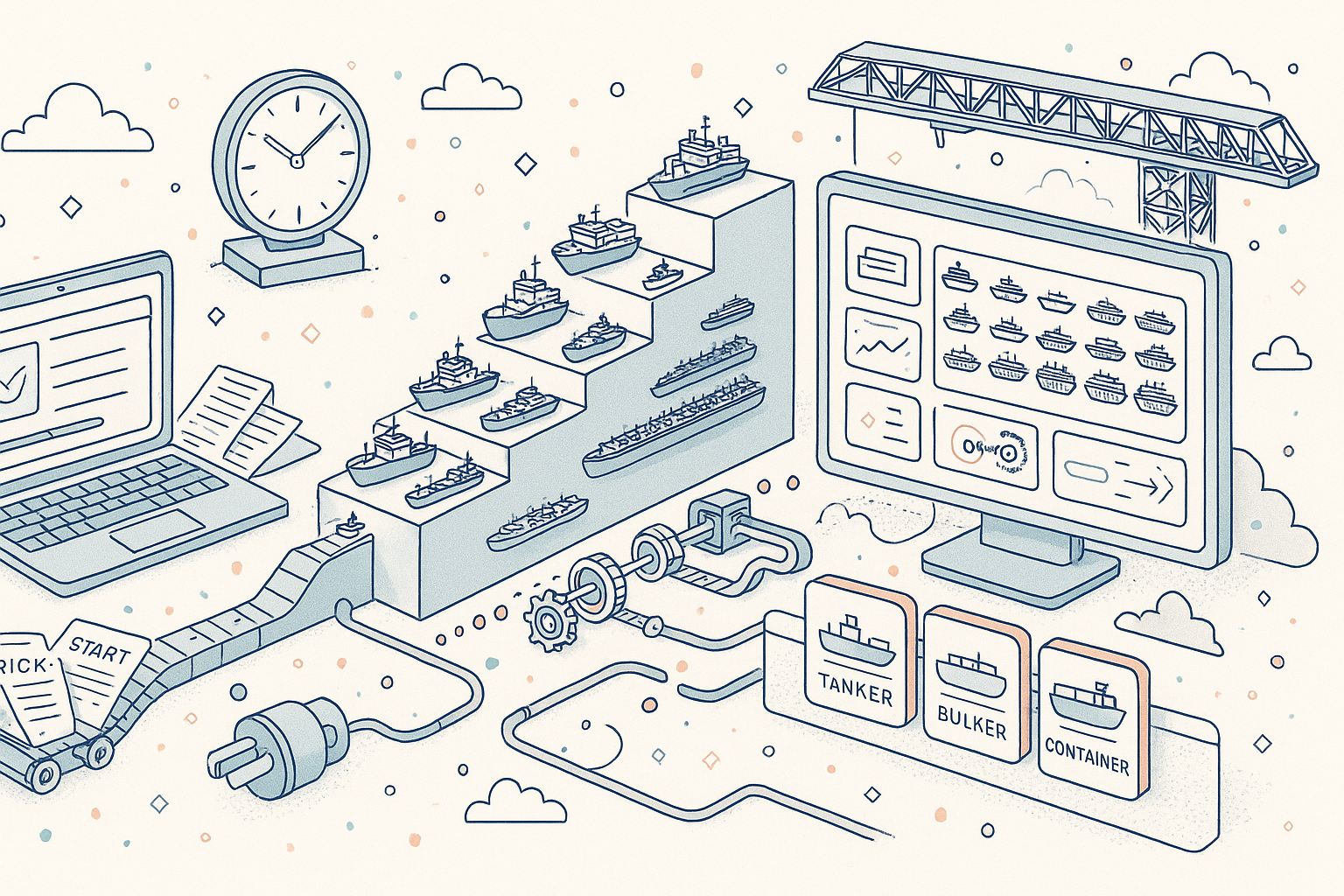
Adding a vessel to the platform is a configuration task, not an IT project. Register the vessel, assign modules, import data if available, and the vessel is immediately operational.
The entire process takes minutes, and it is identical whether the vessel is your second or your two-hundredth.
How Vessel Onboarding Works
The onboarding process is straightforward and designed for operational staff, not IT specialists. You enter the vessel's basic particulars — name, IMO number, vessel type, flag state, classification society, and key dates.
You then select which of Navatom's 30+ modules to activate for that vessel. Common starting configurations include planned maintenance, certificate tracking, crew management, and consumption monitoring, but you can activate any combination of modules at any time.
If the vessel has existing records — whether in another ship management system, in spreadsheets, or in structured files — those records can be imported during or after onboarding. Navatom's support team assists with data migration for complex transfers, ensuring that historical maintenance records, certificate histories, and other operational data are accurately preserved.
For vessels transitioning from paper-based management, manual data entry is supported with structured templates that make the process efficient.
Once registered, the vessel immediately appears in fleet-wide dashboards, reporting tools, and operational views. Shore-based managers can monitor the vessel alongside the rest of the fleet.
Crew on board access the vessel's data through the same web-based interface used across all vessels. There is no staging period, no parallel-run requirement, and no go-live ceremony — the vessel is simply part of the fleet from the moment it is registered.
Scaling Without Performance Compromise
A common concern with maritime cloud platforms is whether performance holds up as usage grows. With Navatom, it does.
The platform's architecture is designed for horizontal scaling — adding more vessels, more users, and more data does not degrade response times, ship-shore data synchronization speed, or reporting performance for existing operations. The fifteenth vessel on the platform experiences the same performance as the first. The hundredth vessel performs identically to the tenth.
This is particularly important for fleet operators in growth phases — whether through organic fleet expansion, acquisitions, or taking on management contracts for third-party vessels. The platform absorbs growth without requiring any action from your side.
There are no capacity planning conversations, no infrastructure upgrade requests, and no performance reviews needed. Navatom simply handles it.
Fleet Transitions and Vessel Lifecycle
Fleets are not static. Vessels are acquired, sold, chartered in, chartered out, transferred between management entities, and sometimes scrapped.
Navatom handles all of these transitions without disruption to the rest of the fleet. When a vessel joins, it integrates instantly.
When a vessel departs, its data is preserved in full while the vessel is removed from active operational views. Historical records remain accessible for regulatory purposes, audit responses, and operational analysis — data is never lost, even for vessels no longer in active management.
For ship management companies that handle third-party fleets, this flexibility is essential. Each managed fleet can be organized independently while still rolling up into a consolidated management view.
As fleet management software built for the operational reality of modern shipping — where fleet composition changes regularly — Navatom adapts in real time, not after an IT migration project.