All 16 Features
Every feature in Bookkeeping is built for daily maritime work — simple to use, fast to navigate, and fully integrated with the rest of Navatom.
Expenditure Management

Manage every financial transaction across your fleet through a unified expenditure system that handles invoices, orders, and payments. Each expenditure record captures vendor details, invoice and order dates, amounts, tax information, and department allocation — everything your accounting team needs in a single, structured document.
The four-status lifecycle — Draft, In Progress, Verified, and Cancelled — enforces a controlled workflow from initial entry to final verification. Expenditures move through stages with full validation at each transition, ensuring that only properly reviewed and approved transactions reach the verified state. Every status change is logged with user attribution and timestamp.
- Invoices, orders & payments
- Draft → InProgress → Verified → Cancelled
- Full vendor & tax capture
- Per-department allocation
- Status-enforced transitions
Seven-Department Cost Allocation
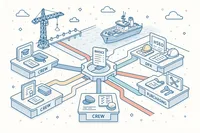
Allocate every expenditure to one of seven predefined cost departments — Crew, DPA, HSEQ, Operation, Purchasing, Technical, and Training. Department-based allocation reflects the operational reality of ship management, where costs must be tracked and reported by functional area for budgeting, variance analysis, and regulatory compliance.
Each department serves as a cost center for fleet-wide financial reporting. Filter, sort, and aggregate expenditures by department to understand where money flows.
Department allocation integrates with the hierarchical category system, giving you both functional and categorical cost visibility across every vessel.
- Crew, DPA, HSEQ, Operation departments
- Purchasing, Technical, Training centers
- Fleet-wide department aggregation
- Functional cost reporting
Hierarchical Expenditure Categories

Organize your chart of expenditure categories into a hierarchical tree structure with parent-child relationships and cumulative budget tracking. Top-level categories define major cost groups, while sub-categories provide the granularity needed for detailed cost analysis. The tree supports unlimited nesting depth for complex organizational structures.
Eleven category operations — New Top, New Sub, Update, Delete, Publish, Move and Delete, Import, Set Currency, Set Reviewal Execution Method, Set Approval Execution Method, Set Multiple Approver, and Set Multiple Reviewer — give administrators full control over the category structure. Cumulative budgets roll up from child to parent, providing instant visibility into spending against plan at every level of the hierarchy.
- Parent-child tree structure
- Unlimited nesting depth
- Cumulative budget rollups
- 11 category operations
- Per-category currency & approvers
Multi-Level Approval Workflow

Enforce financial controls with a dual-stage approval engine that separates review from approval. Every expenditure can require both a review step and an approval step before reaching verified status.
Six action types — My Approve, My Review, My Verify, Waiting for Review, Waiting for Approval, and Waiting for Verify — track where each transaction stands in the workflow.
Three execution methods — All (every designated reviewer/approver must act), Any One (a single approval is sufficient), and Not Required (the stage is skipped) — let you configure approval workflows that match your organization's authority structure. Set execution methods per category, so high-value expenditures require full board approval while routine costs flow through with minimal friction.
- Separate review & approval stages
- All / Any One / Not Required methods
- 6 workflow action types
- Per-category execution configuration
- Full approval audit trail
Chart of Accounts
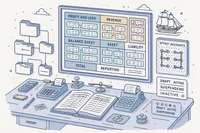
Define your complete general ledger structure with a hierarchical Chart of Accounts supporting nine account types: Profit and Loss, Revenue, Expense, Balance Sheet, Asset, Liability, Equity, Total, and Reporting. Each account carries a type classification, parent-child hierarchy, offset account linkage, and debit-credit orientation (Debit, Credit, or Both).
Four account statuses — Draft, Active, Suspended, and Inactive — control which accounts are available for posting. Parent-child relationships enable consolidation reporting, while offset accounts simplify double-entry bookkeeping by automatically linking contra accounts.
The chart scales from a simple single-vessel setup to a complex multi-company, multi-currency fleet structure.
- 9 account types (P&L, BS, etc.)
- Parent-child hierarchy
- Offset account linkage
- Debit / Credit / Both orientation
- Draft, Active, Suspended, Inactive
Credit & Debit Invoice System

Handle both credit notes and debit invoices within a unified system that maintains proper linkage between related documents. Credit expenditures reduce vendor balances, while debit expenditures increase them — with full traceability between original invoices and their corresponding credit adjustments.
The credit-debit linkage system ensures that every credit note references its source invoice, maintaining audit integrity. Financial summaries automatically calculate net positions by combining debits and credits per vendor, per category, and per vessel.
This eliminates the reconciliation headaches common in maritime accounting where credit notes often arrive weeks after the original invoice.
- Credit notes & debit invoices
- Source invoice referencing
- Automatic net position calculation
- Per-vendor & per-category netting
Multi-Currency Support

Operate across currencies with built-in conversion rate management and per-category currency configuration. Each expenditure category can be denominated in a different currency, reflecting the multi-currency reality of international maritime operations where port charges, bunker costs, and crew wages are paid in different currencies.
Exchange rate snapshots capture the conversion rate at the time of each transaction, providing accurate historical cost records regardless of subsequent rate fluctuations. Currency conversion is applied automatically when aggregating across categories or generating fleet-wide reports, ensuring consistent and auditable multi-currency accounting.
- Per-category currency denomination
- Exchange rate snapshots per transaction
- Automatic conversion on aggregation
- Historical cost accuracy
Distribution-Based Cost Posting

Split a single expenditure across multiple categories using distribution-based posting. When an invoice covers costs that span different departments or budget lines — common in maritime operations where a single port call generates charges across multiple cost centers — the distribution system allocates amounts precisely.
Each distribution line specifies the target category and the allocated amount or percentage. Distribution changes are tracked as dedicated event types in the audit trail, so you always know who allocated what and when.
The system validates that distributions sum to the total expenditure amount, preventing posting errors.
- Split single expenditure across categories
- Amount or percentage allocation
- Sum validation against total
- Dedicated audit trail events
Bank Account Management

Manage your fleet's bank accounts with support for four account types: Checking, Savings, Money Market, and Loan. Each bank account record captures IBAN, SWIFT/BIC codes, bank name, branch details, and multi-holder information for accounts with joint signatories or corporate co-holders.
Two statuses — Active and Closed — track the lifecycle of each account. Bank account data integrates with payment processing, letting you associate expenditures with specific accounts for cash flow tracking.
Multi-holder support handles the common maritime scenario where vessel operating accounts have both the management company and the shipowner as authorized parties.
- Checking, Savings, Money Market, Loan
- IBAN & SWIFT/BIC support
- Multi-holder / joint signatory
- Active & Closed lifecycle
Tax Code & Group Configuration

Configure tax codes and tax groups to handle the complex jurisdictional tax requirements of international maritime operations. Three tax types — Input, Output, and Both — classify each tax code by its direction in the VAT/GST cycle. Tax groups aggregate related tax codes for simplified application to expenditures.
Jurisdiction-based configuration with effective dates ensures that tax calculations reflect the correct rates for the time and place of each transaction. Tax codes carry percentage rates, valid date ranges, and group memberships. When tax regulations change, add new effective-dated entries without losing historical accuracy.
- Input, Output & Both tax types
- Jurisdiction-based configuration
- Effective date ranges
- Tax group aggregation
Payment Terms Management

Define payment terms that standardize your financial agreements with vendors across the fleet. Each payment term specifies net days (the number of days until payment is due), discount percentage for early payment, and discount days (the window within which the early payment discount applies).
Payment terms are linked to vendor records and applied automatically to new expenditures, reducing data entry and ensuring consistency. Standard maritime payment terms (Net 30, Net 60, 2/10 Net 30) can be configured once and applied fleet-wide, while custom terms handle special vendor agreements.
- Net days configuration
- Early payment discount percent
- Discount window (days)
- Auto-applied via vendor linkage
Vendor Integration

Link expenditures to vendor records from the integrated CRM system, maintaining a complete financial relationship history with every supplier. Vendor selection during expenditure creation pulls contact details, default payment terms, and tax information automatically — reducing manual entry and ensuring data consistency.
Twenty-two invoice operations — including Add Vendor, Set Vendor, Invoice Date, Order Date, and more — provide granular control over the vendor-expenditure relationship. Track spending per vendor across vessels, departments, and time periods to identify cost trends, negotiate better terms, and consolidate purchasing across your fleet.
- CRM-linked vendor records
- 22 invoice operations
- Per-vendor spending analytics
- Auto-populated payment terms & tax
- Fleet-wide vendor consolidation
Excel Export & Reporting

Export financial data in three formats — Flatten Categories, Flatten Categories Compact, and Regular — to support different analysis and reporting needs. Flatten exports denormalize the category hierarchy into flat columns for pivot table analysis, while Regular exports preserve the tree structure for hierarchical reporting.
Print-ready reports rendered via Jade templates produce professional PDF documents for management review, auditor submission, and regulatory compliance. The combination of structured data exports and formatted print reports ensures your bookkeeping data serves both analytical and presentational purposes.
- 3 export formats (Flatten, Compact, Regular)
- Pivot-table-ready flat exports
- Hierarchical tree exports
- Jade-rendered PDF print reports
Comments & Collaboration

Add, edit, and delete comments on any expenditure to create a communication thread between accounts payable, approvers, and management. Comments provide context that lives alongside the financial record — notes about invoice discrepancies, vendor discussions, approval conditions, or budget reallocation rationale.
Every comment action is recorded in the event log with full user attribution and timestamp. Comments become part of the permanent financial record, providing the narrative context that auditors value alongside the numbers.
The threaded conversation model eliminates the need for side-channel email discussions about specific transactions.
- Per-expenditure comment threads
- Add, edit & delete with attribution
- Audit-logged comment actions
- Permanent financial record context
Server-Side Row Model Grid

Handle large volumes of financial data with server-side row model grids backed by MongoDB aggregation pipelines. Whether you have hundreds or hundreds of thousands of expenditure records, the grid loads instantly with on-demand row fetching, server-side sorting, and multi-column filtering.
Advanced filtering lets you narrow results by status, department, vendor, date range, currency, category, and approval state. The aggregation pipeline handles complex calculations — budget rollups, currency conversions, department totals — at the database level, keeping the user interface responsive regardless of data volume.
- SSRM with MongoDB aggregation
- On-demand row fetching
- Multi-column filtering & sorting
- Budget rollups at database level
- Responsive at any data volume
Complete Audit Trail

Every action within the bookkeeping module is recorded in a granular event log with twenty-five-plus event types. From expenditure creation and vendor changes to status transitions, credit additions, distribution modifications, and category operations — every change is captured with full user attribution, timestamp, and contextual data.
Event types include ExpenditureAdded, VendorChange, StatusChange, CreditAdded, DistributionChange, and many more. The immutable event log provides a second-by-second narrative of your fleet's financial activity, fully auditable for ISM compliance, flag state inspections, and external audit requirements.
- 25+ event types
- ExpenditureAdded, VendorChange, etc.
- Full user attribution per event
- Immutable, tamper-proof logging
- ISM-compliant audit evidence
Expenditure Management

Manage every financial transaction across your fleet through a unified expenditure system that handles invoices, orders, and payments. Each expenditure record captures vendor details, invoice and order dates, amounts, tax information, and department allocation — everything your accounting team needs in a single, structured document.
The four-status lifecycle — Draft, In Progress, Verified, and Cancelled — enforces a controlled workflow from initial entry to final verification. Expenditures move through stages with full validation at each transition, ensuring that only properly reviewed and approved transactions reach the verified state. Every status change is logged with user attribution and timestamp.
- Invoices, orders & payments
- Draft → InProgress → Verified → Cancelled
- Full vendor & tax capture
- Per-department allocation
- Status-enforced transitions
Seven-Department Cost Allocation
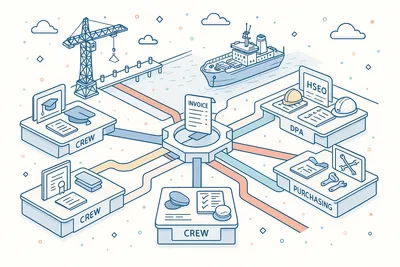
Allocate every expenditure to one of seven predefined cost departments — Crew, DPA, HSEQ, Operation, Purchasing, Technical, and Training. Department-based allocation reflects the operational reality of ship management, where costs must be tracked and reported by functional area for budgeting, variance analysis, and regulatory compliance.
Each department serves as a cost center for fleet-wide financial reporting. Filter, sort, and aggregate expenditures by department to understand where money flows.
Department allocation integrates with the hierarchical category system, giving you both functional and categorical cost visibility across every vessel.
- Crew, DPA, HSEQ, Operation departments
- Purchasing, Technical, Training centers
- Fleet-wide department aggregation
- Functional cost reporting
Hierarchical Expenditure Categories

Organize your chart of expenditure categories into a hierarchical tree structure with parent-child relationships and cumulative budget tracking. Top-level categories define major cost groups, while sub-categories provide the granularity needed for detailed cost analysis. The tree supports unlimited nesting depth for complex organizational structures.
Eleven category operations — New Top, New Sub, Update, Delete, Publish, Move and Delete, Import, Set Currency, Set Reviewal Execution Method, Set Approval Execution Method, Set Multiple Approver, and Set Multiple Reviewer — give administrators full control over the category structure. Cumulative budgets roll up from child to parent, providing instant visibility into spending against plan at every level of the hierarchy.
- Parent-child tree structure
- Unlimited nesting depth
- Cumulative budget rollups
- 11 category operations
- Per-category currency & approvers
Multi-Level Approval Workflow

Enforce financial controls with a dual-stage approval engine that separates review from approval. Every expenditure can require both a review step and an approval step before reaching verified status.
Six action types — My Approve, My Review, My Verify, Waiting for Review, Waiting for Approval, and Waiting for Verify — track where each transaction stands in the workflow.
Three execution methods — All (every designated reviewer/approver must act), Any One (a single approval is sufficient), and Not Required (the stage is skipped) — let you configure approval workflows that match your organization's authority structure. Set execution methods per category, so high-value expenditures require full board approval while routine costs flow through with minimal friction.
- Separate review & approval stages
- All / Any One / Not Required methods
- 6 workflow action types
- Per-category execution configuration
- Full approval audit trail
Chart of Accounts
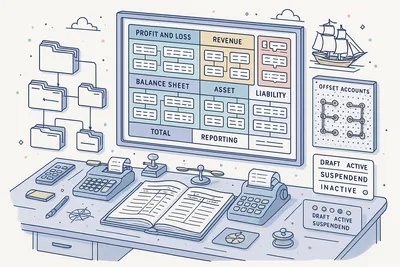
Define your complete general ledger structure with a hierarchical Chart of Accounts supporting nine account types: Profit and Loss, Revenue, Expense, Balance Sheet, Asset, Liability, Equity, Total, and Reporting. Each account carries a type classification, parent-child hierarchy, offset account linkage, and debit-credit orientation (Debit, Credit, or Both).
Four account statuses — Draft, Active, Suspended, and Inactive — control which accounts are available for posting. Parent-child relationships enable consolidation reporting, while offset accounts simplify double-entry bookkeeping by automatically linking contra accounts.
The chart scales from a simple single-vessel setup to a complex multi-company, multi-currency fleet structure.
- 9 account types (P&L, BS, etc.)
- Parent-child hierarchy
- Offset account linkage
- Debit / Credit / Both orientation
- Draft, Active, Suspended, Inactive
Credit & Debit Invoice System
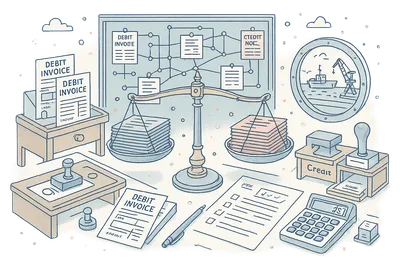
Handle both credit notes and debit invoices within a unified system that maintains proper linkage between related documents. Credit expenditures reduce vendor balances, while debit expenditures increase them — with full traceability between original invoices and their corresponding credit adjustments.
The credit-debit linkage system ensures that every credit note references its source invoice, maintaining audit integrity. Financial summaries automatically calculate net positions by combining debits and credits per vendor, per category, and per vessel.
This eliminates the reconciliation headaches common in maritime accounting where credit notes often arrive weeks after the original invoice.
- Credit notes & debit invoices
- Source invoice referencing
- Automatic net position calculation
- Per-vendor & per-category netting
Multi-Currency Support

Operate across currencies with built-in conversion rate management and per-category currency configuration. Each expenditure category can be denominated in a different currency, reflecting the multi-currency reality of international maritime operations where port charges, bunker costs, and crew wages are paid in different currencies.
Exchange rate snapshots capture the conversion rate at the time of each transaction, providing accurate historical cost records regardless of subsequent rate fluctuations. Currency conversion is applied automatically when aggregating across categories or generating fleet-wide reports, ensuring consistent and auditable multi-currency accounting.
- Per-category currency denomination
- Exchange rate snapshots per transaction
- Automatic conversion on aggregation
- Historical cost accuracy
Distribution-Based Cost Posting
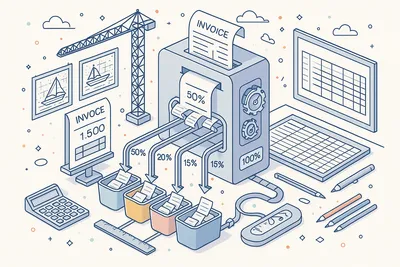
Split a single expenditure across multiple categories using distribution-based posting. When an invoice covers costs that span different departments or budget lines — common in maritime operations where a single port call generates charges across multiple cost centers — the distribution system allocates amounts precisely.
Each distribution line specifies the target category and the allocated amount or percentage. Distribution changes are tracked as dedicated event types in the audit trail, so you always know who allocated what and when.
The system validates that distributions sum to the total expenditure amount, preventing posting errors.
- Split single expenditure across categories
- Amount or percentage allocation
- Sum validation against total
- Dedicated audit trail events
Bank Account Management
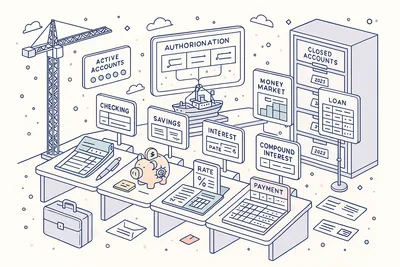
Manage your fleet's bank accounts with support for four account types: Checking, Savings, Money Market, and Loan. Each bank account record captures IBAN, SWIFT/BIC codes, bank name, branch details, and multi-holder information for accounts with joint signatories or corporate co-holders.
Two statuses — Active and Closed — track the lifecycle of each account. Bank account data integrates with payment processing, letting you associate expenditures with specific accounts for cash flow tracking.
Multi-holder support handles the common maritime scenario where vessel operating accounts have both the management company and the shipowner as authorized parties.
- Checking, Savings, Money Market, Loan
- IBAN & SWIFT/BIC support
- Multi-holder / joint signatory
- Active & Closed lifecycle
Tax Code & Group Configuration
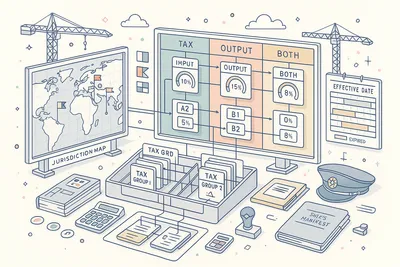
Configure tax codes and tax groups to handle the complex jurisdictional tax requirements of international maritime operations. Three tax types — Input, Output, and Both — classify each tax code by its direction in the VAT/GST cycle. Tax groups aggregate related tax codes for simplified application to expenditures.
Jurisdiction-based configuration with effective dates ensures that tax calculations reflect the correct rates for the time and place of each transaction. Tax codes carry percentage rates, valid date ranges, and group memberships. When tax regulations change, add new effective-dated entries without losing historical accuracy.
- Input, Output & Both tax types
- Jurisdiction-based configuration
- Effective date ranges
- Tax group aggregation
Payment Terms Management

Define payment terms that standardize your financial agreements with vendors across the fleet. Each payment term specifies net days (the number of days until payment is due), discount percentage for early payment, and discount days (the window within which the early payment discount applies).
Payment terms are linked to vendor records and applied automatically to new expenditures, reducing data entry and ensuring consistency. Standard maritime payment terms (Net 30, Net 60, 2/10 Net 30) can be configured once and applied fleet-wide, while custom terms handle special vendor agreements.
- Net days configuration
- Early payment discount percent
- Discount window (days)
- Auto-applied via vendor linkage
Vendor Integration

Link expenditures to vendor records from the integrated CRM system, maintaining a complete financial relationship history with every supplier. Vendor selection during expenditure creation pulls contact details, default payment terms, and tax information automatically — reducing manual entry and ensuring data consistency.
Twenty-two invoice operations — including Add Vendor, Set Vendor, Invoice Date, Order Date, and more — provide granular control over the vendor-expenditure relationship. Track spending per vendor across vessels, departments, and time periods to identify cost trends, negotiate better terms, and consolidate purchasing across your fleet.
- CRM-linked vendor records
- 22 invoice operations
- Per-vendor spending analytics
- Auto-populated payment terms & tax
- Fleet-wide vendor consolidation
Excel Export & Reporting

Export financial data in three formats — Flatten Categories, Flatten Categories Compact, and Regular — to support different analysis and reporting needs. Flatten exports denormalize the category hierarchy into flat columns for pivot table analysis, while Regular exports preserve the tree structure for hierarchical reporting.
Print-ready reports rendered via Jade templates produce professional PDF documents for management review, auditor submission, and regulatory compliance. The combination of structured data exports and formatted print reports ensures your bookkeeping data serves both analytical and presentational purposes.
- 3 export formats (Flatten, Compact, Regular)
- Pivot-table-ready flat exports
- Hierarchical tree exports
- Jade-rendered PDF print reports
Comments & Collaboration

Add, edit, and delete comments on any expenditure to create a communication thread between accounts payable, approvers, and management. Comments provide context that lives alongside the financial record — notes about invoice discrepancies, vendor discussions, approval conditions, or budget reallocation rationale.
Every comment action is recorded in the event log with full user attribution and timestamp. Comments become part of the permanent financial record, providing the narrative context that auditors value alongside the numbers.
The threaded conversation model eliminates the need for side-channel email discussions about specific transactions.
- Per-expenditure comment threads
- Add, edit & delete with attribution
- Audit-logged comment actions
- Permanent financial record context
Server-Side Row Model Grid

Handle large volumes of financial data with server-side row model grids backed by MongoDB aggregation pipelines. Whether you have hundreds or hundreds of thousands of expenditure records, the grid loads instantly with on-demand row fetching, server-side sorting, and multi-column filtering.
Advanced filtering lets you narrow results by status, department, vendor, date range, currency, category, and approval state. The aggregation pipeline handles complex calculations — budget rollups, currency conversions, department totals — at the database level, keeping the user interface responsive regardless of data volume.
- SSRM with MongoDB aggregation
- On-demand row fetching
- Multi-column filtering & sorting
- Budget rollups at database level
- Responsive at any data volume
Complete Audit Trail

Every action within the bookkeeping module is recorded in a granular event log with twenty-five-plus event types. From expenditure creation and vendor changes to status transitions, credit additions, distribution modifications, and category operations — every change is captured with full user attribution, timestamp, and contextual data.
Event types include ExpenditureAdded, VendorChange, StatusChange, CreditAdded, DistributionChange, and many more. The immutable event log provides a second-by-second narrative of your fleet's financial activity, fully auditable for ISM compliance, flag state inspections, and external audit requirements.
- 25+ event types
- ExpenditureAdded, VendorChange, etc.
- Full user attribution per event
- Immutable, tamper-proof logging
- ISM-compliant audit evidence
Technical
Under the Hood
Architecture and engineering behind Bookkeeping — data handling, real-time sync, and interface design.
Server-Side Row Model with MongoDB Aggregation Pipeline
All expenditure views handle large financial datasets with server-side row model grids and MongoDB aggregation pipelines for budget rollups, currency conversions, and department totals. The system stays responsive regardless of transaction volume or fleet size.
Dual-Stage Approval Engine
Expenditures pass through separate review and approval stages, each configurable with three execution methods — All (every designated person must act), Any One (single approval sufficient), or Not Required (stage skipped). Per-category configuration lets you enforce strict controls on high-value items while streamlining routine costs.
Hierarchical Category Tree with Cumulative Budget Tracking
Expenditure categories form a parent-child tree structure with unlimited nesting depth. Budgets roll up cumulatively from child to parent, providing instant spending visibility at every hierarchy level.
Eleven category operations manage the tree lifecycle from creation to deprecation.
Multi-Currency Conversion with Exchange Rate Snapshots
Each transaction captures the exchange rate at the time of posting, preserving accurate historical cost records. Per-category currency denomination and automatic conversion during aggregation ensure consistent multi-currency reporting across fleet-wide financial summaries.
Distribution-Based General Ledger Posting
Single expenditures split across multiple categories via distribution posting, with validation ensuring distributions sum to the total amount. Distribution changes carry dedicated event types in the audit trail for full traceability of cost allocation decisions.
Credit-Debit Invoice Linkage System
Credit notes maintain referential linkage to their source debit invoices, enabling automatic net position calculation per vendor, per category, and per vessel. The linkage system preserves audit integrity across the full credit-debit document chain.
Immutable Event Logging with 25+ Event Types
Every action across the bookkeeping module is recorded in a tamper-proof log with twenty-five-plus event types — ExpenditureAdded, VendorChange, StatusChange, CreditAdded, DistributionChange, and more. The log powers the audit trail, compliance reporting, and real-time notifications.
Solutions
Explore Solutions
Compliance and operational solutions powered by Bookkeeping.
Ready to try Bookkeeping?
Start your free trial today and see how Bookkeeping fits into your fleet operations.