
Benefits
Why Forms?
Key advantages of Forms as part of Navatom's integrated platform.
One Platform for Every Form Type
Web forms, Word templates, Excel spreadsheets, and PDF documents — all managed in a single platform with unified distribution, approval, and tracking. No more switching between tools or losing submissions in email threads.
Build Custom Forms Without Code or External Tools
The visual drag-and-drop builder with 18 field types and OnlyOffice document editor lets your HSEQ team create any form — from simple checklists to complex inspection reports — entirely in the browser without IT support.
Four Approval Flows for Every Operational Scenario
Configure per-assignment approval chains with Full (Ship + Office), Ship-only, Office-only, or No Approval flows. Three execution methods (All of, Any of, Not Required) adapt to every organizational structure and compliance requirement.
Forms Integrated Directly into Maintenance and Risk Assessment
Attach forms to PMS maintenance tasks and risk assessments. Inspection checklists, test records, and safety evaluations link directly to the work orders they support — no duplicate entry, no lost context.
ISM-Compliant Form Management with Full Audit Trail
Six-stage definition lifecycle, seven-stage request lifecycle, version history, and immutable event logging provide the controlled documentation trail that ISM Code, SOLAS, and classification society audits demand.
Scales from Single Vessel to Global Fleet
Server-side pagination, per-assignment configuration, rank-based distribution, and office-ship synchronization ensure the system performs identically whether you manage one vessel or five hundred. Grow your fleet without outgrowing your forms platform.
Navatom Forms is the maritime digital forms platform — covering everything from drag-and-drop web form creation to Word, Excel, and PDF template distribution, with dual-lifecycle management, configurable multi-level approval workflows, and fleet-wide form submission tracking. It replaces paper checklists, emailed spreadsheets, and disconnected form tools with a single controlled system that works identically on ship and ashore.
Built around four form types (Web, DOCX, XLSX, PDF), 18 field types, and a visual drag-and-drop form builder, the module lets your HSEQ team design custom forms without code or external tools. OnlyOffice integration handles Word and Excel template editing directly in the browser.
A six-stage definition lifecycle ensures only approved, controlled form templates reach the fleet, while four configurable approval flows — Full (Ship + Office), Ship-only, Office-only, and No Approval — adapt to every operational scenario.
Form requests follow a seven-stage lifecycle from draft to office approval, with per-assignment approver configuration, recurring scheduling, and calendar integration. Deep PMS and Risk Assessment integration lets you attach forms directly to maintenance tasks and risk evaluations.
With 79 REST endpoints, 90 action handler classes, and full office-ship synchronization, Navatom Forms scales from a single vessel checklist to a global fleet form management program.
Capabilities
Key Features
How Forms helps ship managers work faster and stay compliant.

Four Form Types
Not every form belongs in a browser. Navatom supports four distinct form types — Web (built in the visual form builder), DOCX (Microsoft Word templates), XLSX (Excel spreadsheet templates), and PDF (read-only reference documents). Each type has its own creation, editing, and distribution workflow.
Web forms use the drag-and-drop builder with 18 field types. Word and Excel templates are edited directly in the browser via OnlyOffice integration.
PDF forms distribute static documents for reference. Choose the right format for every use case — from daily checklists to complex inspection reports.
Drag-and-Drop Web Form Builder
Design custom forms visually with a drag-and-drop builder powered by dnd-kit. Arrange fields in a flexible row-and-cell grid layout — drag fields between rows, reorder cells within rows, and resize columns to create exactly the form structure you need. Session persistence saves your work automatically.
The builder supports all 18 field types with live preview. Configure field properties — labels, placeholders, required/optional, default values, validation rules — without touching code.
Virtualized rendering keeps the builder responsive even for forms with hundreds of fields.
- dnd-kit powered drag-and-drop
- Row-and-cell grid layout system
- Live field preview
- Session persistence auto-save
- Virtualized rendering for large forms

18 Field Types
Build forms with 18 specialized field types designed for maritime operations. Input fields include TextBox, Number, TextArea, DatePicker, TimePicker, and Rating/Slider for numeric scales. Selection fields cover CheckBox, Select, MultiSelect, CheckboxGroup, and RadioGroup for structured choices.
The Question field type captures Yes/No/NA responses — the bread and butter of maritime checklists. Table fields handle structured data entry with rows and columns.
Layout fields — Paragraph, Header, and Space — let you add instructions, section dividers, and visual structure to your forms. Rich Text Editor fields capture formatted text with inline styling.
- TextBox, Number, TextArea, DatePicker, TimePicker
- Yes/No/NA Question field for checklists
- Select, MultiSelect, CheckboxGroup, RadioGroup
- Table field for structured data entry
- Rating, Slider, Rich Text Editor

Built-in Document Editor
Edit Word and Excel form templates directly in the browser with OnlyOffice integration. The document editor opens DOCX and XLSX files with full formatting support — tables, styles, formulas, headers, and footers render exactly as they would in Microsoft Office.
JWT-secured editing sessions ensure only authorized users can modify templates. Force-save support means changes are preserved immediately, and theme-aware rendering matches your Navatom color scheme.
No desktop software or file downloads required — template creation happens entirely in the browser.
- OnlyOffice DOCX & XLSX editing
- JWT-secured editing sessions
- Force-save for instant persistence
- Theme-aware rendering
- No desktop software required

Six-Stage Definition Lifecycle
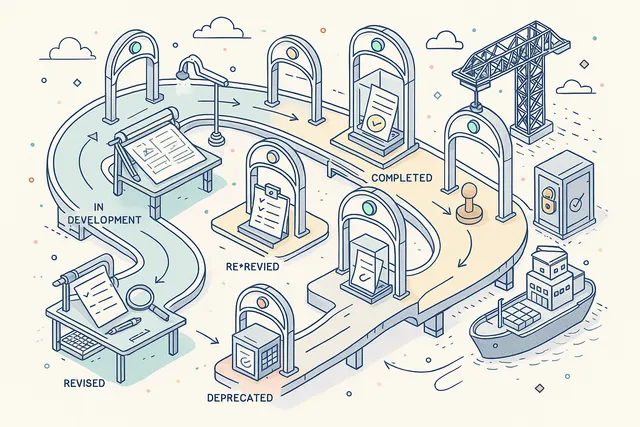
Form definitions follow a controlled six-stage lifecycle: In Development, In Review, Completed, Released, Revised, and Deprecated. Only Released definitions can be assigned to vessels and filled by crew. Each transition enforces validation and records who approved or rejected the change.
The lifecycle prevents unfinished or unapproved forms from reaching the fleet. Development versions let your team iterate on form design without affecting live assignments.
Revision creates a new development copy while keeping the current released version active until the revision is approved.
- InDevelopment → InReview → Completed
- Released → Revised → Deprecated
- Only Released forms reach the fleet
- Transition validation & attribution
- Parallel development versioning
Four Configurable Approval Flows
Every form assignment can use one of four approval flow variants — Full (Ship + Office), Ship-only, Office-only, or No Approval. The approval flow is configured per assignment, not globally, so the same form template can require different approval levels depending on the vessel, rank, or operational context.
Each flow supports three execution methods — All of (every approver must approve), Any of (one approval suffices), and Not Required (auto-approved). Approvers are configured at the assignment level with specific ship ranks and office users, giving you granular control over who reviews every form submission.
- Full: Ship + Office dual review
- Ship-only or Office-only options
- No Approval for auto-approved forms
- Per-assignment flow configuration
- Three execution methods: All/Any/Not Required

Seven-Stage Request Lifecycle
Form requests — the actual filled-out forms — follow a seven-stage lifecycle: Draft, Waiting for Ship Approval, Ship Rejected, Waiting for Office Approval, Office Rejected, Office Approved, and Discarded. The lifecycle adapts to the configured approval flow, skipping stages that do not apply.
Crew members fill forms and submit them for approval. Ship officers review and approve or reject.
Office staff provide final sign-off when required. Rejected forms return to the submitter with feedback.
The lifecycle ensures every form submission follows the exact approval chain configured for its assignment.
- Draft → WaitingForShipApproval → ShipRejected
- WaitingForOfficeApproval → OfficeRejected
- OfficeApproved or Discarded outcomes
- Flow-adaptive stage skipping
- Rejection feedback loop

Ship & Office Form Filling
Crew members fill forms on the vessel, while office staff review, approve, and manage form submissions from shore. The system handles the complete handoff between ship and office — submissions flow from vessel to shore for review, and approvals or rejections flow back to the crew.
Both ship and office users see the same form with the same fields, but their roles in the workflow differ. Ship crews create drafts and submit for approval.
Office reviewers see pending submissions across the fleet and can approve, reject, or request changes. The dual-context architecture ensures forms work identically online and offline.
- Crew fill forms on vessel
- Office reviews & approves from shore
- Complete ship-to-office handoff
- Dual-context architecture
- Online & offline form filling

Version History & Revision Management
Every form definition maintains a complete version history with version numbers, development versions, and revision tracking. When you revise a released form, the system creates a new development copy with an incremented version number while the current version remains active.
The version history records every change to the form structure — fields added, removed, or modified. Development history tracks iterations during the design phase.
Revision reasons are captured when a new version is created, providing a complete audit trail of why the form evolved over time.
- Version number & dev version tracking
- Complete version history log
- Development history per iteration
- Revision reason capture
- Active version preserved during revision

Ship & Rank-Based Assignment
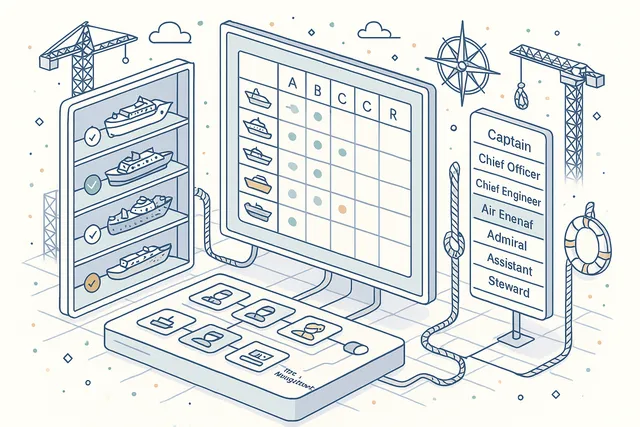
Assign forms to specific vessels and crew ranks with granular control. Each FormAssignment specifies which ships receive the form and which OnBoardRanks (29 available ranks) are responsible for filling it. Per-assignment approver configuration determines who reviews submissions for each vessel.
Assignments support both one-time and recurring distribution. A single form definition can have multiple assignments with different ships, ranks, and approval configurations — so the same safety checklist can require captain approval on one vessel type and chief officer approval on another.
- 29 OnBoardRanks supported
- Per-ship assignment configuration
- Per-assignment approver selection
- Multiple assignments per definition
- Rank-specific form distribution
Recurring Schedule & Calendar Integration
Schedule form submissions with four frequency options — Daily, Weekly, Monthly, and Yearly — or as single one-time events. Each schedule defines a submission window with start and end dates, ensuring crew complete forms within the required timeframe.
Scheduled forms automatically create calendar events visible to assigned crew and office staff. Recurring schedules generate future events based on the configured frequency.
Calendar integration ensures form deadlines appear alongside maintenance tasks, audits, and other vessel operations in the unified planning view.
- Daily, Weekly, Monthly, Yearly frequencies
- Single one-time event support
- Submission window with date range
- Automatic calendar event creation
- Unified planning view integration

PMS & Risk Assessment Integration
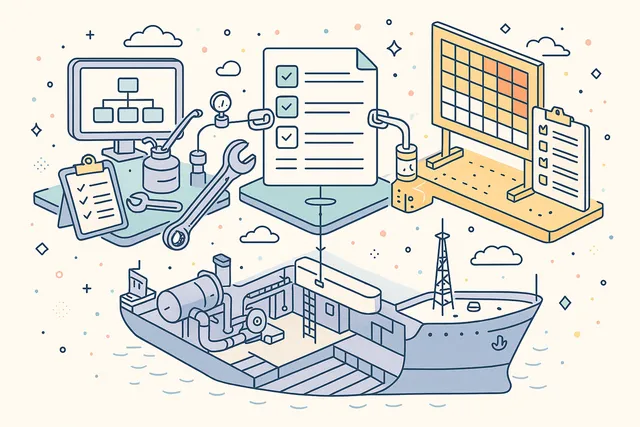
Forms can be attached directly to PMS maintenance tasks and Risk Assessments through the AttachedObjectType system. When a maintenance job requires a structured form — inspection checklist, test record, safety assessment — the form links directly to the PMS work order.
Risk Assessment integration lets you attach forms to risk evaluations, capturing structured data as part of the assessment process. The IsPmsTreeItem interface ensures forms appear in the PMS equipment tree context. Linked forms inherit the parent task's vessel and scheduling context.
- AttachedObjectType: Maintenance link
- AttachedObjectType: Risk Assessment link
- IsPmsTreeItem interface support
- Context inheritance from parent task
- Equipment tree visibility
Custom Label & Categorization System
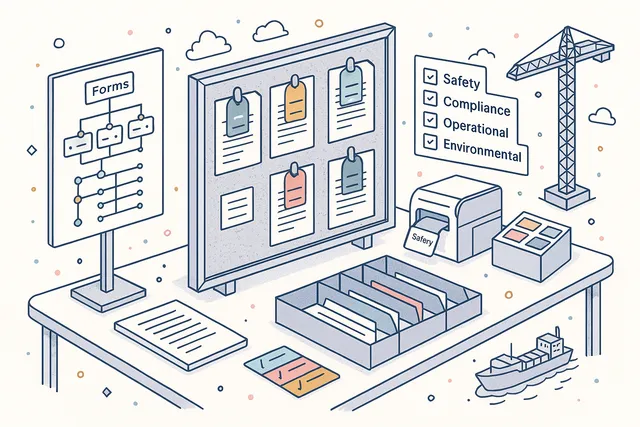
Organize forms with a flexible labeling system using GenericLabel with the Form label type. Create hierarchical label structures with sub-labels for multi-level categorization — Safety, Compliance, Operational, Environmental, or any taxonomy that matches your organization.
Labels support color coding for visual identification across grids and dashboards. Filter forms by label to quickly find the right template.
The hierarchical structure lets you drill from broad categories to specific form groups without a rigid folder system.
- GenericLabel with Form label type
- Hierarchical sub-label structure
- Color-coded visual identification
- Label-based grid filtering
- Flexible organizational taxonomy
Comments, Notes & File Attachments
Add comments at every stage of the form lifecycle — during definition development, review, and request processing. Comments support add, edit, and delete operations with full user attribution and timestamps. Notes capture additional context that does not belong in form fields.
File attachments support evidence uploads on both form definitions and requests. Attach reference documents, images, supporting materials, and verification evidence directly to the form record.
Every attachment is tracked in the event log with upload date, user, and file metadata.
- Per-lifecycle-stage comments
- Add, edit, delete with attribution
- File attachment evidence uploads
- Definition & request attachments
- Full event log tracking

Print & PDF Export
Generate professional PDF outputs for form definitions and completed form requests. Print form structures for offline reference, export completed submissions for archival, and include company headers with configurable landscape or portrait orientation.
Print history records with full version details for audit purposes. The export system preserves form layout, field responses, approval signatures, and timestamps in a clean, professional format suitable for regulatory submissions, management reviews, and external audits.
- Print definitions & completed requests
- Company header inclusion option
- Landscape & portrait orientation
- Version details for audit purposes
- Regulatory submission format

Dashboard & Analytics
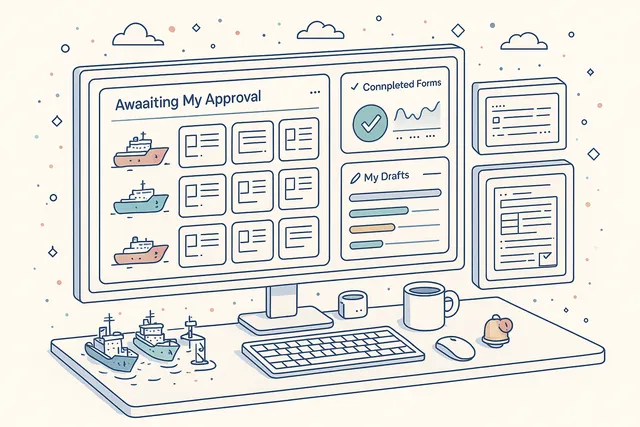
Monitor your form program with three dedicated dashboard widgets: Awaiting My Approval (grouped by vessel), Completed Forms, and My Drafts. Each widget provides at-a-glance visibility into the most critical form management activities.
The Awaiting My Approval widget shows pending submissions grouped by vessel, so approvers can prioritize by ship. Completed Forms tracks submission history.
My Drafts ensures in-progress forms are not forgotten. Drill down from any widget to the underlying form data.
- Awaiting My Approval by vessel
- Completed Forms widget
- My Drafts tracking
- At-a-glance form management KPIs
- Drill-down to underlying data
FAQ
Frequently Asked Questions
Common questions about Forms answered.
What types of forms does the module support?+
Navatom Forms supports four form types: Web forms (built in the visual drag-and-drop builder with 18 field types), DOCX forms (Word templates edited via OnlyOffice), XLSX forms (Excel templates edited via OnlyOffice), and PDF forms (read-only reference documents for distribution). Each type has its own creation, editing, and distribution workflow.
How does the web form builder work?+
The web form builder provides a visual drag-and-drop interface where you arrange fields in a flexible row-and-cell grid layout. Drag fields from a palette, reorder them within rows, and configure properties like labels, validation rules, and default values.
18 field types are available including TextBox, Number, DatePicker, Question (Yes/No/NA), Table, Rating, Slider, and more. Session persistence auto-saves your work, and virtualized rendering keeps the builder responsive for large forms.
Can I use my existing Word or Excel form templates?+
Yes. Upload your existing DOCX or XLSX templates and edit them directly in the browser using the built-in OnlyOffice document editor.
The editor supports full formatting — tables, styles, formulas, headers, and footers — so your templates look and work exactly as they do in Microsoft Office. No desktop software or file conversions required.
How does the approval workflow work?+
Each form assignment configures one of four approval flows: Full (Ship + Office review), Ship-only, Office-only, or No Approval. Within each flow, you choose an execution method — All of (every approver must approve), Any of (one approval suffices), or Not Required (auto-approved).
Approvers are set per assignment with specific ship ranks and office users, so the same form can have different approval chains on different vessels.
Can forms be linked to maintenance tasks?+
Yes. Forms can be attached directly to PMS maintenance tasks and Risk Assessments through the AttachedObjectType system.
When a maintenance job requires a structured form — inspection checklist, test record, safety assessment — the form links to the PMS work order and appears in the equipment tree context. Linked forms inherit the parent task's vessel and scheduling context.
How does scheduling and recurring forms work?+
Form assignments support four scheduling frequencies — Daily, Weekly, Monthly, and Yearly — or single one-time events. Each schedule defines a submission window with start and end dates.
Scheduled forms automatically create calendar events visible to assigned crew and office staff. Recurring schedules generate future events based on the configured frequency.
Does the module work offline on vessels?+
Yes. Vessels operate with a full local deployment that processes form definitions, assignments, and requests independently of office connectivity.
Crew can fill forms, submit for approval, and even approve submissions offline. When satellite connectivity is available, changes synchronize automatically with the office with conflict resolution.
Glossary
Related Maritime Terms
Key terms and concepts related to Forms.
Related Modules
Create, distribute, and manage controlled manuals and procedures across the fleet.
Distribute company circulars and notices with read-receipt tracking and acknowledgements.
Ready to try Forms?
Start your free trial today and see how Forms fits into your fleet operations.
Free Trial
No credit card required
30+ Modules
Fully integrated platform
Cloud-Based
No installation needed